

138
Fish
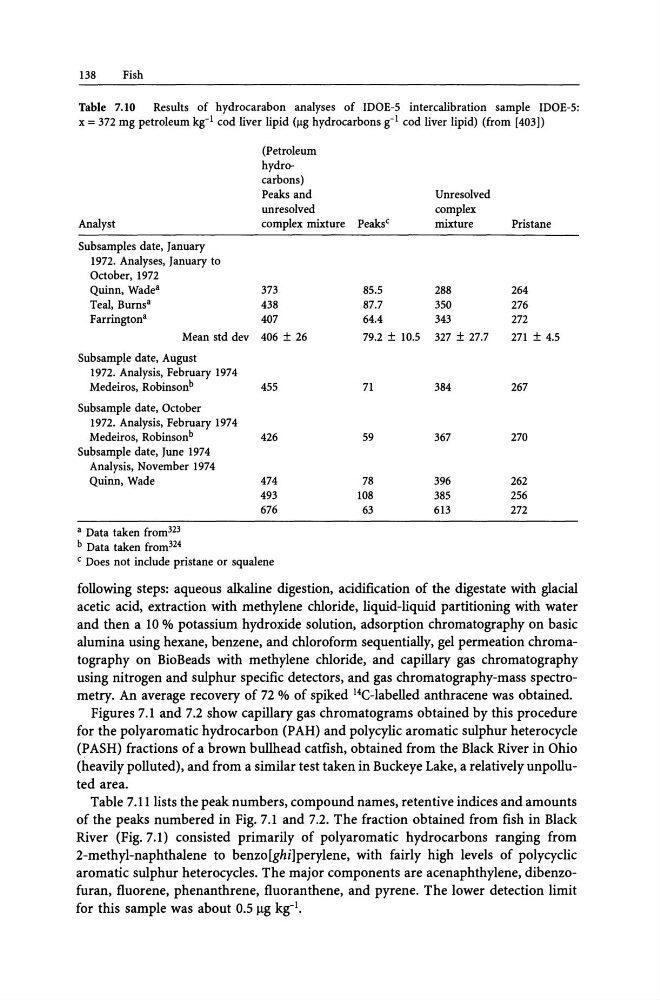
Table 7.10
Results of hydrocarabon analyses of IDOE-5 intercalibration sample IDOE-5:
x = 372 mg petroleum kg-I cod liver lipid (Jig hydrocarbons g-I cod liver lipid) (from [403))
Analyst
Subsamples date, January
1972. Analyses, January to
October, 1972
Quinn, Wade"
Teal, Burns"
Farrington"
Mean std dev
Subsample date, August
1972. Analysis, February 1974
Medeiros, Robinson b
Subsample date, October
1972. Analysis, February 1974
Medeiros, Robinson b
Subsample date, June 1974
Analysis, November 1974
Quinn, Wade
" Data taken from 323
b Data taken from 324
(Petroleum
hydrocarbons)
Peaks and
unresolved
complex mixture
373
438
407
406 ± 26
455
426
474
493
676
, Does not include pristane or squalene
Unresolved
complex
Peaks'
mixture
Pristane
85.5
288
264
87.7
350
276
64.4
343
272
79.2 ± 10.5 327 ± 27.7
271 ± 4.5
71
384
267
59
367
270
78
396
262
108
385
256
63
613
272
following steps: aqueous alkaline digestion, acidification of the digestate with glacial
acetic acid, extraction with methylene chloride, liquid-liquid partitioning with water
and then a 10 % potassium hydroxide solution, adsorption chromatography on basic
alumina using hexane, benzene, and chloroform sequentially, gel permeation chromatography on BioBeads with methylene chloride, and capillary gas chromatography
using nitrogen and sulphur specific detectors, and gas chromatography-mass spectrometry. An average recovery of 72 % of spiked '4C-Iabelled anthracene was obtained.
Figures 7.1 and 7.2 show capillary gas chromatograms obtained by this procedure
for the polyaromatic hydrocarbon (P AH) and polycylic aromatic sulphur heterocycle
(P ASH) fractions of a brown bullhead catfish, obtained from the Black River in Ohio
(heavily polluted), and from a similar test taken in Buckeye Lake, a relatively unpolluted area.
Table 7 .11 lists the peak numbers, compound names, retentive indices and amounts
of the peaks numbered in Fig. 7.1 and 7.2. The fraction obtained from fish in Black
River (Fig. 7.1) consisted primarily of polyaromatic hydrocarbons ranging from
2-methyl-naphthalene to benzo[ghiJperylene, with fairly high levels of polycyclic
aromatic sulphur heterocycles. The major components are acenaphthylene, dibenzofuran, fluorene, phenanthrene, fluoranthene, and pyrene. The lower detection limit
for this sample was about 0.5!lg kg-I.
Fish
Table 7.10
Results of hydrocarabon analyses of IDOE-5 intercalibration sample IDOE-5:
x = 372 mg petroleum kg-I cod liver lipid (Jig hydrocarbons g-I cod liver lipid) (from [403))
Analyst
Subsamples date, January
1972. Analyses, January to
October, 1972
Quinn, Wade"
Teal, Burns"
Farrington"
Mean std dev
Subsample date, August
1972. Analysis, February 1974
Medeiros, Robinson b
Subsample date, October
1972. Analysis, February 1974
Medeiros, Robinson b
Subsample date, June 1974
Analysis, November 1974
Quinn, Wade
" Data taken from 323
b Data taken from 324
(Petroleum
hydrocarbons)
Peaks and
unresolved
complex mixture
373
438
407
406 ± 26
455
426
474
493
676
, Does not include pristane or squalene
Unresolved
complex
Peaks'
mixture
Pristane
85.5
288
264
87.7
350
276
64.4
343
272
79.2 ± 10.5 327 ± 27.7
271 ± 4.5
71
384
267
59
367
270
78
396
262
108
385
256
63
613
272
following steps: aqueous alkaline digestion, acidification of the digestate with glacial
acetic acid, extraction with methylene chloride, liquid-liquid partitioning with water
and then a 10 % potassium hydroxide solution, adsorption chromatography on basic
alumina using hexane, benzene, and chloroform sequentially, gel permeation chromatography on BioBeads with methylene chloride, and capillary gas chromatography
using nitrogen and sulphur specific detectors, and gas chromatography-mass spectrometry. An average recovery of 72 % of spiked '4C-Iabelled anthracene was obtained.
Figures 7.1 and 7.2 show capillary gas chromatograms obtained by this procedure
for the polyaromatic hydrocarbon (P AH) and polycylic aromatic sulphur heterocycle
(P ASH) fractions of a brown bullhead catfish, obtained from the Black River in Ohio
(heavily polluted), and from a similar test taken in Buckeye Lake, a relatively unpolluted area.
Table 7 .11 lists the peak numbers, compound names, retentive indices and amounts
of the peaks numbered in Fig. 7.1 and 7.2. The fraction obtained from fish in Black
River (Fig. 7.1) consisted primarily of polyaromatic hydrocarbons ranging from
2-methyl-naphthalene to benzo[ghiJperylene, with fairly high levels of polycyclic
aromatic sulphur heterocycles. The major components are acenaphthylene, dibenzofuran, fluorene, phenanthrene, fluoranthene, and pyrene. The lower detection limit
for this sample was about 0.5!lg kg-I.