

Metals
121
Hydrochloric Acid Digestion. Weigh 5 g of a representative wet fish sample (2 g of dry
sample) into a 12s-ml pear-shaped flask. Add 5 ml of water and 1 ± 0.1 g of iron(II)
sulphate heptahydrate. Through the Bethge trap, add so ml of hydrochloric acid
(3 + 2) and reflux the reaction mixture for 10 min. Close the tap in the Bethge trap
and collect the first SO ml of distillate over a period of 30 min. Cool and transfer into a
100-ml calibrated flask, washing with water, to give 100 ml of a colourless solution
free from suspended solids. Reagent blank solutions should be obtained from hydrochloric acid (3 + 2) in an identical manner.
Sodium Hydroxide Digestion. Place 2 g of a representative wet fish sample (1 g of dry
sample) into a IsO-ml conical flask, add 10 ml of sodium hydroxide reagent and heat
on a boiling water-bath for 20 min. Cool, add cautiously 35 ml of hydrochloric acid
(1 + 3) and cool further. Transfer the solution into a separating funnel, using 5 ml of
water for washing, add 2 ml of ammonium pyrrolidone dithiocarbamate solution and
mix thoroughly. Extract with 10 ml of 4-methylpentan-2-one, shaking for 2 min, allow
to stand for 5 min or until separation is complete and run off the solvent into another
separating funnel. Repeat the extraction with the addition of ammonium pyrrolidone
dithiocarbamate reagent, and finally extract with 10 ml of 4-methylpentan-2-one. To
the combined solvent extracts add 10 ml of nitric acid (1 + 7) and shake for 2 min.
Repeat this extraction twice and combine the extracts in a beaker. Add 5 ml of
sulphuric acid (1 + 1) and boil until white fumes are evolved. Cool, add 10 ml water,
re-heat to fuming and repeat. Dilute to SO ml. Reagent blank solutions should be
obtained in an identical manner.
Recoveries of inorganic arsenic in spiked fish samples were, respectively, for arsenic(III) 80-94 %, and for arsenic(V) 75-88 %. Total and organic arsenic levels found
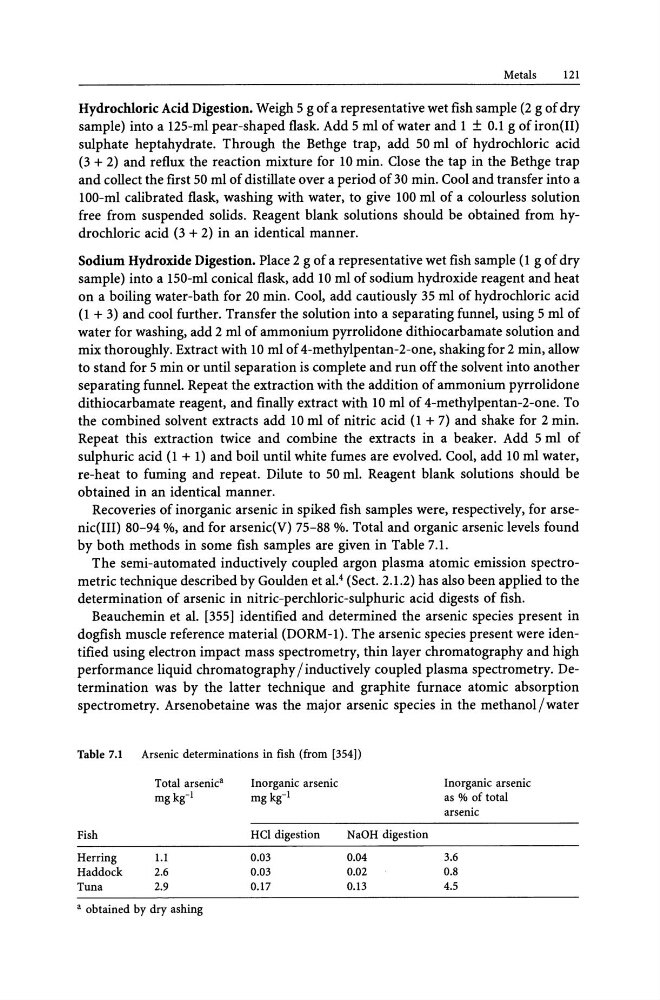
by both methods in some fish samples are given in Table 7.1.
The semi-automated inductively coupled argon plasma atomic emission spectrometric technique described by Goulden et al. 4 (Sect. 2.1.2) has also been applied to the
determination of arsenic in nitric-perchloric-sulphuric acid digests of fish.
Beauchemin et al. [355] identified and determined the arsenic species present in
dogfish muscle reference material (DORM-I). The arsenic species present were identified using electron impact mass spectrometry, thin layer chromatography and high
performance liquid chromatography / inductively coupled plasma spectrometry. Determination was by the latter technique and graphite furnace atomic absorption
spectrometry. Arsenobetaine was the major arsenic species in the methanol/water
Table 7.1
Arsenic determinations in fish (from [354])
Total arsenic"
Inorganic arsenic
Inorganic arsenic
mgkg- 1
mgkg- 1
as % of total
arsenic
Fish
Hel digestion
NaOH digestion
Herring
1.1
0.03
0.04
3.6
Haddock
2.6
0.03
0.02
0.8
Tuna
2.9
0.17
0.13
4.5
" obtained by dry ashing
121
Hydrochloric Acid Digestion. Weigh 5 g of a representative wet fish sample (2 g of dry
sample) into a 12s-ml pear-shaped flask. Add 5 ml of water and 1 ± 0.1 g of iron(II)
sulphate heptahydrate. Through the Bethge trap, add so ml of hydrochloric acid
(3 + 2) and reflux the reaction mixture for 10 min. Close the tap in the Bethge trap
and collect the first SO ml of distillate over a period of 30 min. Cool and transfer into a
100-ml calibrated flask, washing with water, to give 100 ml of a colourless solution
free from suspended solids. Reagent blank solutions should be obtained from hydrochloric acid (3 + 2) in an identical manner.
Sodium Hydroxide Digestion. Place 2 g of a representative wet fish sample (1 g of dry
sample) into a IsO-ml conical flask, add 10 ml of sodium hydroxide reagent and heat
on a boiling water-bath for 20 min. Cool, add cautiously 35 ml of hydrochloric acid
(1 + 3) and cool further. Transfer the solution into a separating funnel, using 5 ml of
water for washing, add 2 ml of ammonium pyrrolidone dithiocarbamate solution and
mix thoroughly. Extract with 10 ml of 4-methylpentan-2-one, shaking for 2 min, allow
to stand for 5 min or until separation is complete and run off the solvent into another
separating funnel. Repeat the extraction with the addition of ammonium pyrrolidone
dithiocarbamate reagent, and finally extract with 10 ml of 4-methylpentan-2-one. To
the combined solvent extracts add 10 ml of nitric acid (1 + 7) and shake for 2 min.
Repeat this extraction twice and combine the extracts in a beaker. Add 5 ml of
sulphuric acid (1 + 1) and boil until white fumes are evolved. Cool, add 10 ml water,
re-heat to fuming and repeat. Dilute to SO ml. Reagent blank solutions should be
obtained in an identical manner.
Recoveries of inorganic arsenic in spiked fish samples were, respectively, for arsenic(III) 80-94 %, and for arsenic(V) 75-88 %. Total and organic arsenic levels found
by both methods in some fish samples are given in Table 7.1.
The semi-automated inductively coupled argon plasma atomic emission spectrometric technique described by Goulden et al. 4 (Sect. 2.1.2) has also been applied to the
determination of arsenic in nitric-perchloric-sulphuric acid digests of fish.
Beauchemin et al. [355] identified and determined the arsenic species present in
dogfish muscle reference material (DORM-I). The arsenic species present were identified using electron impact mass spectrometry, thin layer chromatography and high
performance liquid chromatography / inductively coupled plasma spectrometry. Determination was by the latter technique and graphite furnace atomic absorption
spectrometry. Arsenobetaine was the major arsenic species in the methanol/water
Table 7.1
Arsenic determinations in fish (from [354])
Total arsenic"
Inorganic arsenic
Inorganic arsenic
mgkg- 1
mgkg- 1
as % of total
arsenic
Fish
Hel digestion
NaOH digestion
Herring
1.1
0.03
0.04
3.6
Haddock
2.6
0.03
0.02
0.8
Tuna
2.9
0.17
0.13
4.5
" obtained by dry ashing