

Metals
97
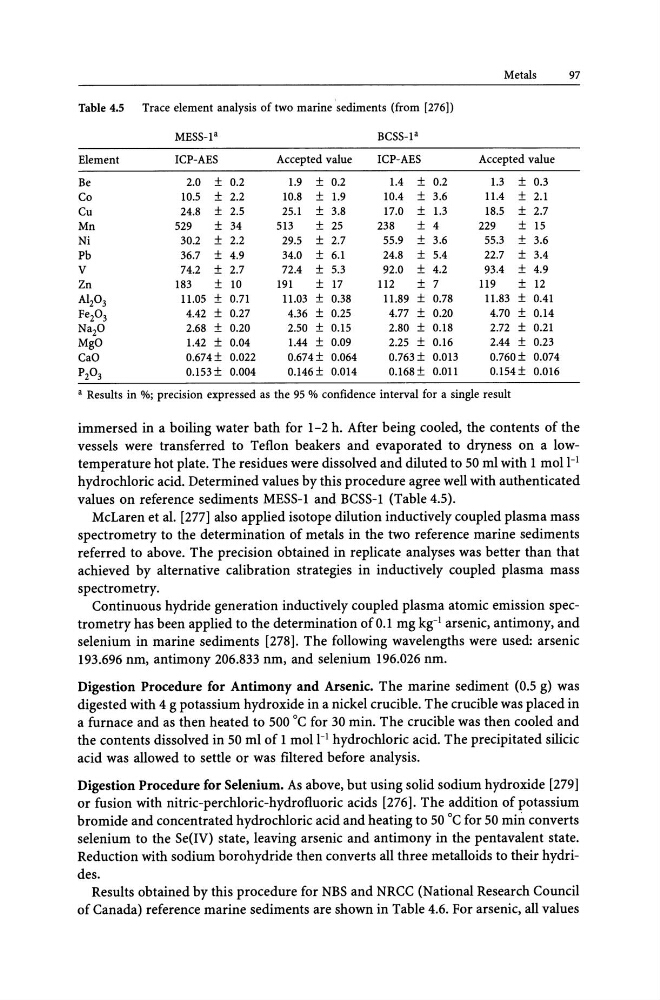
Table 4.5
Trace element analysis of two marine sediments (from [276])
MESS-I"
BCSS-1"
Element
ICP-AES
Accepted value
ICP-AES
Accepted value
Be
2.0 ± 0.2
1.9 ± 0.2
1.4 ± 0.2
1.3 ± 0.3
Co
10.5 ± 2.2
10.8 ± 1.9
10.4 ± 3.6
11.4 ± 2.1
Cu
24.8 ± 2.5
25.1 ± 3.8
17.0 ± 1.3
18.5 ± 2.7
Mn
529
± 34
513
± 25
238
± 4
229
± 15
Ni
30.2 ± 2.2
29.5 ± 2.7
55.9 ± 3.6
55.3 ± 3.6
Ph
36.7 ± 4.9
34.0 ± 6.1
24.8 ± 5.4
22.7 ± 3.4
V
74.2 ± 2.7
72.4 ± 5.3
92.0 ± 4.2
93.4 ± 4.9
Zn
183
± 10
191
± 17
112
± 7
119
± 12
AlP3
11.05 ± 0.71
11.03 ± 0.38
11.89 ± 0.78
11.83 ± 0.41
Fe 2 0 3
4.42 ± 0.27
4.36 ± 0.25
4.77 ± 0.20
4.70 ± 0.14
Na 2 0
2.68 ± 0.20
2.50 ± 0.15
2.80 ± 0.18
2.72 ± 0.21
MgO
1.42 ± 0.04
1.44 ± 0.09
2.25 ± 0.16
2.44 ± 0.23
CaO
0.674± 0.022
0.674± 0.064
0.763± 0.013
0.760 ± 0.074
P 2 0 3
0.153 ± 0.004
0.146± 0.014
0.168± 0.011
0.154± 0.016
" Results in %; precision expressed as the 95 % confidence interval for a single result
immersed in a boiling water bath for 1-2 h. After being cooled, the contents of the
vessels were transferred to Teflon beakers and evaporated to dryness on a lowtemperature hot plate. The residues were dissolved and diluted to 50 ml with 1 moll- 1
hydrochloric acid. Determined values by this procedure agree well with authenticated
values on reference sediments MESS-1 and BCSS-1 (Table 4.5).
McLaren et al. [277] also applied isotope dilution inductively coupled plasma mass
spectrometry to the determination of metals in the two reference marine sediments
referred to above. The precision obtained in replicate analyses was better than that
achieved by alternative calibration strategies in inductively coupled plasma mass
spectrometry.
Continuous hydride generation inductively coupled plasma atomic emission spectrometry has been applied to the determination of 0.1 mg kg- 1 arsenic, antimony, and
selenium in marine sediments [278]. The following wavelengths were used: arsenic
193.696 nm, antimony 206.833 nm, and selenium 196.026 nm.
Digestion Procedure for Antimony and Arsenic. The marine sediment (0.5 g) was
digested with 4 g potassium hydroxide in a nickel crucible. The crucible was placed in
a furnace and as then heated to 500°C for 30 min. The crucible was then cooled and
the contents dissolved in 50 ml of 1 moll- 1 hydrochloric acid. The precipitated silicic
acid was allowed to settle or was filtered before analysis.
Digestion Procedure for Selenium. As above, but using solid sodium hydroxide [279]
or fusion with nitric-perchloric-hydrofluoric acids [276]. The addition of potassium
bromide and concentrated hydrochloric acid and heating to 50°C for 50 min converts
selenium to the Se(IV) state, leaving arsenic and antimony in the pentavalent state.
Reduction with sodium borohydride then converts all three metalloids to their hydrides.
Results obtained by this procedure for NBS and NRCC (National Research Council
of Canada) reference marine sediments are shown in Table 4.6. For arsenic, all values
97
Table 4.5
Trace element analysis of two marine sediments (from [276])
MESS-I"
BCSS-1"
Element
ICP-AES
Accepted value
ICP-AES
Accepted value
Be
2.0 ± 0.2
1.9 ± 0.2
1.4 ± 0.2
1.3 ± 0.3
Co
10.5 ± 2.2
10.8 ± 1.9
10.4 ± 3.6
11.4 ± 2.1
Cu
24.8 ± 2.5
25.1 ± 3.8
17.0 ± 1.3
18.5 ± 2.7
Mn
529
± 34
513
± 25
238
± 4
229
± 15
Ni
30.2 ± 2.2
29.5 ± 2.7
55.9 ± 3.6
55.3 ± 3.6
Ph
36.7 ± 4.9
34.0 ± 6.1
24.8 ± 5.4
22.7 ± 3.4
V
74.2 ± 2.7
72.4 ± 5.3
92.0 ± 4.2
93.4 ± 4.9
Zn
183
± 10
191
± 17
112
± 7
119
± 12
AlP3
11.05 ± 0.71
11.03 ± 0.38
11.89 ± 0.78
11.83 ± 0.41
Fe 2 0 3
4.42 ± 0.27
4.36 ± 0.25
4.77 ± 0.20
4.70 ± 0.14
Na 2 0
2.68 ± 0.20
2.50 ± 0.15
2.80 ± 0.18
2.72 ± 0.21
MgO
1.42 ± 0.04
1.44 ± 0.09
2.25 ± 0.16
2.44 ± 0.23
CaO
0.674± 0.022
0.674± 0.064
0.763± 0.013
0.760 ± 0.074
P 2 0 3
0.153 ± 0.004
0.146± 0.014
0.168± 0.011
0.154± 0.016
" Results in %; precision expressed as the 95 % confidence interval for a single result
immersed in a boiling water bath for 1-2 h. After being cooled, the contents of the
vessels were transferred to Teflon beakers and evaporated to dryness on a lowtemperature hot plate. The residues were dissolved and diluted to 50 ml with 1 moll- 1
hydrochloric acid. Determined values by this procedure agree well with authenticated
values on reference sediments MESS-1 and BCSS-1 (Table 4.5).
McLaren et al. [277] also applied isotope dilution inductively coupled plasma mass
spectrometry to the determination of metals in the two reference marine sediments
referred to above. The precision obtained in replicate analyses was better than that
achieved by alternative calibration strategies in inductively coupled plasma mass
spectrometry.
Continuous hydride generation inductively coupled plasma atomic emission spectrometry has been applied to the determination of 0.1 mg kg- 1 arsenic, antimony, and
selenium in marine sediments [278]. The following wavelengths were used: arsenic
193.696 nm, antimony 206.833 nm, and selenium 196.026 nm.
Digestion Procedure for Antimony and Arsenic. The marine sediment (0.5 g) was
digested with 4 g potassium hydroxide in a nickel crucible. The crucible was placed in
a furnace and as then heated to 500°C for 30 min. The crucible was then cooled and
the contents dissolved in 50 ml of 1 moll- 1 hydrochloric acid. The precipitated silicic
acid was allowed to settle or was filtered before analysis.
Digestion Procedure for Selenium. As above, but using solid sodium hydroxide [279]
or fusion with nitric-perchloric-hydrofluoric acids [276]. The addition of potassium
bromide and concentrated hydrochloric acid and heating to 50°C for 50 min converts
selenium to the Se(IV) state, leaving arsenic and antimony in the pentavalent state.
Reduction with sodium borohydride then converts all three metalloids to their hydrides.
Results obtained by this procedure for NBS and NRCC (National Research Council
of Canada) reference marine sediments are shown in Table 4.6. For arsenic, all values