

92
Marine Sediments
4.2.3
Cadmium
Wavelength modulation inductively coupled plasma echelle spectrometry has been
used to determine cadmium [251]. This method was applied to two standard marine
sediments, one (US Geological Survey MAG-I) from a relatively unpolluted marine
sediment, and the other (Environment Canada WQB-2) from a freshwater harbour of
an industrial city. A correction was necessary to overcome interference by the
214.445 nm and 226.505 nm lines of iron which interfere at both the cadmium
214.438 nm and the cadmium 226.502 nm lines. Cadmium determinations were in
good agreement with nominal values for the two standard sediments; WQS-2, expected 1.5 ± 0.2 mg kg- I found 2.0 ± 0.5 mg kg-I, and MAG-I, expected 0.17 ± 0.1 mg
kg- I found less than 0.2 mg kg-I.
4.2.4
Cobalt and Copper
Spectrophotometric methods, involving the use, respectively, of dimethyl-glyoxime
and 2-nitroso-1 naphthol, have been used to determine nickel and cobalt in marine
sediments [252]. Differential pulse anodic stripping voltammetry using in situ plating
techniques has been used to determine down to 0.1 ~g kg- I copper in acid extracts of
marine sediments [253].
4.2.5
Lead
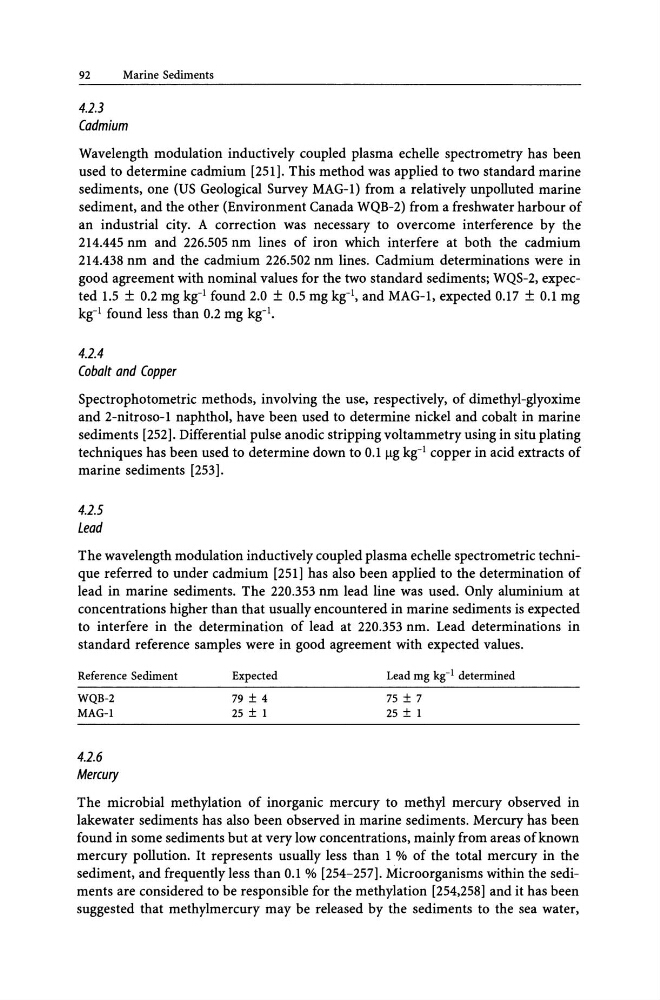
The wavelength modulation inductively coupled plasma echelle spectrometric technique referred to under cadmium [251] has also been applied to the determination of
lead in marine sediments. The 220.353 nm lead line was used. Only aluminium at
concentrations higher than that usually encountered in marine sediments is expected
to interfere in the determination of lead at 220.353 nm. Lead determinations in
standard reference samples were in good agreement with expected values.
Reference Sediment
WQB-2
MAG-l
4.2.6
Mercury
Expected
79 ± 4
25 ± 1
Lead mg kg- I determined
75 ± 7
25 ± 1
The microbial methylation of inorganic mercury to methyl mercury observed in
lakewater sediments has also been observed in marine sediments. Mercury has been
found in some sediments but at very low concentrations, mainly from areas of known
mercury pollution. It represents usually less than 1 % of the total mercury in the
sediment, and frequently less than 0.1 % [254-257]. Microorganisms within the sediments are considered to be responsible for the methylation [254,258] and it has been
suggested that methylmercury may be released by the sediments to the sea water,
Marine Sediments
4.2.3
Cadmium
Wavelength modulation inductively coupled plasma echelle spectrometry has been
used to determine cadmium [251]. This method was applied to two standard marine
sediments, one (US Geological Survey MAG-I) from a relatively unpolluted marine
sediment, and the other (Environment Canada WQB-2) from a freshwater harbour of
an industrial city. A correction was necessary to overcome interference by the
214.445 nm and 226.505 nm lines of iron which interfere at both the cadmium
214.438 nm and the cadmium 226.502 nm lines. Cadmium determinations were in
good agreement with nominal values for the two standard sediments; WQS-2, expected 1.5 ± 0.2 mg kg- I found 2.0 ± 0.5 mg kg-I, and MAG-I, expected 0.17 ± 0.1 mg
kg- I found less than 0.2 mg kg-I.
4.2.4
Cobalt and Copper
Spectrophotometric methods, involving the use, respectively, of dimethyl-glyoxime
and 2-nitroso-1 naphthol, have been used to determine nickel and cobalt in marine
sediments [252]. Differential pulse anodic stripping voltammetry using in situ plating
techniques has been used to determine down to 0.1 ~g kg- I copper in acid extracts of
marine sediments [253].
4.2.5
Lead
The wavelength modulation inductively coupled plasma echelle spectrometric technique referred to under cadmium [251] has also been applied to the determination of
lead in marine sediments. The 220.353 nm lead line was used. Only aluminium at
concentrations higher than that usually encountered in marine sediments is expected
to interfere in the determination of lead at 220.353 nm. Lead determinations in
standard reference samples were in good agreement with expected values.
Reference Sediment
WQB-2
MAG-l
4.2.6
Mercury
Expected
79 ± 4
25 ± 1
Lead mg kg- I determined
75 ± 7
25 ± 1
The microbial methylation of inorganic mercury to methyl mercury observed in
lakewater sediments has also been observed in marine sediments. Mercury has been
found in some sediments but at very low concentrations, mainly from areas of known
mercury pollution. It represents usually less than 1 % of the total mercury in the
sediment, and frequently less than 0.1 % [254-257]. Microorganisms within the sediments are considered to be responsible for the methylation [254,258] and it has been
suggested that methylmercury may be released by the sediments to the sea water,