

90
Marine Sediments
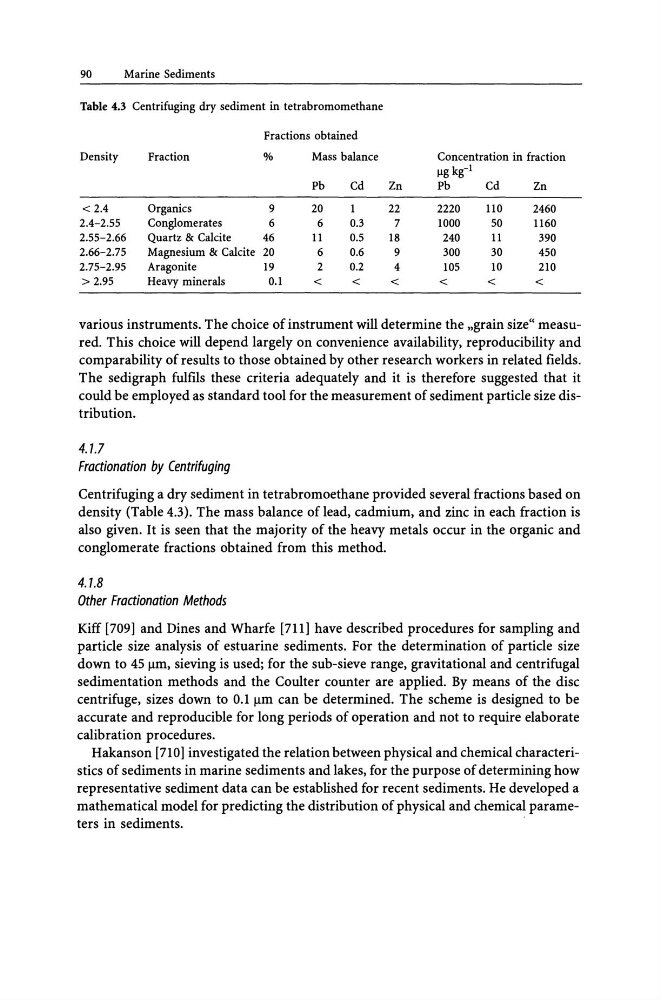
Table 4.3 Centrifuging dry sediment in tetrabromomethane
Fractions obtained
Density
Fraction
%
Mass balance
Concentration in fraction
I1g kg- 1
Ph
Cd
Zn
Ph
Cd
Zn
< 2.4
Organics
9
20
1
22
2220
110
2460
2.4-2.55
Conglomerates
6
6
0.3
7
1000
50
1160
2.55-2.66
Quartz & Calcite
46
II
0.5
18
240
II
390
2.66-2.75
Magnesium & Calcite 20
6
0.6
9
300
30
450
2.75-2.95
Aragonite
19
2
0.2
4
105
10
210
> 2.95
Heavy minerals
0.1
<
<
<
<
<
<
various instruments. The choice of instrument will determine the "grain size" measured. This choice will depend largely on convenience availability, reproducibility and
comparability of results to those obtained by other research workers in related fields.
The sedigraph fulfIls these criteria adequately and it is therefore suggested that it
could be employed as standard tool for the measurement of sediment particle size distribution.
4.1.7
Fractionation by Centrifuging
Centrifuging a dry sediment in tetrabromoethane provided several fractions based on
density (Table 4.3). The mass balance of lead, cadmium, and zinc in each fraction is
also given. It is seen that the majority of the heavy metals occur in the organic and
conglomerate fractions obtained from this method.
4.1.8
Other Fractionation Methods
Kiff [709] and Dines and Wharfe [711] have described procedures for sampling and
particle size analysis of estuarine sediments. For the determination of particle size
down to 45 j.LIIl, sieving is used; for the sub-sieve range, gravitational and centrifugal
sedimentation methods and the Coulter counter are applied. By means of the disc
centrifuge, sizes down to 0.1 j.LIIl can be determined. The scheme is designed to be
accurate and reproducible for long periods of operation and not to require elaborate
calibration procedures.
Hakanson [710] investigated the relation between physical and chemical characteristics of sediments in marine sediments and lakes, for the purpose of determining how
representative sediment data can be established for recent sediments. He developed a
mathematical model for predicting the distribution of physical and chemical parameters in sediments.
Marine Sediments
Table 4.3 Centrifuging dry sediment in tetrabromomethane
Fractions obtained
Density
Fraction
%
Mass balance
Concentration in fraction
I1g kg- 1
Ph
Cd
Zn
Ph
Cd
Zn
< 2.4
Organics
9
20
1
22
2220
110
2460
2.4-2.55
Conglomerates
6
6
0.3
7
1000
50
1160
2.55-2.66
Quartz & Calcite
46
II
0.5
18
240
II
390
2.66-2.75
Magnesium & Calcite 20
6
0.6
9
300
30
450
2.75-2.95
Aragonite
19
2
0.2
4
105
10
210
> 2.95
Heavy minerals
0.1
<
<
<
<
<
<
various instruments. The choice of instrument will determine the "grain size" measured. This choice will depend largely on convenience availability, reproducibility and
comparability of results to those obtained by other research workers in related fields.
The sedigraph fulfIls these criteria adequately and it is therefore suggested that it
could be employed as standard tool for the measurement of sediment particle size distribution.
4.1.7
Fractionation by Centrifuging
Centrifuging a dry sediment in tetrabromoethane provided several fractions based on
density (Table 4.3). The mass balance of lead, cadmium, and zinc in each fraction is
also given. It is seen that the majority of the heavy metals occur in the organic and
conglomerate fractions obtained from this method.
4.1.8
Other Fractionation Methods
Kiff [709] and Dines and Wharfe [711] have described procedures for sampling and
particle size analysis of estuarine sediments. For the determination of particle size
down to 45 j.LIIl, sieving is used; for the sub-sieve range, gravitational and centrifugal
sedimentation methods and the Coulter counter are applied. By means of the disc
centrifuge, sizes down to 0.1 j.LIIl can be determined. The scheme is designed to be
accurate and reproducible for long periods of operation and not to require elaborate
calibration procedures.
Hakanson [710] investigated the relation between physical and chemical characteristics of sediments in marine sediments and lakes, for the purpose of determining how
representative sediment data can be established for recent sediments. He developed a
mathematical model for predicting the distribution of physical and chemical parameters in sediments.