

O. Vedina : Environmental Assessment and Management in Moldavia
61
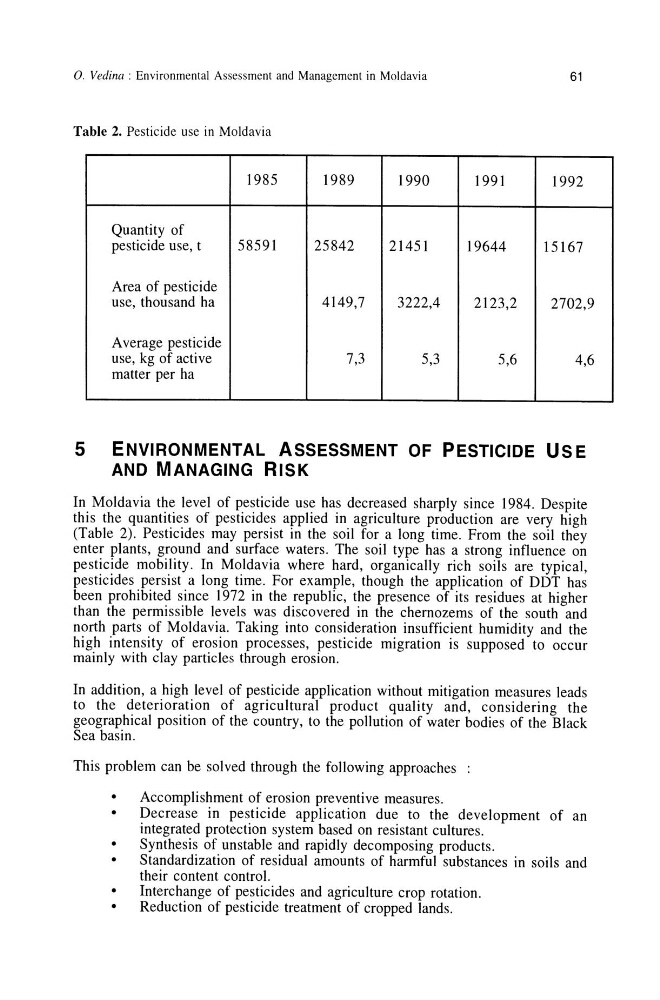
Table 2. Pesticide use in Moldavia
1985
1989
1990
1991
1992
Quantity of
pesticide use, t
58591
25842
21451
19644
15167
Area of pesticide
use, thousand ha
4149,7
3222,4
2123,2
2702,9
Average pesticide
use, kg of active
7,3
5,3
5,6
4,6
matter per ha
5 ENVIRONMENTAL ASSESSMENT OF PESTICIDE us E
AND MANAGING RISK
In Moldavia the level of pesticide use has decreased sharply since 1984. Despite
this the quantities of pesticides applied in agriculture production are very high
(Table 2). Pesticides may persist in the soil for a long time. From the soil they
enter plants, ground and surface waters. The soil type has a strong influence on
pesticide mobility. In Moldavia where hard, organically rich soils are typical,
pesticides persist a long time. For example, though the application of DDT has
been prohibited since 1972 in the republic, the presence of its residues at higher
than the permissible levels was discovered in the chemozems of the south and
north parts of Moldavia. Taking into consideration insufficient humidity and the
high intensity of erosion processes, pesticide migration is supposed to occur
mainly with clay particles through erosion.
In addition, a high level of pesticide application without mitigation measures leads
to the deterioration of agricultural product quality and, considering the
geographical position of the country, to the pollution of water bodies of the Black
Sea basin.
This problem can be solved through the following approaches :
•
Accomplishment of erosion preventive measures.
•
Decrease in pesticide application due to the development of an
integrated protection system based on resistant cultures.
Synthesis of unstable and rapidly decomposing products.
Standardization of residual amounts of harmful substances in soils and
their content control.
Interchange of pesticides and agriculture crop rotation.
Reduction of pesticide treatment of cropped lands.
61
Table 2. Pesticide use in Moldavia
1985
1989
1990
1991
1992
Quantity of
pesticide use, t
58591
25842
21451
19644
15167
Area of pesticide
use, thousand ha
4149,7
3222,4
2123,2
2702,9
Average pesticide
use, kg of active
7,3
5,3
5,6
4,6
matter per ha
5 ENVIRONMENTAL ASSESSMENT OF PESTICIDE us E
AND MANAGING RISK
In Moldavia the level of pesticide use has decreased sharply since 1984. Despite
this the quantities of pesticides applied in agriculture production are very high
(Table 2). Pesticides may persist in the soil for a long time. From the soil they
enter plants, ground and surface waters. The soil type has a strong influence on
pesticide mobility. In Moldavia where hard, organically rich soils are typical,
pesticides persist a long time. For example, though the application of DDT has
been prohibited since 1972 in the republic, the presence of its residues at higher
than the permissible levels was discovered in the chemozems of the south and
north parts of Moldavia. Taking into consideration insufficient humidity and the
high intensity of erosion processes, pesticide migration is supposed to occur
mainly with clay particles through erosion.
In addition, a high level of pesticide application without mitigation measures leads
to the deterioration of agricultural product quality and, considering the
geographical position of the country, to the pollution of water bodies of the Black
Sea basin.
This problem can be solved through the following approaches :
•
Accomplishment of erosion preventive measures.
•
Decrease in pesticide application due to the development of an
integrated protection system based on resistant cultures.
Synthesis of unstable and rapidly decomposing products.
Standardization of residual amounts of harmful substances in soils and
their content control.
Interchange of pesticides and agriculture crop rotation.
Reduction of pesticide treatment of cropped lands.