

20
Water In Ecosystems: A Non Renewable Resource
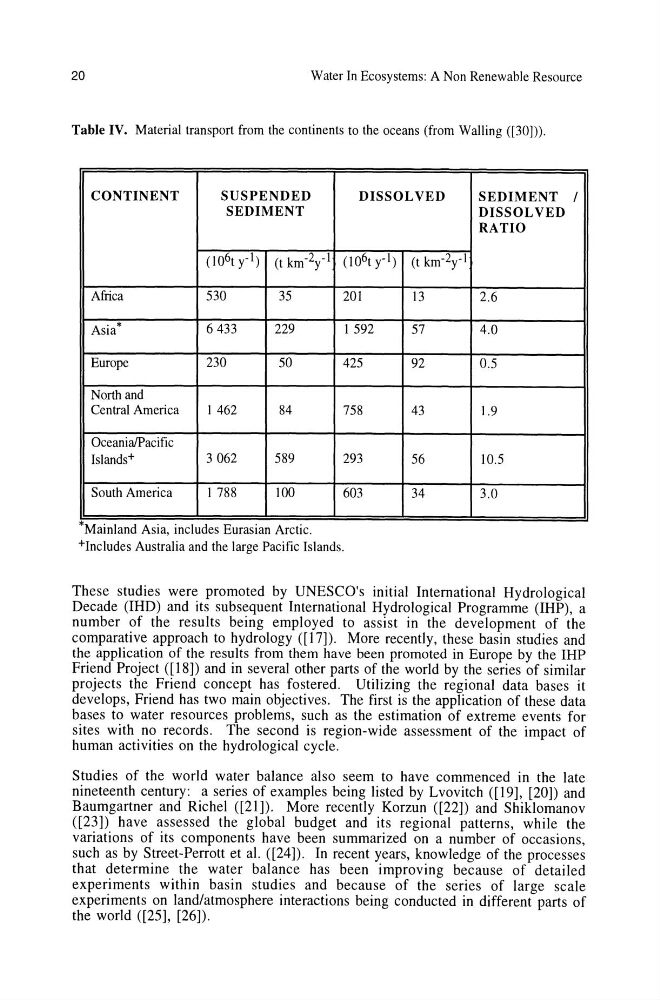
Table IV. Material transport from the continents to the oceans (from Walling ([30))).
CONTINENT
SUSPENDED
DISSOLVED
SEDIMENT
(106t y-l) (t km- 2 f l (106t y-l)
Africa
530
35
201
Asia*
6433
229
1 592
Europe
230
50
425
North and
Central America
1462
84
758
OceanialPacific
Islands+
3062
589
293
South America
1 788
100
603
*Mainland Asia, includes Eurasian Arctic.
+Includes Australia and the large Pacific Islands.
(t km-2y-l
13
57
92
43
56
34
SEDIMENT
DISSOLVED
RATIO
2.6
4.0
0.5
1.9
10.5
3.0
/
These studies were promoted by UNESCO's initial International Hydrological
Decade (IHD) and its subsequent International Hydrological Programme (IHP), a
number of the results being employed to assist in the development of the
comparative approach to hydrology ([17]). More recently, these basin studies and
the application of the results from them have been promoted in Europe by the IHP
Friend Project ([ 18]) and in several other parts of the world by the series of similar
projects the Friend concept has fostered. Utilizing the regional data bases it
develops, Friend has two main objectives. The first is the application of these data
bases to water resources problems, such as the estimation of extreme events for
sites with no records. The second is region-wide assessment of the impact of
human activities on the hydrological cycle.
Studies of the world water balance also seem to have commenced in the late
nineteenth century: a series of examples being listed by Lvovitch ([19], [20]) and
Baumgartner and Richel ([21]). More recently Korzun ([22]) and Shiklomanov
([23]) have assessed the global budget and its regional patterns, while the
variations of its components have been summarized on a number of occasions,
such as by Street-Perrott et a!. ([24]). In recent years, knowledge of the processes
that determine the water balance has been improving because of detailed
experiments within basin studies and because of the series of large scale
experiments on land/atmosphere interactions being conducted in different parts of
the world ([25], [26]).
Water In Ecosystems: A Non Renewable Resource
Table IV. Material transport from the continents to the oceans (from Walling ([30))).
CONTINENT
SUSPENDED
DISSOLVED
SEDIMENT
(106t y-l) (t km- 2 f l (106t y-l)
Africa
530
35
201
Asia*
6433
229
1 592
Europe
230
50
425
North and
Central America
1462
84
758
OceanialPacific
Islands+
3062
589
293
South America
1 788
100
603
*Mainland Asia, includes Eurasian Arctic.
+Includes Australia and the large Pacific Islands.
(t km-2y-l
13
57
92
43
56
34
SEDIMENT
DISSOLVED
RATIO
2.6
4.0
0.5
1.9
10.5
3.0
/
These studies were promoted by UNESCO's initial International Hydrological
Decade (IHD) and its subsequent International Hydrological Programme (IHP), a
number of the results being employed to assist in the development of the
comparative approach to hydrology ([17]). More recently, these basin studies and
the application of the results from them have been promoted in Europe by the IHP
Friend Project ([ 18]) and in several other parts of the world by the series of similar
projects the Friend concept has fostered. Utilizing the regional data bases it
develops, Friend has two main objectives. The first is the application of these data
bases to water resources problems, such as the estimation of extreme events for
sites with no records. The second is region-wide assessment of the impact of
human activities on the hydrological cycle.
Studies of the world water balance also seem to have commenced in the late
nineteenth century: a series of examples being listed by Lvovitch ([19], [20]) and
Baumgartner and Richel ([21]). More recently Korzun ([22]) and Shiklomanov
([23]) have assessed the global budget and its regional patterns, while the
variations of its components have been summarized on a number of occasions,
such as by Street-Perrott et a!. ([24]). In recent years, knowledge of the processes
that determine the water balance has been improving because of detailed
experiments within basin studies and because of the series of large scale
experiments on land/atmosphere interactions being conducted in different parts of
the world ([25], [26]).