

O. G. Mekenyan et al. : Photo-Induced Toxicity of PARs
-1.5
-2.0
S'
;§ -2.5
0;
o
-'
-3.0
-3.5
4
5
t
,/ 8~~5
}>
26
6
7
8
HOMO-LUMO' Gap [eVJ-PM3 (Triplet State)
269
9
10
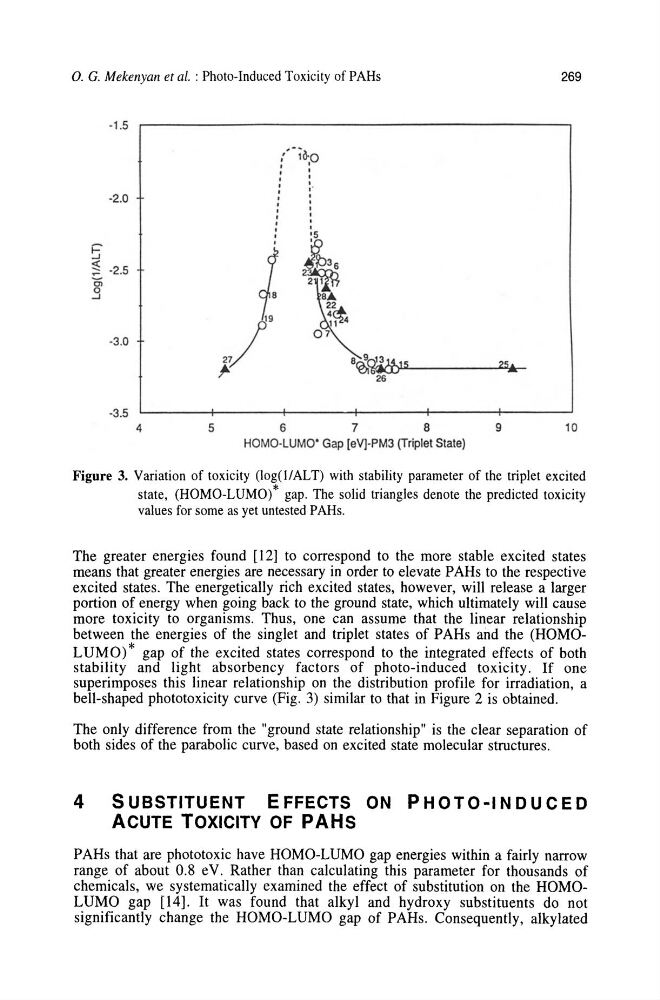
Figure 3. Variation of toxicity (log(l/ AL T) with stability parameter of the triplet excited
state, (ROMO-LUMO) * gap. The solid triangles denote the predicted toxicity
values for some as yet untested PARs.
The greater energies found [12] to correspond to the more stable excited states
means that greater energies are necessary in order to elevate PAHs to the respective
excited states. The energetically rich excited states, however, will release a larger
portion of energy when going back to the ground state, which ultimately will cause
more toxicity to organisms. Thus, one can assume that the linear relationship
between the energies of the singlet and triplet states of PAHs and the (HOMOL UM 0) * gap of the excited states correspond to the integrated effects of both
stability and light absorbency factors of photo-induced toxicity . If one
superimposes this linear relationship on the distribution profile for irradiation, a
bell-shaped phototoxicity curve (Fig. 3) similar to that in Figure 2 is obtained.
The only difference from the "ground state relationship" is the clear separation of
both sides of the parabolic curve, based on excited state molecular structures.
4
SUBSTITUENT EFFECTS ON PHOTO-INDUCED
ACUTE TOXICITY OF PAHS
PAHs that are phototoxic have HOMO-LUMO gap energies within a fairly narrow
range of about 0.8 eV. Rather than calculating this parameter for thousands of
chemicals, we systematically examined the effect of substitution on the HOMOLUMO gap [14]. It was found that alkyl and hydroxy substituents do not
significantly change the HOMO-LUMO gap of PAHs. Consequently, alkylated
-1.5
-2.0
S'
;§ -2.5
0;
o
-'
-3.0
-3.5
4
5
t
,/ 8~~5
}>
26
6
7
8
HOMO-LUMO' Gap [eVJ-PM3 (Triplet State)
269
9
10
Figure 3. Variation of toxicity (log(l/ AL T) with stability parameter of the triplet excited
state, (ROMO-LUMO) * gap. The solid triangles denote the predicted toxicity
values for some as yet untested PARs.
The greater energies found [12] to correspond to the more stable excited states
means that greater energies are necessary in order to elevate PAHs to the respective
excited states. The energetically rich excited states, however, will release a larger
portion of energy when going back to the ground state, which ultimately will cause
more toxicity to organisms. Thus, one can assume that the linear relationship
between the energies of the singlet and triplet states of PAHs and the (HOMOL UM 0) * gap of the excited states correspond to the integrated effects of both
stability and light absorbency factors of photo-induced toxicity . If one
superimposes this linear relationship on the distribution profile for irradiation, a
bell-shaped phototoxicity curve (Fig. 3) similar to that in Figure 2 is obtained.
The only difference from the "ground state relationship" is the clear separation of
both sides of the parabolic curve, based on excited state molecular structures.
4
SUBSTITUENT EFFECTS ON PHOTO-INDUCED
ACUTE TOXICITY OF PAHS
PAHs that are phototoxic have HOMO-LUMO gap energies within a fairly narrow
range of about 0.8 eV. Rather than calculating this parameter for thousands of
chemicals, we systematically examined the effect of substitution on the HOMOLUMO gap [14]. It was found that alkyl and hydroxy substituents do not
significantly change the HOMO-LUMO gap of PAHs. Consequently, alkylated