

242
Accessing Geoenvironmental Data: From On-line to Expert Systems
+
Site
Pressio
1.n~1
l.n
4
l.n
1.1
1.1
1.1
Boring
Probe
Results
l.l..¢.. l.n
1.1
.¢.
1.1
1.11
L 1.1
1.1
1.1
Water
Layer
Curve
Values
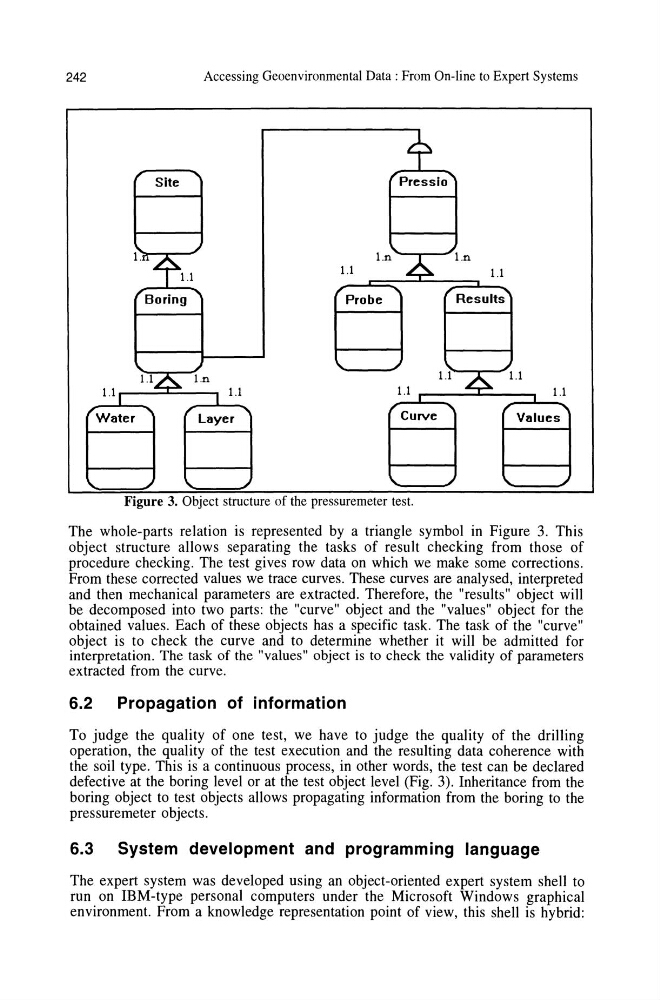
Figure 3. Object structure of the pressuremeter test.
The whole-parts relation is represented by a triangle symbol in Figure 3. This
object structure allows separating the tasks of result checking from those of
procedure checking. The test gives row data on which we make some corrections.
From these corrected values we trace curves. These curves are analysed, interpreted
and then mechanical parameters are extracted. Therefore, the "results" object will
be decomposed into two parts: the "curve" object and the "values" object for the
obtained values. Each of these objects has a specific task. The task of the "curve"
object is to check the curve and to determine whether it will be admitted for
interpretation. The task of the "values" object is to check the validity of parameters
extracted from the curve.
6.2
Propagation of information
To judge the quality of one test, we have to judge the quality of the drilling
operation, the quality of the test execution and the resulting data coherence with
the soil type. This is a continuous process, in other words, the test can be declared
defective at the boring level or at the test object level (Fig. 3). Inheritance from the
boring object to test objects allows propagating information from the boring to the
pressuremeter objects.
6.3 System development and programming language
The expert system was developed using an object-oriented expert system shell to
run on IBM-type personal computers under the Microsoft Windows graphical
environment. From a knowledge representation point of view, this shell is hybrid:
Accessing Geoenvironmental Data: From On-line to Expert Systems
+
Site
Pressio
1.n~1
l.n
4
l.n
1.1
1.1
1.1
Boring
Probe
Results
l.l..¢.. l.n
1.1
.¢.
1.1
1.11
L 1.1
1.1
1.1
Water
Layer
Curve
Values
Figure 3. Object structure of the pressuremeter test.
The whole-parts relation is represented by a triangle symbol in Figure 3. This
object structure allows separating the tasks of result checking from those of
procedure checking. The test gives row data on which we make some corrections.
From these corrected values we trace curves. These curves are analysed, interpreted
and then mechanical parameters are extracted. Therefore, the "results" object will
be decomposed into two parts: the "curve" object and the "values" object for the
obtained values. Each of these objects has a specific task. The task of the "curve"
object is to check the curve and to determine whether it will be admitted for
interpretation. The task of the "values" object is to check the validity of parameters
extracted from the curve.
6.2
Propagation of information
To judge the quality of one test, we have to judge the quality of the drilling
operation, the quality of the test execution and the resulting data coherence with
the soil type. This is a continuous process, in other words, the test can be declared
defective at the boring level or at the test object level (Fig. 3). Inheritance from the
boring object to test objects allows propagating information from the boring to the
pressuremeter objects.
6.3 System development and programming language
The expert system was developed using an object-oriented expert system shell to
run on IBM-type personal computers under the Microsoft Windows graphical
environment. From a knowledge representation point of view, this shell is hybrid: