

C. Tartari et al. : GIS for Environmental Assessment
2 5
30
100 ' 10' m2
25
50
20
0.5
20
g 20
0
250
~
iii 15
"
W 10
...
z - 15
go.
" ~ 10
u:
"
5
5
I1nl
~ ~I
m
"""
o 4200
4600
5000
5400
5800
Altitude (m a.s,l.)
0
I_lakes o Watersheds
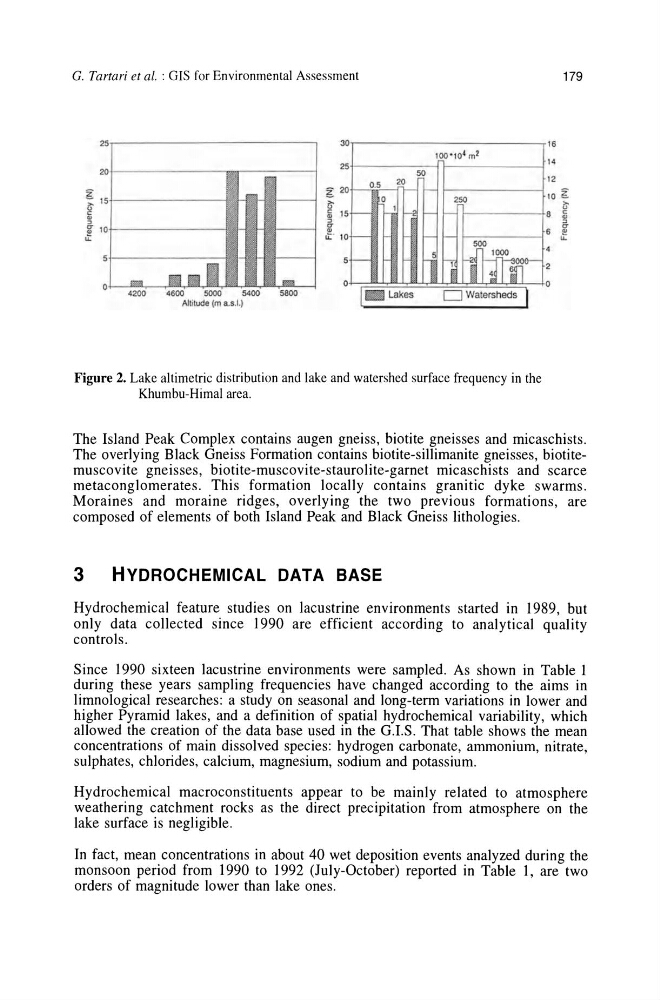
Figure 2. Lake altimetric distribution and lake and watershed surface frequency in the
Khumbu-Himal area.
179
16
14
12
10 g ,..
u
8 c:
" :>
a
6 ~
..
0
The Island Peak Complex contains augen gneiss, biotite gneisses and micaschists.
The overlying Black Gneiss Formation contains biotite-sillimanite gneisses, biotitemuscovite gneisses, biotite-muscovite-staurolite-garnet micaschists and scarce
metaconglomerates . This formation locally contains granitic dyke swarms .
Moraines and moraine ridges, overlying the two previous formations, are
composed of elements of both Island Peak and Black Gneiss lithologies.
3
HYDROCHEMICAL DATA BASE
Hydrochemical feature studies on lacustrine environments started in 1989, but
only data collected since 1990 are efficient according to analytical quality
controls.
Since 1990 sixteen lacustrine environments were sampled. As shown in Table 1
during these years sampling frequencies have changed according to the aims in
limnological researches: a study on seasonal and long-term variations in lower and
higher Pyramid lakes, and a definition of spatial hydrochemical variability, which
allowed the creation of the data base used in the G.I.S. That table shows the mean
concentrations of main dissolved species: hydrogen carbonate, ammonium, nitrate,
sulphates, chlorides, calcium, magnesium, sodium and potassium.
Hydrochemical macroconstituents appear to be mainly related to atmosphere
weathering catchment rocks as the direct precipitation from atmosphere on the
lake surface is negligible.
In fact, mean concentrations in about 40 wet deposition events analyzed during the
monsoon period from 1990 to 1992 (July-October) reported in Table 1, are two
orders of magnitude lower than lake ones.
2 5
30
100 ' 10' m2
25
50
20
0.5
20
g 20
0
250
~
iii 15
"
W 10
...
z - 15
go.
" ~ 10
u:
"
5
5
I1nl
~ ~I
m
"""
o 4200
4600
5000
5400
5800
Altitude (m a.s,l.)
0
I_lakes o Watersheds
Figure 2. Lake altimetric distribution and lake and watershed surface frequency in the
Khumbu-Himal area.
179
16
14
12
10 g ,..
u
8 c:
" :>
a
6 ~
..
0
The Island Peak Complex contains augen gneiss, biotite gneisses and micaschists.
The overlying Black Gneiss Formation contains biotite-sillimanite gneisses, biotitemuscovite gneisses, biotite-muscovite-staurolite-garnet micaschists and scarce
metaconglomerates . This formation locally contains granitic dyke swarms .
Moraines and moraine ridges, overlying the two previous formations, are
composed of elements of both Island Peak and Black Gneiss lithologies.
3
HYDROCHEMICAL DATA BASE
Hydrochemical feature studies on lacustrine environments started in 1989, but
only data collected since 1990 are efficient according to analytical quality
controls.
Since 1990 sixteen lacustrine environments were sampled. As shown in Table 1
during these years sampling frequencies have changed according to the aims in
limnological researches: a study on seasonal and long-term variations in lower and
higher Pyramid lakes, and a definition of spatial hydrochemical variability, which
allowed the creation of the data base used in the G.I.S. That table shows the mean
concentrations of main dissolved species: hydrogen carbonate, ammonium, nitrate,
sulphates, chlorides, calcium, magnesium, sodium and potassium.
Hydrochemical macroconstituents appear to be mainly related to atmosphere
weathering catchment rocks as the direct precipitation from atmosphere on the
lake surface is negligible.
In fact, mean concentrations in about 40 wet deposition events analyzed during the
monsoon period from 1990 to 1992 (July-October) reported in Table 1, are two
orders of magnitude lower than lake ones.