

P. Aile: Modeling Paleoclimatic Changes Using a Feedback Energetic System
Incident solar
energy
Reflected
117
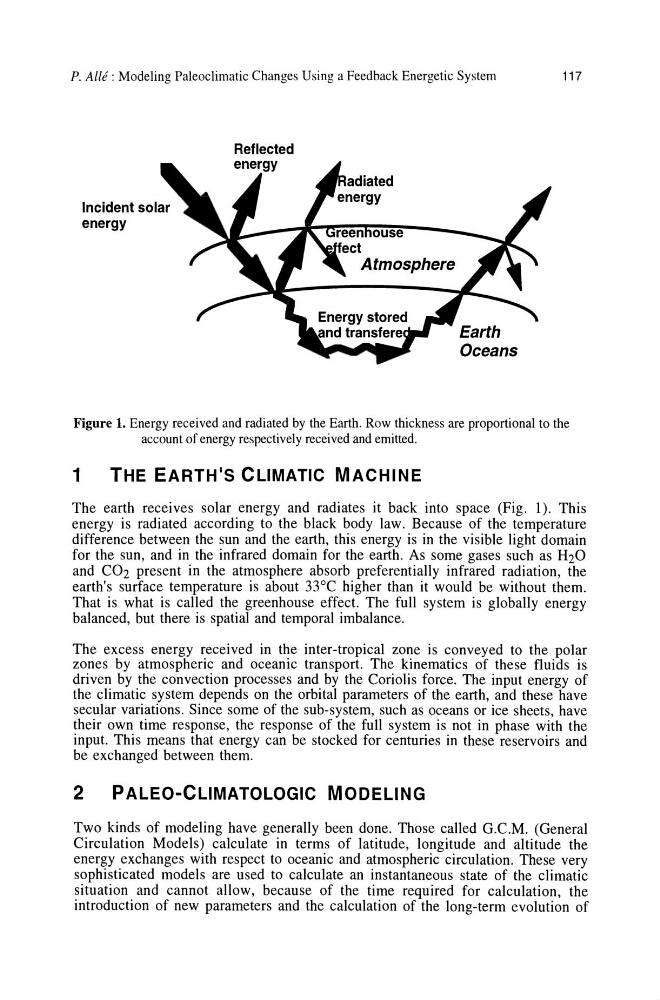
Figure 1. Energy received and radiated by the Earth. Row thickness are proportional to the
account of energy respectively received and emitted.
1
THE EARTH'S CLIMATIC MACHINE
The earth receives solar energy and radiates it back into space (Fig. 1). This
energy is radiated according to the black body law. Because of the temperature
difference between the sun and the earth, this energy is in the visible light domain
for the sun, and in the infrared domain for the earth. As some gases such as H20
and C02 present in the atmosphere absorb preferentially infrared radiation, the
earth's surface temperature is about 33°C higher than it would be without them.
That is what is called the greenhouse effect. The full system is globally energy
balanced, but there is spatial and temporal imbalance.
The excess energy received in the inter-tropical zone is conveyed to the polar
zones by atmospheric and oceanic transport. The kinematics of these fluids is
driven by the convection processes and by the Coriolis force. The input energy of
the climatic system depends on the orbital parameters of the earth, and these have
secular variations. Since some of the sub-system, such as oceans or ice sheets, have
their own time response, the response of the full system is not in phase with the
input. This means that energy can be stocked for centuries in these reservoirs and
be exchanged between them.
2 PALEO-CLIMATOLOGIC MODELING
Two kinds of modeling have generally been done. Those called G.C.M. (General
Circulation Models) calculate in terms of latitude, longitude and altitude the
energy exchanges with respect to oceanic and atmospheric circulation. These very
sophisticated models are used to calculate an instantaneous state of the climatic
situation and cannot allow, because of the time required for calculation, the
introduction of new parameters and the calculation of the long-term evolution of
Incident solar
energy
Reflected
117
Figure 1. Energy received and radiated by the Earth. Row thickness are proportional to the
account of energy respectively received and emitted.
1
THE EARTH'S CLIMATIC MACHINE
The earth receives solar energy and radiates it back into space (Fig. 1). This
energy is radiated according to the black body law. Because of the temperature
difference between the sun and the earth, this energy is in the visible light domain
for the sun, and in the infrared domain for the earth. As some gases such as H20
and C02 present in the atmosphere absorb preferentially infrared radiation, the
earth's surface temperature is about 33°C higher than it would be without them.
That is what is called the greenhouse effect. The full system is globally energy
balanced, but there is spatial and temporal imbalance.
The excess energy received in the inter-tropical zone is conveyed to the polar
zones by atmospheric and oceanic transport. The kinematics of these fluids is
driven by the convection processes and by the Coriolis force. The input energy of
the climatic system depends on the orbital parameters of the earth, and these have
secular variations. Since some of the sub-system, such as oceans or ice sheets, have
their own time response, the response of the full system is not in phase with the
input. This means that energy can be stocked for centuries in these reservoirs and
be exchanged between them.
2 PALEO-CLIMATOLOGIC MODELING
Two kinds of modeling have generally been done. Those called G.C.M. (General
Circulation Models) calculate in terms of latitude, longitude and altitude the
energy exchanges with respect to oceanic and atmospheric circulation. These very
sophisticated models are used to calculate an instantaneous state of the climatic
situation and cannot allow, because of the time required for calculation, the
introduction of new parameters and the calculation of the long-term evolution of