

96
Water In Ecosystems: A Non Renewable Resource
Microcosms have been used in ecotoxicology for some twenty years now. It is
impossible in the scope of this chapter to completely analyze the theory and all the
application aspects required by such an approach. We shall, therefore, only present
those points that seem basic to us.
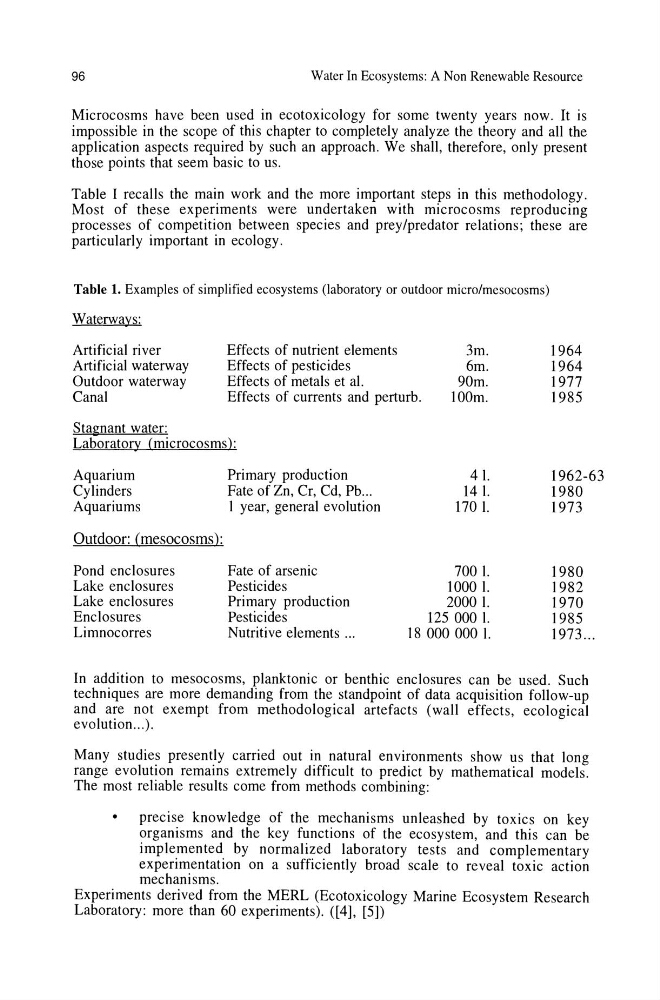
Table I recalls the main work and the more important steps in this methodology.
Most of these experiments were undertaken with microcosms reproducing
processes of competition between species and prey/predator relations; these are
particularly important in ecology.
Table 1. Examples of simplified ecosystems (laboratory or outdoor microimesocosms)
Waterways:
Artificial river
Artificial waterway
Outdoor waterway
Canal
Stagnant water:
Effects of nutrient elements
Effects of pesticides
Effects of metals et al.
Effects of currents and perturb.
3m.
6m.
90m.
100m.
Laboratory (microcosms):
Aquarium
Cylinders
Aquariums
Outdoor: (mesocosms):
Pond enclosures
Lake enclosures
Lake enclosures
Enclosures
Limnocorres
Primary production
Fate of Zn, Cr, Cd, Pb ...
1 year, general evolution
Fate of arsenic
Pesticides
Primary production
Pesticides
Nutritive elements ...
41.
14 1.
170 1.
7001.
10001.
2000 I.
125 000 1.
18 000 000 1.
1964
1964
1977
1985
1962-63
1980
1973
1980
1982
1970
1985
1973 ...
In addition to mesocosms, planktonic or benthic enclosures can be used. Such
techniques are more demanding from the standpoint of data acquisition follow-up
and are not exempt from methodological artefacts (wall effects, ecological
evolution ... ).
Many studies presently carried out in natural environments show us that long
range evolution remains extremely difficult to predict by mathematical models.
The most reliable results come from methods combining:
precise knowledge of the mechanisms unleashed by toxics on key
organisms and the key functions of the ecosystem, and this can be
implemented by normalized laboratory tests and complementary
experimentation on a sufficiently broad scale to reveal toxic action
mechanisms.
Experiments derived from the MERL (Ecotoxicology Marine Ecosystem Research
Laboratory: more than 60 experiments). ([4], [5])
Water In Ecosystems: A Non Renewable Resource
Microcosms have been used in ecotoxicology for some twenty years now. It is
impossible in the scope of this chapter to completely analyze the theory and all the
application aspects required by such an approach. We shall, therefore, only present
those points that seem basic to us.
Table I recalls the main work and the more important steps in this methodology.
Most of these experiments were undertaken with microcosms reproducing
processes of competition between species and prey/predator relations; these are
particularly important in ecology.
Table 1. Examples of simplified ecosystems (laboratory or outdoor microimesocosms)
Waterways:
Artificial river
Artificial waterway
Outdoor waterway
Canal
Stagnant water:
Effects of nutrient elements
Effects of pesticides
Effects of metals et al.
Effects of currents and perturb.
3m.
6m.
90m.
100m.
Laboratory (microcosms):
Aquarium
Cylinders
Aquariums
Outdoor: (mesocosms):
Pond enclosures
Lake enclosures
Lake enclosures
Enclosures
Limnocorres
Primary production
Fate of Zn, Cr, Cd, Pb ...
1 year, general evolution
Fate of arsenic
Pesticides
Primary production
Pesticides
Nutritive elements ...
41.
14 1.
170 1.
7001.
10001.
2000 I.
125 000 1.
18 000 000 1.
1964
1964
1977
1985
1962-63
1980
1973
1980
1982
1970
1985
1973 ...
In addition to mesocosms, planktonic or benthic enclosures can be used. Such
techniques are more demanding from the standpoint of data acquisition follow-up
and are not exempt from methodological artefacts (wall effects, ecological
evolution ... ).
Many studies presently carried out in natural environments show us that long
range evolution remains extremely difficult to predict by mathematical models.
The most reliable results come from methods combining:
precise knowledge of the mechanisms unleashed by toxics on key
organisms and the key functions of the ecosystem, and this can be
implemented by normalized laboratory tests and complementary
experimentation on a sufficiently broad scale to reveal toxic action
mechanisms.
Experiments derived from the MERL (Ecotoxicology Marine Ecosystem Research
Laboratory: more than 60 experiments). ([4], [5])