

P. Masclet : Contamination of Lake Water by Pesticides via Atmospheric Transport
91
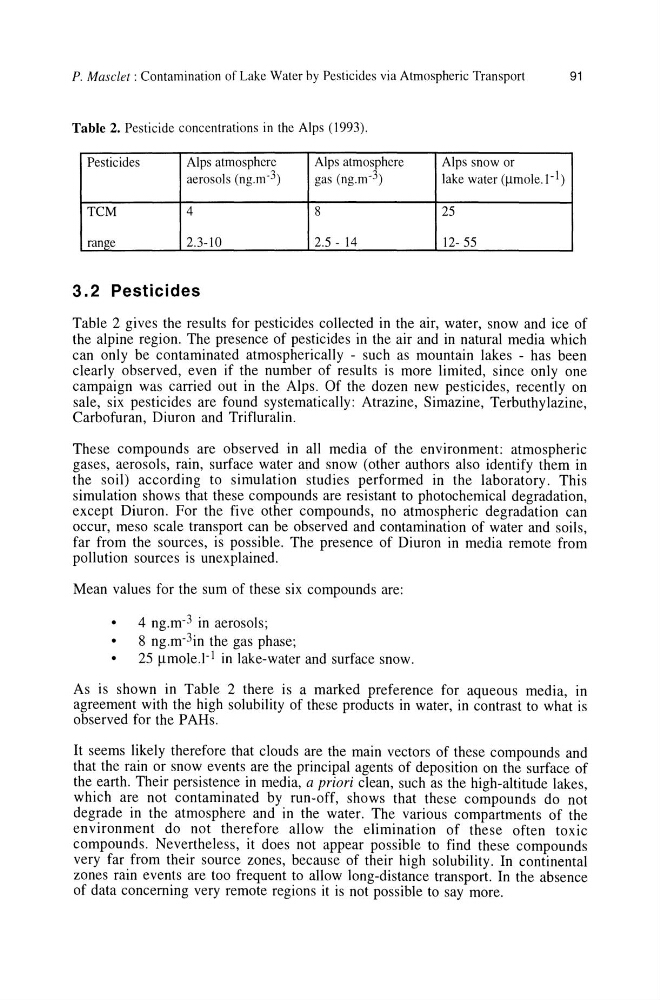
Table 2. Pesticide concentrations in the Alps (1993).
Pesticides
Alps atmosphere
Alps atmosphere
Alps snow or
aerosols (ng.m- 3 )
gas (ng.m- 3 )
lake water (J.lmole.l- 1 )
TCM
4
8
25
range
2.3-10
2.5 - 14
12- 55
3.2 Pesticides
Table 2 gives the results for pesticides collected in the air, water, snow and ice of
the alpine region. The presence of pesticides in the air and in natural media which
can only be contaminated atmospherically - such as mountain lakes - has been
clearly observed, even if the number of results is more limited, since only one
campaign was carried out in the Alps. Of the dozen new pesticides, recently on
sale, six pesticides are found systematically: Atrazine, Simazine, Terbuthylazine,
Carbofuran, Diuron and Trifluralin.
These compounds are observed in all media of the environment: atmospheric
gases, aerosols, rain, surface water and snow (other authors also identify them in
the soil) according to simulation studies performed in the laboratory. This
simulation shows that these compounds are resistant to photochemical degradation,
except Diuron. For the five other compounds, no atmospheric degradation can
occur, meso scale transport can be observed and contamination of water and soils,
far from the sources, is possible. The presence of Diuron in media remote from
pollution sources is unexplained.
Mean values for the sum of these six compounds are:
• 4 ng.m- 3 in aerosols;
•
8 ng.m- 3 in the gas phase;
•
25 Jlmole.l- 1 in lake-water and surface snow.
As is shown in Table 2 there is a marked preference for aqueous media, in
agreement with the high solubility of these products in water, in contrast to what is
observed for the PAHs.
It seems likely therefore that clouds are the main vectors of these compounds and
that the rain or snow events are the principal agents of deposition on the surface of
the earth. Their persistence in media, a priori clean, such as the high-altitude lakes,
which are not contaminated by run-off, shows that these compounds do not
degrade in the atmosphere and in the water. The various compartments of the
environment do not therefore allow the elimination of these often toxic
compounds. Nevertheless, it does not appear possible to find these compounds
very far from their source zones, because of their high solubility. In continental
zones rain events are too frequent to allow long-distance transport. In the absence
of data concerning very remote regions it is not possible to say more.
91
Table 2. Pesticide concentrations in the Alps (1993).
Pesticides
Alps atmosphere
Alps atmosphere
Alps snow or
aerosols (ng.m- 3 )
gas (ng.m- 3 )
lake water (J.lmole.l- 1 )
TCM
4
8
25
range
2.3-10
2.5 - 14
12- 55
3.2 Pesticides
Table 2 gives the results for pesticides collected in the air, water, snow and ice of
the alpine region. The presence of pesticides in the air and in natural media which
can only be contaminated atmospherically - such as mountain lakes - has been
clearly observed, even if the number of results is more limited, since only one
campaign was carried out in the Alps. Of the dozen new pesticides, recently on
sale, six pesticides are found systematically: Atrazine, Simazine, Terbuthylazine,
Carbofuran, Diuron and Trifluralin.
These compounds are observed in all media of the environment: atmospheric
gases, aerosols, rain, surface water and snow (other authors also identify them in
the soil) according to simulation studies performed in the laboratory. This
simulation shows that these compounds are resistant to photochemical degradation,
except Diuron. For the five other compounds, no atmospheric degradation can
occur, meso scale transport can be observed and contamination of water and soils,
far from the sources, is possible. The presence of Diuron in media remote from
pollution sources is unexplained.
Mean values for the sum of these six compounds are:
• 4 ng.m- 3 in aerosols;
•
8 ng.m- 3 in the gas phase;
•
25 Jlmole.l- 1 in lake-water and surface snow.
As is shown in Table 2 there is a marked preference for aqueous media, in
agreement with the high solubility of these products in water, in contrast to what is
observed for the PAHs.
It seems likely therefore that clouds are the main vectors of these compounds and
that the rain or snow events are the principal agents of deposition on the surface of
the earth. Their persistence in media, a priori clean, such as the high-altitude lakes,
which are not contaminated by run-off, shows that these compounds do not
degrade in the atmosphere and in the water. The various compartments of the
environment do not therefore allow the elimination of these often toxic
compounds. Nevertheless, it does not appear possible to find these compounds
very far from their source zones, because of their high solubility. In continental
zones rain events are too frequent to allow long-distance transport. In the absence
of data concerning very remote regions it is not possible to say more.