

P. Masclet : Contamination of Lake Water by Pesticides via Atmospheric Transport
89
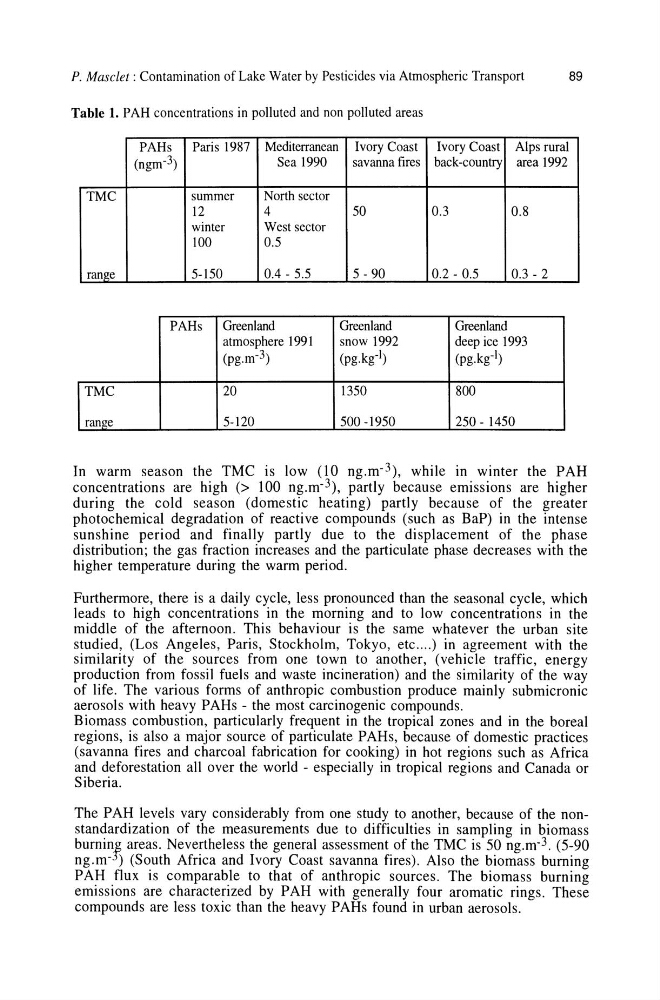
Table 1. PAR concentrations in polluted and non polluted areas
PARs Paris 1987 Mediterranean Ivory Coast Ivory Coast Alps rural
(ngm- 3 )
Sea 1990
savanna fires back-country area 1992
TMC
summer
North sector
12
4
50
0.3
0.8
winter
West sector
100
0.5
range
5-150
0.4 - 5.5
5 - 90
0.2 - 0.5
0.3 - 2
PARs Greenland
Greenland
Greenland
atmosphere 1991
snow 1992
deep ice 1993
(pg.m-3)
(pg.kg- i )
(pg.kg- i )
TMC
20
1350
800
range
5-120
500 -1950
250 - 1450
In warm season the TMC is low (10 ng.m- 3 ), while in winter the PAR
concentrations are high (> 100 ng.m- 3 ), partly because emissions are higher
during the cold season (domestic heating) partly because of the greater
photochemical degradation of reactive compounds (such as BaP) in the intense
sunshine period and finally partly due to the displacement of the phase
distribution; the gas fraction increases and the particulate phase decreases with the
higher temperature during the warm period.
Furthermore, there is a daily cycle, less pronounced than the seasonal cycle, which
leads to high concentrations in the morning and to low concentrations in the
middle of the afternoon. This behaviour is the same whatever the urban site
studied, (Los Angeles, Paris, Stockholm, Tokyo, etc .... ) in agreement with the
similarity of the sources from one town to another, (vehicle traffic, energy
production from fossil fuels and waste incineration) and the similarity of the way
of life. The various forms of anthropic combustion produce mainly submicronic
aerosols with heavy PARs - the most carcinogenic compounds.
Biomass combustion, particularly frequent in the tropical zones and in the boreal
regions, is also a major source of particulate PARs, because of domestic practices
(savanna fires and charcoal fabrication for cooking) in hot regions such as Africa
and deforestation all over the world - especially in tropical regions and Canada or
Siberia.
The PAR levels vary considerably from one study to another, because of the nonstandardization of the measurements due to difficulties in sampling in biomass
burnin!, areas. Nevertheless the general assessment of the TMC is 50 ng.m- 3 . (5-90
ng.m- ) (South Africa and Ivory Coast savanna fires). Also the biomass burning
PAR flux is comparable to that of anthropic sources. The biomass burning
emissions are characterized by PAR with generally four aromatic rings. These
compounds are less toxic than the heavy PARs found in urban aerosols.
89
Table 1. PAR concentrations in polluted and non polluted areas
PARs Paris 1987 Mediterranean Ivory Coast Ivory Coast Alps rural
(ngm- 3 )
Sea 1990
savanna fires back-country area 1992
TMC
summer
North sector
12
4
50
0.3
0.8
winter
West sector
100
0.5
range
5-150
0.4 - 5.5
5 - 90
0.2 - 0.5
0.3 - 2
PARs Greenland
Greenland
Greenland
atmosphere 1991
snow 1992
deep ice 1993
(pg.m-3)
(pg.kg- i )
(pg.kg- i )
TMC
20
1350
800
range
5-120
500 -1950
250 - 1450
In warm season the TMC is low (10 ng.m- 3 ), while in winter the PAR
concentrations are high (> 100 ng.m- 3 ), partly because emissions are higher
during the cold season (domestic heating) partly because of the greater
photochemical degradation of reactive compounds (such as BaP) in the intense
sunshine period and finally partly due to the displacement of the phase
distribution; the gas fraction increases and the particulate phase decreases with the
higher temperature during the warm period.
Furthermore, there is a daily cycle, less pronounced than the seasonal cycle, which
leads to high concentrations in the morning and to low concentrations in the
middle of the afternoon. This behaviour is the same whatever the urban site
studied, (Los Angeles, Paris, Stockholm, Tokyo, etc .... ) in agreement with the
similarity of the sources from one town to another, (vehicle traffic, energy
production from fossil fuels and waste incineration) and the similarity of the way
of life. The various forms of anthropic combustion produce mainly submicronic
aerosols with heavy PARs - the most carcinogenic compounds.
Biomass combustion, particularly frequent in the tropical zones and in the boreal
regions, is also a major source of particulate PARs, because of domestic practices
(savanna fires and charcoal fabrication for cooking) in hot regions such as Africa
and deforestation all over the world - especially in tropical regions and Canada or
Siberia.
The PAR levels vary considerably from one study to another, because of the nonstandardization of the measurements due to difficulties in sampling in biomass
burnin!, areas. Nevertheless the general assessment of the TMC is 50 ng.m- 3 . (5-90
ng.m- ) (South Africa and Ivory Coast savanna fires). Also the biomass burning
PAR flux is comparable to that of anthropic sources. The biomass burning
emissions are characterized by PAR with generally four aromatic rings. These
compounds are less toxic than the heavy PARs found in urban aerosols.