

medieval times of castration of boy singers to produce adult males with
high-pitched voices (“castrati”). However, the details of the hormonal
mechanisms mediating the pubertal voice shift have not been worked out
in any species and are currently receiving intense scrutiny (Yamaguchi and
Kelley, Chapter 6).
Other examples of laryngeal hypertrophy are even more extreme. In
howler monkeys (genus Alouatta), for example, the male hyoid apparatus
and larynx are vastly enlarged, with the swollen, hollow hyoid occupying
the entire space within the mandible (Schön-Ybarra 1986, 1988). The hyoid
contains a laryngeal air sac similar to that seen in many other primates,
which may function as some sort of resonator (see below). It is possible that
the mandible functions to limit further growth of the hyoid; it also is
enlarged relative to other primates. Howler monkeys produce loud, lowpitched roars, which appear to function in intergroup spacing; these calls
may have provided the selective force underlying laryngeal hypertrophy in
this genus. Finally, the most pronounced laryngeal hypertrophy in the
animal kingdom is seen in African epomophorine fruit bats, especially the
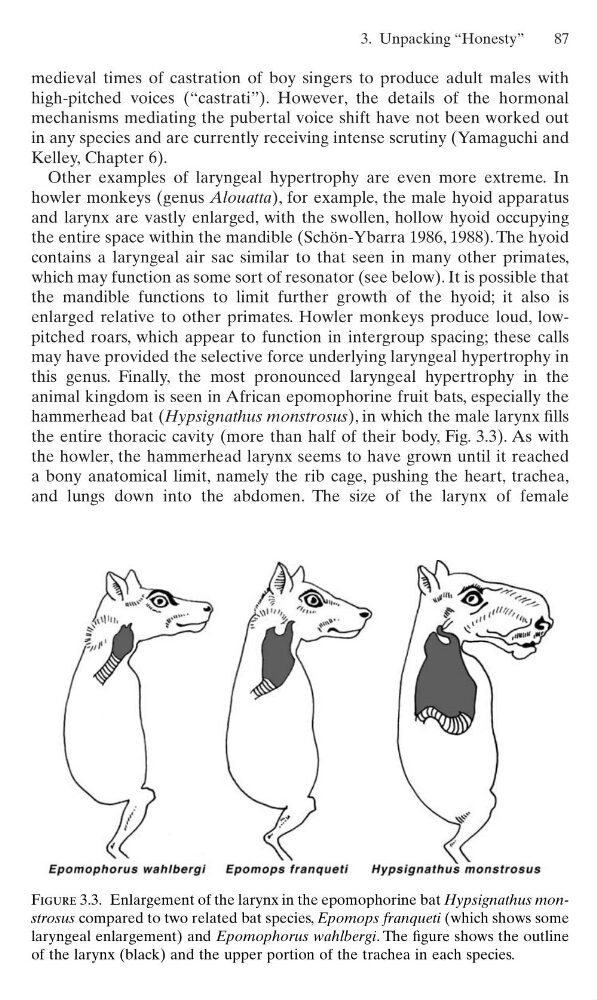
hammerhead bat (Hypsignathus monstrosus), in which the male larynx fills
the entire thoracic cavity (more than half of their body, Fig. 3.3). As with
the howler, the hammerhead larynx seems to have grown until it reached
a bony anatomical limit, namely the rib cage, pushing the heart, trachea,
and lungs down into the abdomen. The size of the larynx of female
3. Unpacking “Honesty”
87
Figure 3.3. Enlargement of the larynx in the epomophorine bat Hypsignathus monstrosus compared to two related bat species, Epomops franqueti (which shows some
laryngeal enlargement) and Epomophorus wahlbergi. The figure shows the outline
of the larynx (black) and the upper portion of the trachea in each species.
high-pitched voices (“castrati”). However, the details of the hormonal
mechanisms mediating the pubertal voice shift have not been worked out
in any species and are currently receiving intense scrutiny (Yamaguchi and
Kelley, Chapter 6).
Other examples of laryngeal hypertrophy are even more extreme. In
howler monkeys (genus Alouatta), for example, the male hyoid apparatus
and larynx are vastly enlarged, with the swollen, hollow hyoid occupying
the entire space within the mandible (Schön-Ybarra 1986, 1988). The hyoid
contains a laryngeal air sac similar to that seen in many other primates,
which may function as some sort of resonator (see below). It is possible that
the mandible functions to limit further growth of the hyoid; it also is
enlarged relative to other primates. Howler monkeys produce loud, lowpitched roars, which appear to function in intergroup spacing; these calls
may have provided the selective force underlying laryngeal hypertrophy in
this genus. Finally, the most pronounced laryngeal hypertrophy in the
animal kingdom is seen in African epomophorine fruit bats, especially the
hammerhead bat (Hypsignathus monstrosus), in which the male larynx fills
the entire thoracic cavity (more than half of their body, Fig. 3.3). As with
the howler, the hammerhead larynx seems to have grown until it reached
a bony anatomical limit, namely the rib cage, pushing the heart, trachea,
and lungs down into the abdomen. The size of the larynx of female
3. Unpacking “Honesty”
87
Figure 3.3. Enlargement of the larynx in the epomophorine bat Hypsignathus monstrosus compared to two related bat species, Epomops franqueti (which shows some
laryngeal enlargement) and Epomophorus wahlbergi. The figure shows the outline
of the larynx (black) and the upper portion of the trachea in each species.