

priate conceptual framework to understand their production is quite new
and has until recently been confined mostly to physics journals. Fortunately,
however, one of the ideal tools to analyze such calls is the familiar narrowband spectrographic representation. Consequently, the next few years will
bring a much more detailed understanding of both the acoustic production
of nonlinearities in animal vocalizations and their behavioral and evolutionary significance.
In addition to the larynx or syrinx, there are other possible sources of
acoustic energy available in all terrestrial vertebrates. Given adequately
high flow, a narrow constriction anywhere along the path from lungs to lips
or nostrils can produce turbulent noise (as in human whispers or “s” sounds,
or snake hisses), thus providing a set of other possible sources of broadband noise. Such a turbulent source can operate alone or simultaneously
with the laryngeal or syringeal source. For example, the English sound “f”
is produced by a turbulent noise source alone, generated at a constriction
between the teeth and lips. In contrast, the “v” sound is created by phonating simultaneously with “f” and thus is a dual-source sound. Both nonlaryngeal sources and dual-source sounds are common in human speech,
78
W.T. Fitch and M.D. Hauser
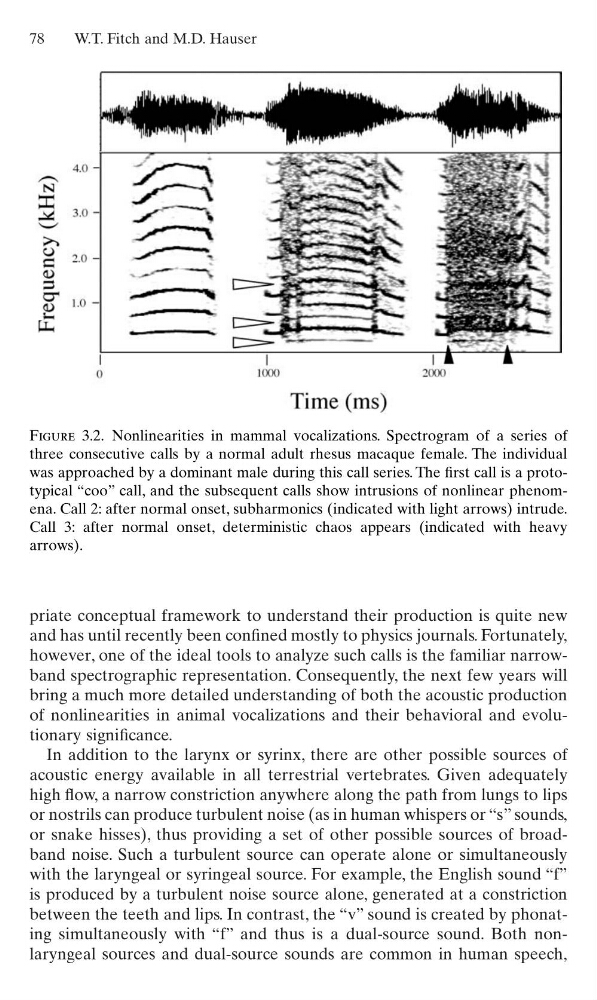
Figure 3.2. Nonlinearities in mammal vocalizations. Spectrogram of a series of
three consecutive calls by a normal adult rhesus macaque female. The individual
was approached by a dominant male during this call series. The first call is a prototypical “coo” call, and the subsequent calls show intrusions of nonlinear phenomena. Call 2: after normal onset, subharmonics (indicated with light arrows) intrude.
Call 3: after normal onset, deterministic chaos appears (indicated with heavy
arrows).
and has until recently been confined mostly to physics journals. Fortunately,
however, one of the ideal tools to analyze such calls is the familiar narrowband spectrographic representation. Consequently, the next few years will
bring a much more detailed understanding of both the acoustic production
of nonlinearities in animal vocalizations and their behavioral and evolutionary significance.
In addition to the larynx or syrinx, there are other possible sources of
acoustic energy available in all terrestrial vertebrates. Given adequately
high flow, a narrow constriction anywhere along the path from lungs to lips
or nostrils can produce turbulent noise (as in human whispers or “s” sounds,
or snake hisses), thus providing a set of other possible sources of broadband noise. Such a turbulent source can operate alone or simultaneously
with the laryngeal or syringeal source. For example, the English sound “f”
is produced by a turbulent noise source alone, generated at a constriction
between the teeth and lips. In contrast, the “v” sound is created by phonating simultaneously with “f” and thus is a dual-source sound. Both nonlaryngeal sources and dual-source sounds are common in human speech,
78
W.T. Fitch and M.D. Hauser
Figure 3.2. Nonlinearities in mammal vocalizations. Spectrogram of a series of
three consecutive calls by a normal adult rhesus macaque female. The individual
was approached by a dominant male during this call series. The first call is a prototypical “coo” call, and the subsequent calls show intrusions of nonlinear phenomena. Call 2: after normal onset, subharmonics (indicated with light arrows) intrude.
Call 3: after normal onset, deterministic chaos appears (indicated with heavy
arrows).