

Nonhuman primates such as chimpanzees (Pan troglodytes and P. paniscus) produce vocalizations, such as low hoots and pant hoots, that have both
inspiratory and expiratory components (Marler 1969; Marler and Tenaza
1977; de Waal 1988), as do human infant cries (Truby and Lind 1965; Wolff
1969). In birds, which have an extremely complex and efficient respiratory
system, the respiratory dynamics underlying vocalization appear to be
equally complex. Many songbirds appear to produce shallow, rapid respiratory cycles called “mini-breaths,” which allow extended periods of unbroken song and suggest a level of respiratory/vocal coordination far superior
to that seen in other tetrapods (Calder 1970; Hartley and Suthers 1989).
2.1.2. The Voice Source
In terrestrial vertebrates, vocalizations are initially generated by a structure
that converts air flow from the lungs (or air sacs) into acoustic energy. This
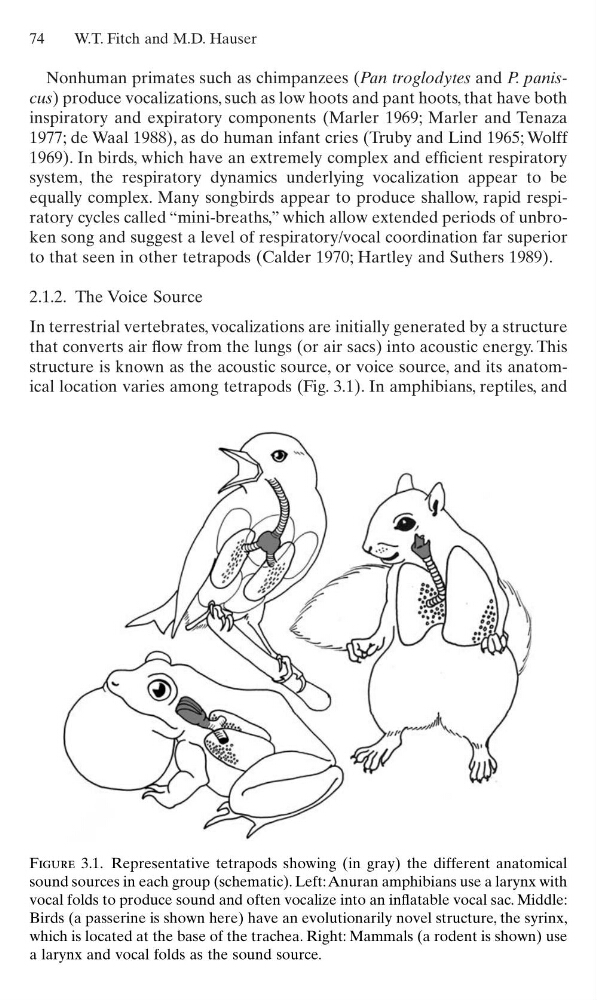
structure is known as the acoustic source, or voice source, and its anatomical location varies among tetrapods (Fig. 3.1). In amphibians, reptiles, and
74
W.T. Fitch and M.D. Hauser
Figure 3.1. Representative tetrapods showing (in gray) the different anatomical
sound sources in each group (schematic). Left: Anuran amphibians use a larynx with
vocal folds to produce sound and often vocalize into an inflatable vocal sac. Middle:
Birds (a passerine is shown here) have an evolutionarily novel structure, the syrinx,
which is located at the base of the trachea. Right: Mammals (a rodent is shown) use
a larynx and vocal folds as the sound source.
inspiratory and expiratory components (Marler 1969; Marler and Tenaza
1977; de Waal 1988), as do human infant cries (Truby and Lind 1965; Wolff
1969). In birds, which have an extremely complex and efficient respiratory
system, the respiratory dynamics underlying vocalization appear to be
equally complex. Many songbirds appear to produce shallow, rapid respiratory cycles called “mini-breaths,” which allow extended periods of unbroken song and suggest a level of respiratory/vocal coordination far superior
to that seen in other tetrapods (Calder 1970; Hartley and Suthers 1989).
2.1.2. The Voice Source
In terrestrial vertebrates, vocalizations are initially generated by a structure
that converts air flow from the lungs (or air sacs) into acoustic energy. This
structure is known as the acoustic source, or voice source, and its anatomical location varies among tetrapods (Fig. 3.1). In amphibians, reptiles, and
74
W.T. Fitch and M.D. Hauser
Figure 3.1. Representative tetrapods showing (in gray) the different anatomical
sound sources in each group (schematic). Left: Anuran amphibians use a larynx with
vocal folds to produce sound and often vocalize into an inflatable vocal sac. Middle:
Birds (a passerine is shown here) have an evolutionarily novel structure, the syrinx,
which is located at the base of the trachea. Right: Mammals (a rodent is shown) use
a larynx and vocal folds as the sound source.