

the details regarding the physical attributes of the important parameters
are not well-known and are site-specific and difficult to generalize.
10.1. Surface Temperature
In cases when surface water is warmer than deeper water, sound velocity
decreases with increased depth and sound in the upper surface layer
will be refracted down into the cooler water. Situations in which cold
water nears the surface occur seasonally along shelf breaks and sea
mounts as a result of upwellings or other oceanographic changes. Acoustically, such conditions bring the deep sound channel closer to the surface
thereby increasing an animal’s access to a long range communication
path. Biologically, such conditions are often associated with areas of
high productivity and concentrations of marine animals (e.g., Croll et al.
1999).
10.2. Depth and Substrate: Cutoff Frequencies
Both the composition of the bottom substrate and water depth influence
the frequency below which sound transmission is negligible, referred to as
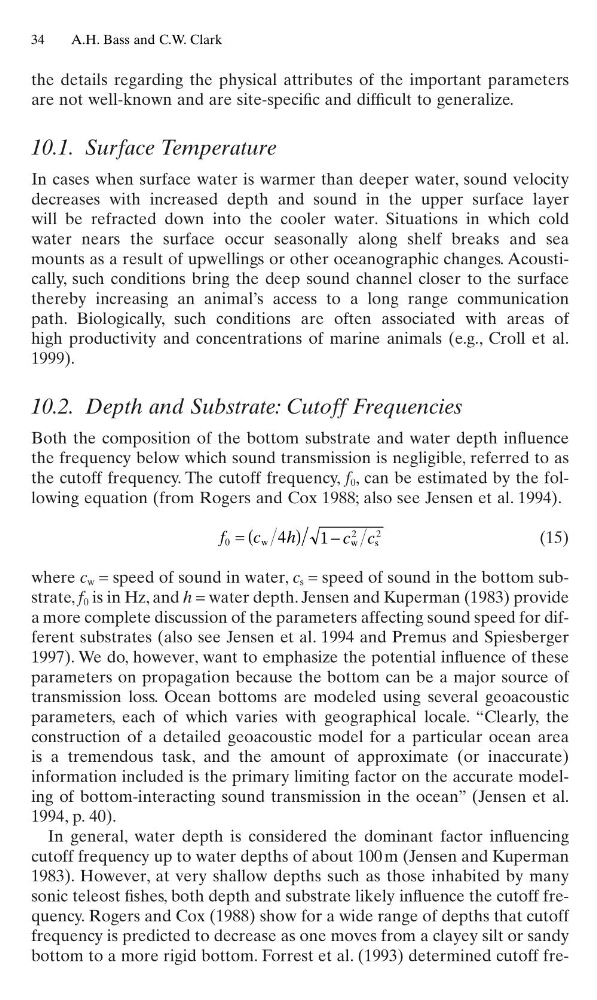
the cutoff frequency. The cutoff frequency, f 0 , can be estimated by the following equation (from Rogers and Cox 1988; also see Jensen et al. 1994).
(15)
where c w = speed of sound in water, c s = speed of sound in the bottom substrate, f 0 is in Hz, and h = water depth. Jensen and Kuperman (1983) provide
a more complete discussion of the parameters affecting sound speed for different substrates (also see Jensen et al. 1994 and Premus and Spiesberger
1997). We do, however, want to emphasize the potential influence of these
parameters on propagation because the bottom can be a major source of
transmission loss. Ocean bottoms are modeled using several geoacoustic
parameters, each of which varies with geographical locale. “Clearly, the
construction of a detailed geoacoustic model for a particular ocean area
is a tremendous task, and the amount of approximate (or inaccurate)
information included is the primary limiting factor on the accurate modeling of bottom-interacting sound transmission in the ocean” (Jensen et al.
1994, p. 40).
In general, water depth is considered the dominant factor influencing
cutoff frequency up to water depths of about 100 m (Jensen and Kuperman
1983). However, at very shallow depths such as those inhabited by many
sonic teleost fishes, both depth and substrate likely influence the cutoff frequency. Rogers and Cox (1988) show for a wide range of depths that cutoff
frequency is predicted to decrease as one moves from a clayey silt or sandy
bottom to a more rigid bottom. Forrest et al. (1993) determined cutoff fref
c
h
c c
0
2
2
4
1
= (
)
-
w
w
s
34
A.H. Bass and C.W. Clark
are not well-known and are site-specific and difficult to generalize.
10.1. Surface Temperature
In cases when surface water is warmer than deeper water, sound velocity
decreases with increased depth and sound in the upper surface layer
will be refracted down into the cooler water. Situations in which cold
water nears the surface occur seasonally along shelf breaks and sea
mounts as a result of upwellings or other oceanographic changes. Acoustically, such conditions bring the deep sound channel closer to the surface
thereby increasing an animal’s access to a long range communication
path. Biologically, such conditions are often associated with areas of
high productivity and concentrations of marine animals (e.g., Croll et al.
1999).
10.2. Depth and Substrate: Cutoff Frequencies
Both the composition of the bottom substrate and water depth influence
the frequency below which sound transmission is negligible, referred to as
the cutoff frequency. The cutoff frequency, f 0 , can be estimated by the following equation (from Rogers and Cox 1988; also see Jensen et al. 1994).
(15)
where c w = speed of sound in water, c s = speed of sound in the bottom substrate, f 0 is in Hz, and h = water depth. Jensen and Kuperman (1983) provide
a more complete discussion of the parameters affecting sound speed for different substrates (also see Jensen et al. 1994 and Premus and Spiesberger
1997). We do, however, want to emphasize the potential influence of these
parameters on propagation because the bottom can be a major source of
transmission loss. Ocean bottoms are modeled using several geoacoustic
parameters, each of which varies with geographical locale. “Clearly, the
construction of a detailed geoacoustic model for a particular ocean area
is a tremendous task, and the amount of approximate (or inaccurate)
information included is the primary limiting factor on the accurate modeling of bottom-interacting sound transmission in the ocean” (Jensen et al.
1994, p. 40).
In general, water depth is considered the dominant factor influencing
cutoff frequency up to water depths of about 100 m (Jensen and Kuperman
1983). However, at very shallow depths such as those inhabited by many
sonic teleost fishes, both depth and substrate likely influence the cutoff frequency. Rogers and Cox (1988) show for a wide range of depths that cutoff
frequency is predicted to decrease as one moves from a clayey silt or sandy
bottom to a more rigid bottom. Forrest et al. (1993) determined cutoff fref
c
h
c c
0
2
2
4
1
= (
)
-
w
w
s
34
A.H. Bass and C.W. Clark