

This representation of sound propagation, although simple and effective
for illustrating different paths, is insufficient for estimating transmission
loss, primarily because propagation depends on range, depth, and frequency,
and the interactions of all of the various terms are complicated. Propagation prediction methods include both ray and wave modeling, with modal
analysis and the use of parabolic equation methods that are beyond
the scope of this chapter (see Jensen et al. 1994; Richardson et al. 1995).
However, we will later discuss the implications of these propagation-model
30
A.H. Bass and C.W. Clark
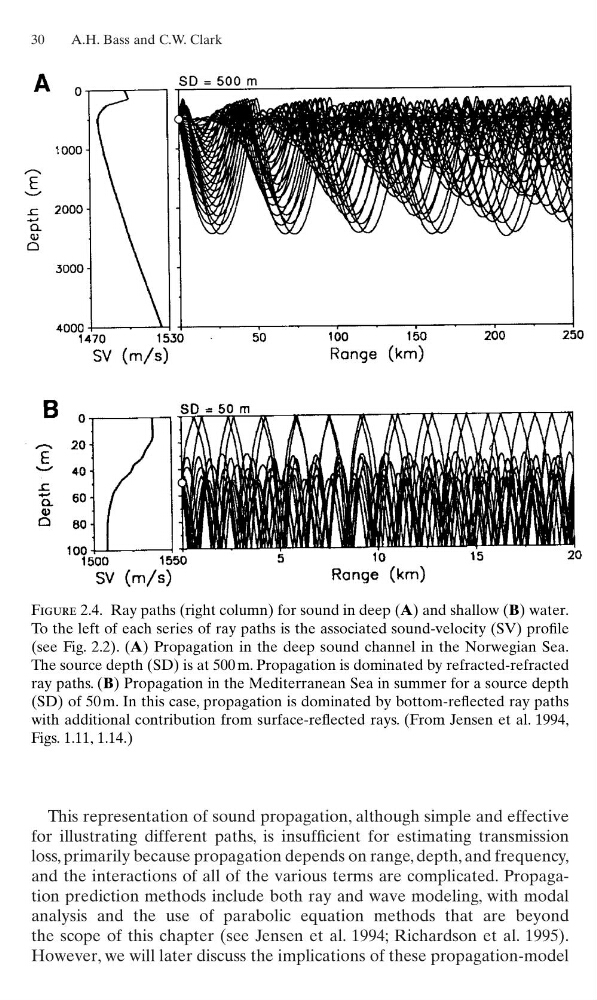
Figure 2.4. Ray paths (right column) for sound in deep (A) and shallow (B) water.
To the left of each series of ray paths is the associated sound-velocity (SV) profile
(see Fig. 2.2). (A) Propagation in the deep sound channel in the Norwegian Sea.
The source depth (SD) is at 500 m. Propagation is dominated by refracted-refracted
ray paths. (B) Propagation in the Mediterranean Sea in summer for a source depth
(SD) of 50 m. In this case, propagation is dominated by bottom-reflected ray paths
with additional contribution from surface-reflected rays. (From Jensen et al. 1994,
Figs. 1.11, 1.14.)
for illustrating different paths, is insufficient for estimating transmission
loss, primarily because propagation depends on range, depth, and frequency,
and the interactions of all of the various terms are complicated. Propagation prediction methods include both ray and wave modeling, with modal
analysis and the use of parabolic equation methods that are beyond
the scope of this chapter (see Jensen et al. 1994; Richardson et al. 1995).
However, we will later discuss the implications of these propagation-model
30
A.H. Bass and C.W. Clark
Figure 2.4. Ray paths (right column) for sound in deep (A) and shallow (B) water.
To the left of each series of ray paths is the associated sound-velocity (SV) profile
(see Fig. 2.2). (A) Propagation in the deep sound channel in the Norwegian Sea.
The source depth (SD) is at 500 m. Propagation is dominated by refracted-refracted
ray paths. (B) Propagation in the Mediterranean Sea in summer for a source depth
(SD) of 50 m. In this case, propagation is dominated by bottom-reflected ray paths
with additional contribution from surface-reflected rays. (From Jensen et al. 1994,
Figs. 1.11, 1.14.)