

classify conspecific songs, they do so by memorizing large numbers of unique
song components (i.e., motifs) and then organizing subsets of these motifs
into separate classes. As a cognitive strategy, classifying songs according to
their component structure represents a parsimonious method of dealing
with these complex acoustic signals. Because individual starlings tend to
360
T.Q. Gentner and D. Margoliash
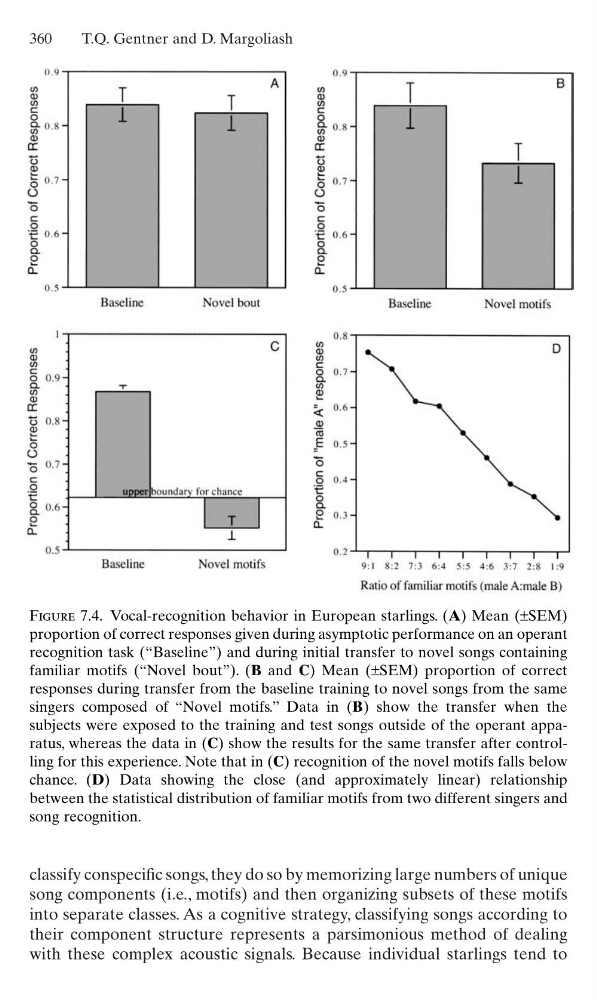
Figure 7.4. Vocal-recognition behavior in European starlings. (A) Mean (±SEM)
proportion of correct responses given during asymptotic performance on an operant
recognition task (“Baseline”) and during initial transfer to novel songs containing
familiar motifs (“Novel bout”). (B and C) Mean (±SEM) proportion of correct
responses during transfer from the baseline training to novel songs from the same
singers composed of “Novel motifs.” Data in (B) show the transfer when the
subjects were exposed to the training and test songs outside of the operant apparatus, whereas the data in (C) show the results for the same transfer after controlling for this experience. Note that in (C) recognition of the novel motifs falls below
chance. (D) Data showing the close (and approximately linear) relationship
between the statistical distribution of familiar motifs from two different singers and
song recognition.
song components (i.e., motifs) and then organizing subsets of these motifs
into separate classes. As a cognitive strategy, classifying songs according to
their component structure represents a parsimonious method of dealing
with these complex acoustic signals. Because individual starlings tend to
360
T.Q. Gentner and D. Margoliash
Figure 7.4. Vocal-recognition behavior in European starlings. (A) Mean (±SEM)
proportion of correct responses given during asymptotic performance on an operant
recognition task (“Baseline”) and during initial transfer to novel songs containing
familiar motifs (“Novel bout”). (B and C) Mean (±SEM) proportion of correct
responses during transfer from the baseline training to novel songs from the same
singers composed of “Novel motifs.” Data in (B) show the transfer when the
subjects were exposed to the training and test songs outside of the operant apparatus, whereas the data in (C) show the results for the same transfer after controlling for this experience. Note that in (C) recognition of the novel motifs falls below
chance. (D) Data showing the close (and approximately linear) relationship
between the statistical distribution of familiar motifs from two different singers and
song recognition.