

direct connection with motor output in the case of the VMP, or a shared
developmental trajectory in the case of the AFP.
In the VMP, the roles of the nuclei HVc and RA in song production have
been well-established through electrolytic lesions (Nottebohm et al. 1976),
electrophysiological recordings in singing birds (McCasland and Konishi
1981; Yu and Margoliash 1996), and perturbation experiments using
electrical-stimulation (Vu et al. 1994). Zebra finch songs are composed of
repeated motifs, which are sequences of different syllables. Each syllable
typically comprises several notes. Recordings of single neurons in singing
birds demonstrate that premotor activity, in what are probably HVc
interneurons (see below), is organized by the syllable type. That is, repetitions of the same syllables are associated with similar activity patterns,
independent of position within the song, whereas different syllables are
346
T.Q. Gentner and D. Margoliash
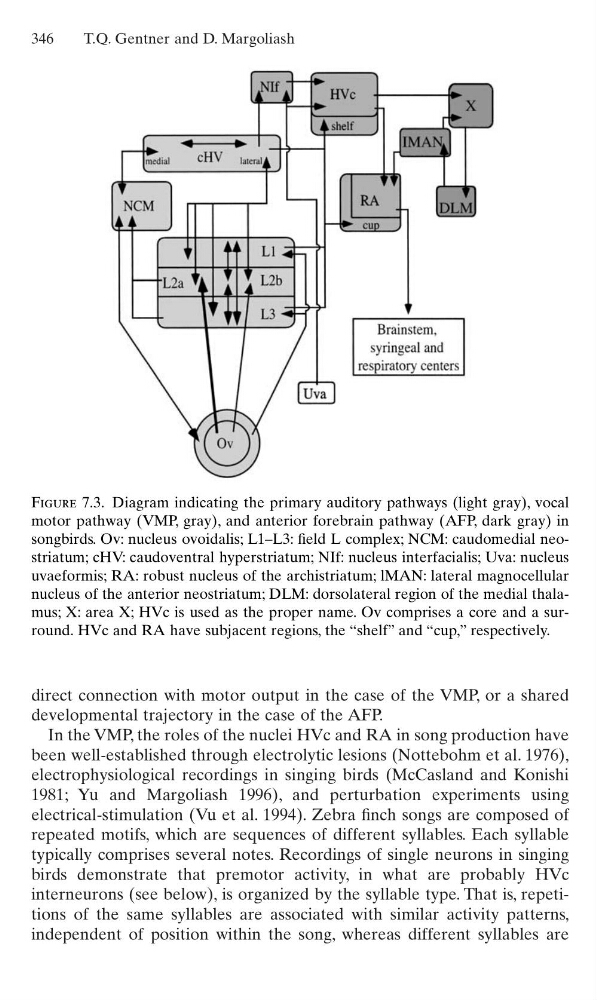
Figure 7.3. Diagram indicating the primary auditory pathways (light gray), vocal
motor pathway (VMP, gray), and anterior forebrain pathway (AFP, dark gray) in
songbirds. Ov: nucleus ovoidalis; L1–L3: field L complex; NCM: caudomedial neostriatum; cHV: caudoventral hyperstriatum; NIf: nucleus interfacialis; Uva: nucleus
uvaeformis; RA: robust nucleus of the archistriatum; lMAN: lateral magnocellular
nucleus of the anterior neostriatum; DLM: dorsolateral region of the medial thalamus; X: area X; HVc is used as the proper name. Ov comprises a core and a surround. HVc and RA have subjacent regions, the “shelf” and “cup,” respectively.
developmental trajectory in the case of the AFP.
In the VMP, the roles of the nuclei HVc and RA in song production have
been well-established through electrolytic lesions (Nottebohm et al. 1976),
electrophysiological recordings in singing birds (McCasland and Konishi
1981; Yu and Margoliash 1996), and perturbation experiments using
electrical-stimulation (Vu et al. 1994). Zebra finch songs are composed of
repeated motifs, which are sequences of different syllables. Each syllable
typically comprises several notes. Recordings of single neurons in singing
birds demonstrate that premotor activity, in what are probably HVc
interneurons (see below), is organized by the syllable type. That is, repetitions of the same syllables are associated with similar activity patterns,
independent of position within the song, whereas different syllables are
346
T.Q. Gentner and D. Margoliash
Figure 7.3. Diagram indicating the primary auditory pathways (light gray), vocal
motor pathway (VMP, gray), and anterior forebrain pathway (AFP, dark gray) in
songbirds. Ov: nucleus ovoidalis; L1–L3: field L complex; NCM: caudomedial neostriatum; cHV: caudoventral hyperstriatum; NIf: nucleus interfacialis; Uva: nucleus
uvaeformis; RA: robust nucleus of the archistriatum; lMAN: lateral magnocellular
nucleus of the anterior neostriatum; DLM: dorsolateral region of the medial thalamus; X: area X; HVc is used as the proper name. Ov comprises a core and a surround. HVc and RA have subjacent regions, the “shelf” and “cup,” respectively.