

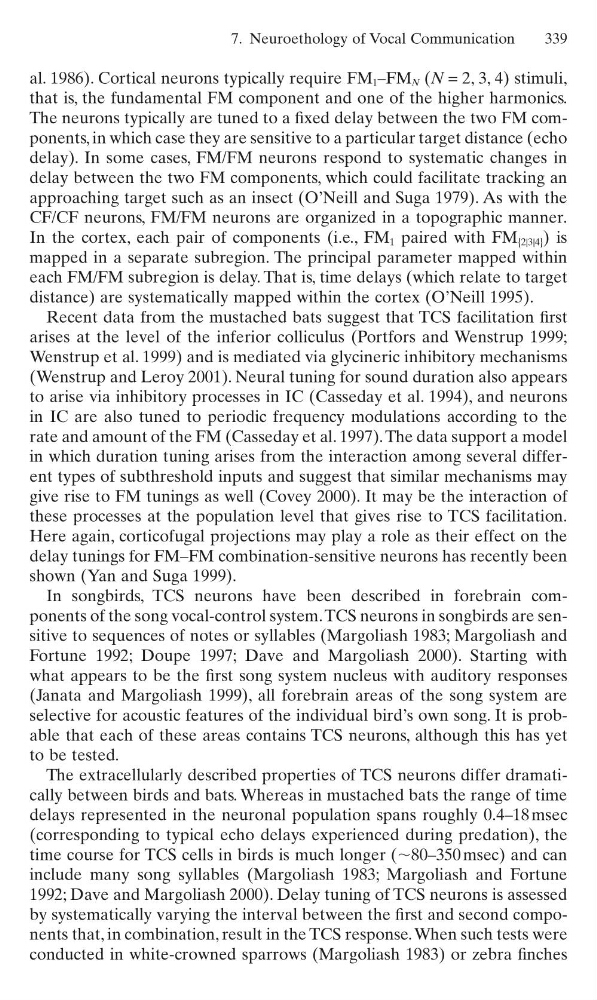
al. 1986). Cortical neurons typically require FM 1 –FM N (N = 2, 3, 4) stimuli,
that is, the fundamental FM component and one of the higher harmonics.
The neurons typically are tuned to a fixed delay between the two FM components, in which case they are sensitive to a particular target distance (echo
delay). In some cases, FM/FM neurons respond to systematic changes in
delay between the two FM components, which could facilitate tracking an
approaching target such as an insect (O’Neill and Suga 1979). As with the
CF/CF neurons, FM/FM neurons are organized in a topographic manner.
In the cortex, each pair of components (i.e., FM 1 paired with FM {2|3|4} ) is
mapped in a separate subregion. The principal parameter mapped within
each FM/FM subregion is delay. That is, time delays (which relate to target
distance) are systematically mapped within the cortex (O’Neill 1995).
Recent data from the mustached bats suggest that TCS facilitation first
arises at the level of the inferior colliculus (Portfors and Wenstrup 1999;
Wenstrup et al. 1999) and is mediated via glycineric inhibitory mechanisms
(Wenstrup and Leroy 2001). Neural tuning for sound duration also appears
to arise via inhibitory processes in IC (Casseday et al. 1994), and neurons
in IC are also tuned to periodic frequency modulations according to the
rate and amount of the FM (Casseday et al. 1997). The data support a model
in which duration tuning arises from the interaction among several different types of subthreshold inputs and suggest that similar mechanisms may
give rise to FM tunings as well (Covey 2000). It may be the interaction of
these processes at the population level that gives rise to TCS facilitation.
Here again, corticofugal projections may play a role as their effect on the
delay tunings for FM–FM combination-sensitive neurons has recently been
shown (Yan and Suga 1999).
In songbirds, TCS neurons have been described in forebrain components of the song vocal-control system.TCS neurons in songbirds are sensitive to sequences of notes or syllables (Margoliash 1983; Margoliash and
Fortune 1992; Doupe 1997; Dave and Margoliash 2000). Starting with
what appears to be the first song system nucleus with auditory responses
(Janata and Margoliash 1999), all forebrain areas of the song system are
selective for acoustic features of the individual bird’s own song. It is probable that each of these areas contains TCS neurons, although this has yet
to be tested.
The extracellularly described properties of TCS neurons differ dramatically between birds and bats. Whereas in mustached bats the range of time
delays represented in the neuronal population spans roughly 0.4–18 msec
(corresponding to typical echo delays experienced during predation), the
time course for TCS cells in birds is much longer (ϳ80–350 msec) and can
include many song syllables (Margoliash 1983; Margoliash and Fortune
1992; Dave and Margoliash 2000). Delay tuning of TCS neurons is assessed
by systematically varying the interval between the first and second components that, in combination, result in the TCS response. When such tests were
conducted in white-crowned sparrows (Margoliash 1983) or zebra finches
7. Neuroethology of Vocal Communication
339
that is, the fundamental FM component and one of the higher harmonics.
The neurons typically are tuned to a fixed delay between the two FM components, in which case they are sensitive to a particular target distance (echo
delay). In some cases, FM/FM neurons respond to systematic changes in
delay between the two FM components, which could facilitate tracking an
approaching target such as an insect (O’Neill and Suga 1979). As with the
CF/CF neurons, FM/FM neurons are organized in a topographic manner.
In the cortex, each pair of components (i.e., FM 1 paired with FM {2|3|4} ) is
mapped in a separate subregion. The principal parameter mapped within
each FM/FM subregion is delay. That is, time delays (which relate to target
distance) are systematically mapped within the cortex (O’Neill 1995).
Recent data from the mustached bats suggest that TCS facilitation first
arises at the level of the inferior colliculus (Portfors and Wenstrup 1999;
Wenstrup et al. 1999) and is mediated via glycineric inhibitory mechanisms
(Wenstrup and Leroy 2001). Neural tuning for sound duration also appears
to arise via inhibitory processes in IC (Casseday et al. 1994), and neurons
in IC are also tuned to periodic frequency modulations according to the
rate and amount of the FM (Casseday et al. 1997). The data support a model
in which duration tuning arises from the interaction among several different types of subthreshold inputs and suggest that similar mechanisms may
give rise to FM tunings as well (Covey 2000). It may be the interaction of
these processes at the population level that gives rise to TCS facilitation.
Here again, corticofugal projections may play a role as their effect on the
delay tunings for FM–FM combination-sensitive neurons has recently been
shown (Yan and Suga 1999).
In songbirds, TCS neurons have been described in forebrain components of the song vocal-control system.TCS neurons in songbirds are sensitive to sequences of notes or syllables (Margoliash 1983; Margoliash and
Fortune 1992; Doupe 1997; Dave and Margoliash 2000). Starting with
what appears to be the first song system nucleus with auditory responses
(Janata and Margoliash 1999), all forebrain areas of the song system are
selective for acoustic features of the individual bird’s own song. It is probable that each of these areas contains TCS neurons, although this has yet
to be tested.
The extracellularly described properties of TCS neurons differ dramatically between birds and bats. Whereas in mustached bats the range of time
delays represented in the neuronal population spans roughly 0.4–18 msec
(corresponding to typical echo delays experienced during predation), the
time course for TCS cells in birds is much longer (ϳ80–350 msec) and can
include many song syllables (Margoliash 1983; Margoliash and Fortune
1992; Dave and Margoliash 2000). Delay tuning of TCS neurons is assessed
by systematically varying the interval between the first and second components that, in combination, result in the TCS response. When such tests were
conducted in white-crowned sparrows (Margoliash 1983) or zebra finches
7. Neuroethology of Vocal Communication
339