

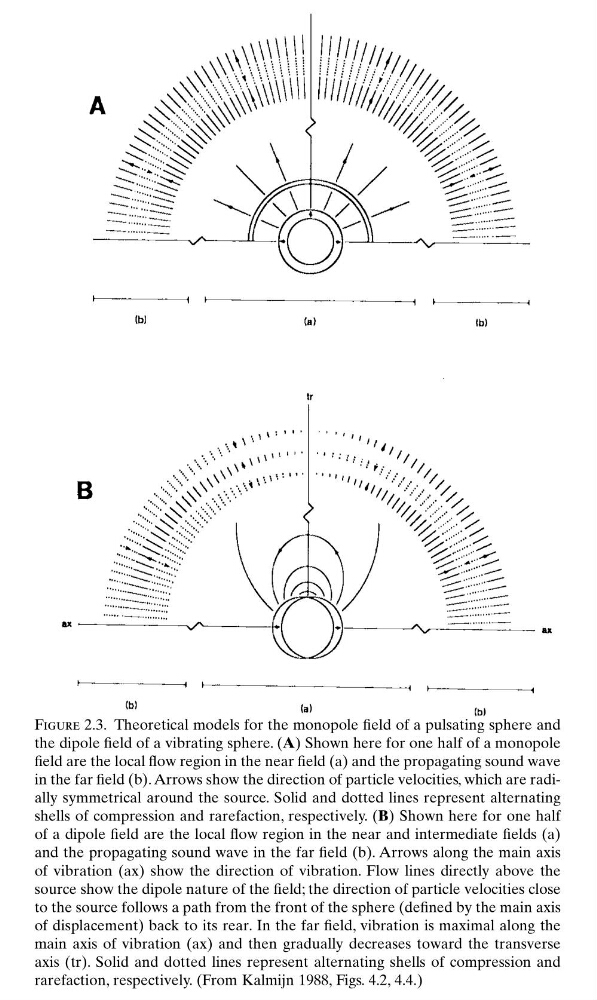
Figure 2.3. Theoretical models for the monopole field of a pulsating sphere and
the dipole field of a vibrating sphere. (A) Shown here for one half of a monopole
field are the local flow region in the near field (a) and the propagating sound wave
in the far field (b). Arrows show the direction of particle velocities, which are radially symmetrical around the source. Solid and dotted lines represent alternating
shells of compression and rarefaction, respectively. (B) Shown here for one half
of a dipole field are the local flow region in the near and intermediate fields (a)
and the propagating sound wave in the far field (b). Arrows along the main axis
of vibration (ax) show the direction of vibration. Flow lines directly above the
source show the dipole nature of the field; the direction of particle velocities close
to the source follows a path from the front of the sphere (defined by the main axis
of displacement) back to its rear. In the far field, vibration is maximal along the
main axis of vibration (ax) and then gradually decreases toward the transverse
axis (tr). Solid and dotted lines represent alternating shells of compression and
rarefaction, respectively. (From Kalmijn 1988, Figs. 4.2, 4.4.)
the dipole field of a vibrating sphere. (A) Shown here for one half of a monopole
field are the local flow region in the near field (a) and the propagating sound wave
in the far field (b). Arrows show the direction of particle velocities, which are radially symmetrical around the source. Solid and dotted lines represent alternating
shells of compression and rarefaction, respectively. (B) Shown here for one half
of a dipole field are the local flow region in the near and intermediate fields (a)
and the propagating sound wave in the far field (b). Arrows along the main axis
of vibration (ax) show the direction of vibration. Flow lines directly above the
source show the dipole nature of the field; the direction of particle velocities close
to the source follows a path from the front of the sphere (defined by the main axis
of displacement) back to its rear. In the far field, vibration is maximal along the
main axis of vibration (ax) and then gradually decreases toward the transverse
axis (tr). Solid and dotted lines represent alternating shells of compression and
rarefaction, respectively. (From Kalmijn 1988, Figs. 4.2, 4.4.)