

from the sender to the receiver and then back to the sender again, where
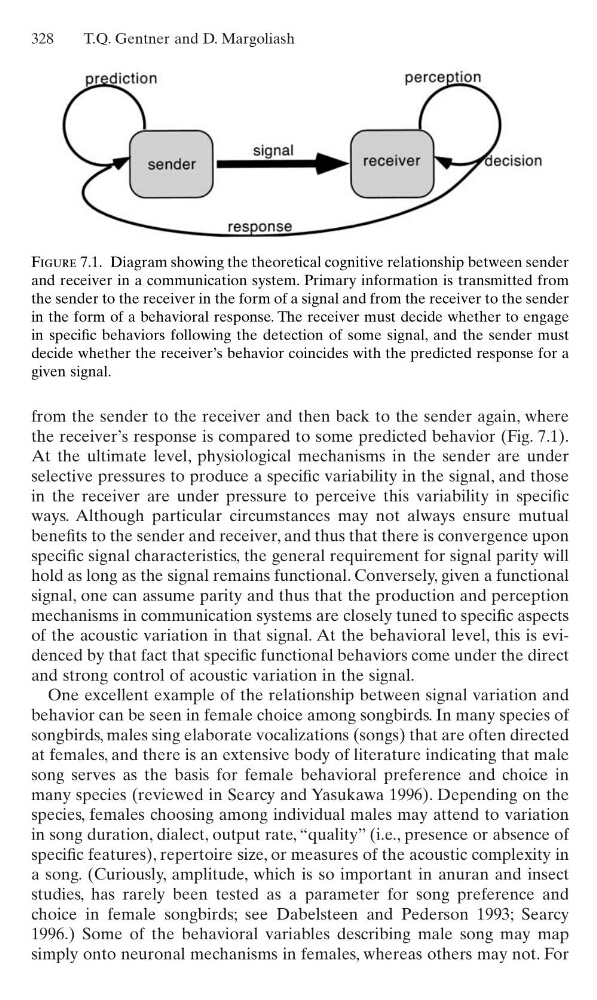
the receiver’s response is compared to some predicted behavior (Fig. 7.1).
At the ultimate level, physiological mechanisms in the sender are under
selective pressures to produce a specific variability in the signal, and those
in the receiver are under pressure to perceive this variability in specific
ways. Although particular circumstances may not always ensure mutual
benefits to the sender and receiver, and thus that there is convergence upon
specific signal characteristics, the general requirement for signal parity will
hold as long as the signal remains functional. Conversely, given a functional
signal, one can assume parity and thus that the production and perception
mechanisms in communication systems are closely tuned to specific aspects
of the acoustic variation in that signal. At the behavioral level, this is evidenced by that fact that specific functional behaviors come under the direct
and strong control of acoustic variation in the signal.
One excellent example of the relationship between signal variation and
behavior can be seen in female choice among songbirds. In many species of
songbirds, males sing elaborate vocalizations (songs) that are often directed
at females, and there is an extensive body of literature indicating that male
song serves as the basis for female behavioral preference and choice in
many species (reviewed in Searcy and Yasukawa 1996). Depending on the
species, females choosing among individual males may attend to variation
in song duration, dialect, output rate, “quality” (i.e., presence or absence of
specific features), repertoire size, or measures of the acoustic complexity in
a song. (Curiously, amplitude, which is so important in anuran and insect
studies, has rarely been tested as a parameter for song preference and
choice in female songbirds; see Dabelsteen and Pederson 1993; Searcy
1996.) Some of the behavioral variables describing male song may map
simply onto neuronal mechanisms in females, whereas others may not. For
328
T.Q. Gentner and D. Margoliash
Figure 7.1. Diagram showing the theoretical cognitive relationship between sender
and receiver in a communication system. Primary information is transmitted from
the sender to the receiver in the form of a signal and from the receiver to the sender
in the form of a behavioral response. The receiver must decide whether to engage
in specific behaviors following the detection of some signal, and the sender must
decide whether the receiver’s behavior coincides with the predicted response for a
given signal.
the receiver’s response is compared to some predicted behavior (Fig. 7.1).
At the ultimate level, physiological mechanisms in the sender are under
selective pressures to produce a specific variability in the signal, and those
in the receiver are under pressure to perceive this variability in specific
ways. Although particular circumstances may not always ensure mutual
benefits to the sender and receiver, and thus that there is convergence upon
specific signal characteristics, the general requirement for signal parity will
hold as long as the signal remains functional. Conversely, given a functional
signal, one can assume parity and thus that the production and perception
mechanisms in communication systems are closely tuned to specific aspects
of the acoustic variation in that signal. At the behavioral level, this is evidenced by that fact that specific functional behaviors come under the direct
and strong control of acoustic variation in the signal.
One excellent example of the relationship between signal variation and
behavior can be seen in female choice among songbirds. In many species of
songbirds, males sing elaborate vocalizations (songs) that are often directed
at females, and there is an extensive body of literature indicating that male
song serves as the basis for female behavioral preference and choice in
many species (reviewed in Searcy and Yasukawa 1996). Depending on the
species, females choosing among individual males may attend to variation
in song duration, dialect, output rate, “quality” (i.e., presence or absence of
specific features), repertoire size, or measures of the acoustic complexity in
a song. (Curiously, amplitude, which is so important in anuran and insect
studies, has rarely been tested as a parameter for song preference and
choice in female songbirds; see Dabelsteen and Pederson 1993; Searcy
1996.) Some of the behavioral variables describing male song may map
simply onto neuronal mechanisms in females, whereas others may not. For
328
T.Q. Gentner and D. Margoliash
Figure 7.1. Diagram showing the theoretical cognitive relationship between sender
and receiver in a communication system. Primary information is transmitted from
the sender to the receiver in the form of a signal and from the receiver to the sender
in the form of a behavioral response. The receiver must decide whether to engage
in specific behaviors following the detection of some signal, and the sender must
decide whether the receiver’s behavior coincides with the predicted response for a
given signal.