

finding suggests that PG may act centrally to selectively suppress the activation of the vocal pathway for advertisement calling, although it is not
clear whether the effects of PG are physiological or pharmacological (i.e.,
whether endogenous, not exogenous, levels of PG inhibit calling in vivo).
In some frogs, females also vocalize during courtship. Examples include
midwife toads of the genus Alytes (Marquez and Verrell 1991), Rana blythi
(Emerson 1992), and the carpenter frog, Rana virgatipes (Given 1993). A
particularly dramatic example of female advertisement is rapping in
Xenopus laevis (Tobias et al. 1998). When about to oviposit, females give a
rapid series of clicks that act as an acoustic aphrodisiac for males, provoking heightened vocal activity, phonotaxis, and clasping. Oviposition is stimulated by gonadotropin, which also raises circulating estrogen levels, but
estrogen itself is not sufficient to induce females to rap (Wu et al. 2001).
Endocrine or neural activity associated with the transit of eggs through the
oviduct is a candidate for stimulation of rapping.
Where do androgens act to activate advertisement calling in males?
Studies in a variety of anurans have revealed intracellular receptors for
androgen in the vocal organ, the larynx, or (in terrestrial frogs) in muscles
associated with expiration (Segil et al. 1987; Kelley et al. 1989; Fischer et al.
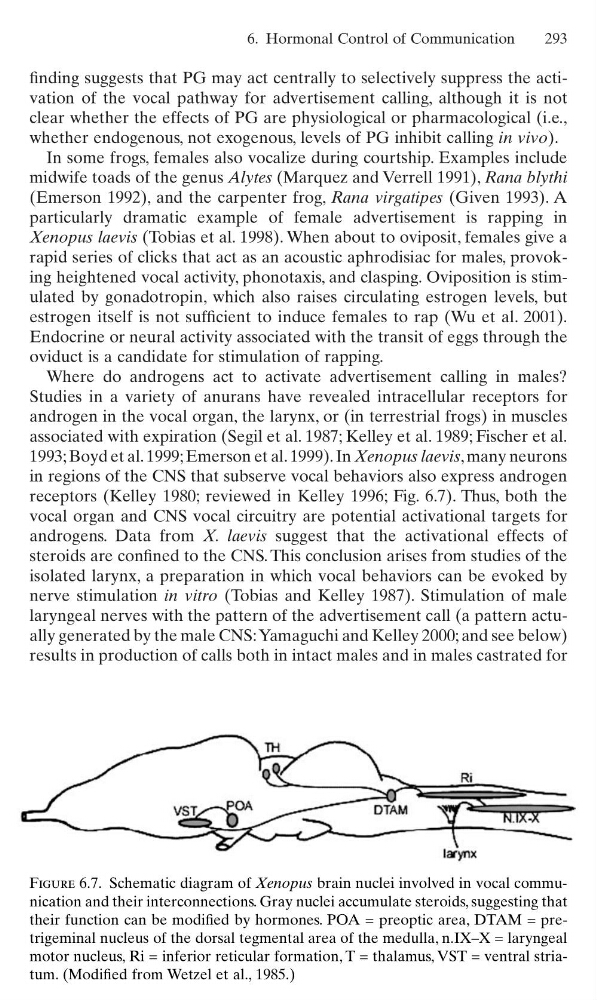
1993; Boyd et al. 1999; Emerson et al. 1999). In Xenopus laevis, many neurons
in regions of the CNS that subserve vocal behaviors also express androgen
receptors (Kelley 1980; reviewed in Kelley 1996; Fig. 6.7). Thus, both the
vocal organ and CNS vocal circuitry are potential activational targets for
androgens. Data from X. laevis suggest that the activational effects of
steroids are confined to the CNS. This conclusion arises from studies of the
isolated larynx, a preparation in which vocal behaviors can be evoked by
nerve stimulation in vitro (Tobias and Kelley 1987). Stimulation of male
laryngeal nerves with the pattern of the advertisement call (a pattern actually generated by the male CNS:Yamaguchi and Kelley 2000; and see below)
results in production of calls both in intact males and in males castrated for
6. Hormonal Control of Communication
293
Figure 6.7. Schematic diagram of Xenopus brain nuclei involved in vocal communication and their interconnections. Gray nuclei accumulate steroids, suggesting that
their function can be modified by hormones. POA = preoptic area, DTAM = pretrigeminal nucleus of the dorsal tegmental area of the medulla, n.IX–X = laryngeal
motor nucleus, Ri = inferior reticular formation, T = thalamus, VST = ventral striatum. (Modified from Wetzel et al., 1985.)
clear whether the effects of PG are physiological or pharmacological (i.e.,
whether endogenous, not exogenous, levels of PG inhibit calling in vivo).
In some frogs, females also vocalize during courtship. Examples include
midwife toads of the genus Alytes (Marquez and Verrell 1991), Rana blythi
(Emerson 1992), and the carpenter frog, Rana virgatipes (Given 1993). A
particularly dramatic example of female advertisement is rapping in
Xenopus laevis (Tobias et al. 1998). When about to oviposit, females give a
rapid series of clicks that act as an acoustic aphrodisiac for males, provoking heightened vocal activity, phonotaxis, and clasping. Oviposition is stimulated by gonadotropin, which also raises circulating estrogen levels, but
estrogen itself is not sufficient to induce females to rap (Wu et al. 2001).
Endocrine or neural activity associated with the transit of eggs through the
oviduct is a candidate for stimulation of rapping.
Where do androgens act to activate advertisement calling in males?
Studies in a variety of anurans have revealed intracellular receptors for
androgen in the vocal organ, the larynx, or (in terrestrial frogs) in muscles
associated with expiration (Segil et al. 1987; Kelley et al. 1989; Fischer et al.
1993; Boyd et al. 1999; Emerson et al. 1999). In Xenopus laevis, many neurons
in regions of the CNS that subserve vocal behaviors also express androgen
receptors (Kelley 1980; reviewed in Kelley 1996; Fig. 6.7). Thus, both the
vocal organ and CNS vocal circuitry are potential activational targets for
androgens. Data from X. laevis suggest that the activational effects of
steroids are confined to the CNS. This conclusion arises from studies of the
isolated larynx, a preparation in which vocal behaviors can be evoked by
nerve stimulation in vitro (Tobias and Kelley 1987). Stimulation of male
laryngeal nerves with the pattern of the advertisement call (a pattern actually generated by the male CNS:Yamaguchi and Kelley 2000; and see below)
results in production of calls both in intact males and in males castrated for
6. Hormonal Control of Communication
293
Figure 6.7. Schematic diagram of Xenopus brain nuclei involved in vocal communication and their interconnections. Gray nuclei accumulate steroids, suggesting that
their function can be modified by hormones. POA = preoptic area, DTAM = pretrigeminal nucleus of the dorsal tegmental area of the medulla, n.IX–X = laryngeal
motor nucleus, Ri = inferior reticular formation, T = thalamus, VST = ventral striatum. (Modified from Wetzel et al., 1985.)