

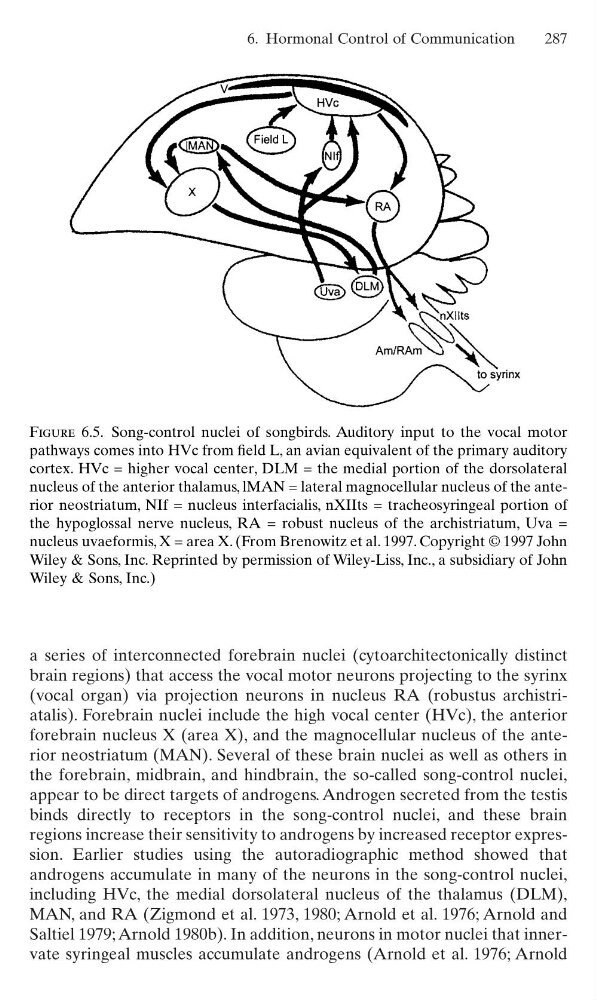
a series of interconnected forebrain nuclei (cytoarchitectonically distinct
brain regions) that access the vocal motor neurons projecting to the syrinx
(vocal organ) via projection neurons in nucleus RA (robustus archistriatalis). Forebrain nuclei include the high vocal center (HVc), the anterior
forebrain nucleus X (area X), and the magnocellular nucleus of the anterior neostriatum (MAN). Several of these brain nuclei as well as others in
the forebrain, midbrain, and hindbrain, the so-called song-control nuclei,
appear to be direct targets of androgens. Androgen secreted from the testis
binds directly to receptors in the song-control nuclei, and these brain
regions increase their sensitivity to androgens by increased receptor expression. Earlier studies using the autoradiographic method showed that
androgens accumulate in many of the neurons in the song-control nuclei,
including HVc, the medial dorsolateral nucleus of the thalamus (DLM),
MAN, and RA (Zigmond et al. 1973, 1980; Arnold et al. 1976; Arnold and
Saltiel 1979; Arnold 1980b). In addition, neurons in motor nuclei that innervate syringeal muscles accumulate androgens (Arnold et al. 1976; Arnold
6. Hormonal Control of Communication
287
Figure 6.5. Song-control nuclei of songbirds. Auditory input to the vocal motor
pathways comes into HVc from field L, an avian equivalent of the primary auditory
cortex. HVc = higher vocal center, DLM = the medial portion of the dorsolateral
nucleus of the anterior thalamus, lMAN = lateral magnocellular nucleus of the anterior neostriatum, NIf = nucleus interfacialis, nXIIts = tracheosyringeal portion of
the hypoglossal nerve nucleus, RA = robust nucleus of the archistriatum, Uva =
nucleus uvaeformis, X = area X. (From Brenowitz et al. 1997. Copyright © 1997 John
Wiley & Sons, Inc. Reprinted by permission of Wiley-Liss, Inc., a subsidiary of John
Wiley & Sons, Inc.)
brain regions) that access the vocal motor neurons projecting to the syrinx
(vocal organ) via projection neurons in nucleus RA (robustus archistriatalis). Forebrain nuclei include the high vocal center (HVc), the anterior
forebrain nucleus X (area X), and the magnocellular nucleus of the anterior neostriatum (MAN). Several of these brain nuclei as well as others in
the forebrain, midbrain, and hindbrain, the so-called song-control nuclei,
appear to be direct targets of androgens. Androgen secreted from the testis
binds directly to receptors in the song-control nuclei, and these brain
regions increase their sensitivity to androgens by increased receptor expression. Earlier studies using the autoradiographic method showed that
androgens accumulate in many of the neurons in the song-control nuclei,
including HVc, the medial dorsolateral nucleus of the thalamus (DLM),
MAN, and RA (Zigmond et al. 1973, 1980; Arnold et al. 1976; Arnold and
Saltiel 1979; Arnold 1980b). In addition, neurons in motor nuclei that innervate syringeal muscles accumulate androgens (Arnold et al. 1976; Arnold
6. Hormonal Control of Communication
287
Figure 6.5. Song-control nuclei of songbirds. Auditory input to the vocal motor
pathways comes into HVc from field L, an avian equivalent of the primary auditory
cortex. HVc = higher vocal center, DLM = the medial portion of the dorsolateral
nucleus of the anterior thalamus, lMAN = lateral magnocellular nucleus of the anterior neostriatum, NIf = nucleus interfacialis, nXIIts = tracheosyringeal portion of
the hypoglossal nerve nucleus, RA = robust nucleus of the archistriatum, Uva =
nucleus uvaeformis, X = area X. (From Brenowitz et al. 1997. Copyright © 1997 John
Wiley & Sons, Inc. Reprinted by permission of Wiley-Liss, Inc., a subsidiary of John
Wiley & Sons, Inc.)