

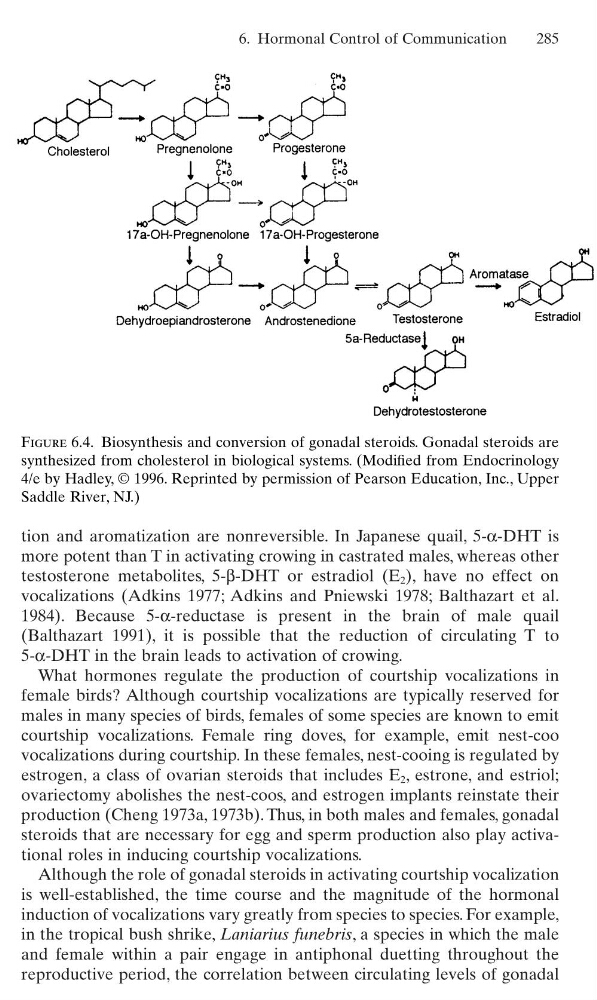
tion and aromatization are nonreversible. In Japanese quail, 5-a-DHT is
more potent than T in activating crowing in castrated males, whereas other
testosterone metabolites, 5-b-DHT or estradiol (E 2 ), have no effect on
vocalizations (Adkins 1977; Adkins and Pniewski 1978; Balthazart et al.
1984). Because 5-a-reductase is present in the brain of male quail
(Balthazart 1991), it is possible that the reduction of circulating T to
5-a-DHT in the brain leads to activation of crowing.
What hormones regulate the production of courtship vocalizations in
female birds? Although courtship vocalizations are typically reserved for
males in many species of birds, females of some species are known to emit
courtship vocalizations. Female ring doves, for example, emit nest-coo
vocalizations during courtship. In these females, nest-cooing is regulated by
estrogen, a class of ovarian steroids that includes E 2 , estrone, and estriol;
ovariectomy abolishes the nest-coos, and estrogen implants reinstate their
production (Cheng 1973a, 1973b). Thus, in both males and females, gonadal
steroids that are necessary for egg and sperm production also play activational roles in inducing courtship vocalizations.
Although the role of gonadal steroids in activating courtship vocalization
is well-established, the time course and the magnitude of the hormonal
induction of vocalizations vary greatly from species to species. For example,
in the tropical bush shrike, Laniarius funebris, a species in which the male
and female within a pair engage in antiphonal duetting throughout the
reproductive period, the correlation between circulating levels of gonadal
6. Hormonal Control of Communication
285
Figure 6.4. Biosynthesis and conversion of gonadal steroids. Gonadal steroids are
synthesized from cholesterol in biological systems. (Modified from Endocrinology
4/e by Hadley, © 1996. Reprinted by permission of Pearson Education, Inc., Upper
Saddle River, NJ.)
more potent than T in activating crowing in castrated males, whereas other
testosterone metabolites, 5-b-DHT or estradiol (E 2 ), have no effect on
vocalizations (Adkins 1977; Adkins and Pniewski 1978; Balthazart et al.
1984). Because 5-a-reductase is present in the brain of male quail
(Balthazart 1991), it is possible that the reduction of circulating T to
5-a-DHT in the brain leads to activation of crowing.
What hormones regulate the production of courtship vocalizations in
female birds? Although courtship vocalizations are typically reserved for
males in many species of birds, females of some species are known to emit
courtship vocalizations. Female ring doves, for example, emit nest-coo
vocalizations during courtship. In these females, nest-cooing is regulated by
estrogen, a class of ovarian steroids that includes E 2 , estrone, and estriol;
ovariectomy abolishes the nest-coos, and estrogen implants reinstate their
production (Cheng 1973a, 1973b). Thus, in both males and females, gonadal
steroids that are necessary for egg and sperm production also play activational roles in inducing courtship vocalizations.
Although the role of gonadal steroids in activating courtship vocalization
is well-established, the time course and the magnitude of the hormonal
induction of vocalizations vary greatly from species to species. For example,
in the tropical bush shrike, Laniarius funebris, a species in which the male
and female within a pair engage in antiphonal duetting throughout the
reproductive period, the correlation between circulating levels of gonadal
6. Hormonal Control of Communication
285
Figure 6.4. Biosynthesis and conversion of gonadal steroids. Gonadal steroids are
synthesized from cholesterol in biological systems. (Modified from Endocrinology
4/e by Hadley, © 1996. Reprinted by permission of Pearson Education, Inc., Upper
Saddle River, NJ.)