

6. Hormonal Control of Communication
281
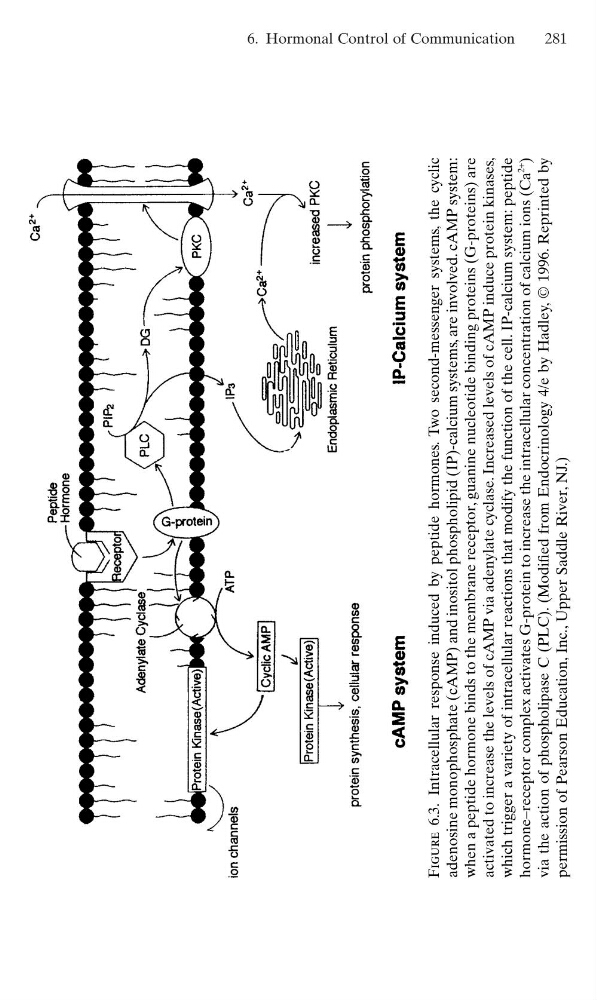
Figure 6.3. Intracellular response induced by peptide hormones. Two second-messenger systems, the cyclic
adenosine monophosphate (cAMP) and inositol phospholipid (IP)-calcium systems, are involved. cAMP system:
when a peptide hormone binds to the membrane receptor, guanine nucleotide binding proteins (G-proteins) are
activated to increase the levels of cAMP via adenylate cyclase. Increased levels of cAMP induce protein kinases,
which trigger a variety of intracellular reactions that modify the function of the cell. IP-calcium system: peptide
hormone–receptor complex activates G-protein to increase the intracellular concentration of calcium ions (Ca
2+
)
via the action of phospholipase C (PLC). (Modified from Endocrinology 4/e by Hadley, © 1996. Reprinted by
permission of Pearson Education, Inc., Upper Saddle River, NJ.)
281
Figure 6.3. Intracellular response induced by peptide hormones. Two second-messenger systems, the cyclic
adenosine monophosphate (cAMP) and inositol phospholipid (IP)-calcium systems, are involved. cAMP system:
when a peptide hormone binds to the membrane receptor, guanine nucleotide binding proteins (G-proteins) are
activated to increase the levels of cAMP via adenylate cyclase. Increased levels of cAMP induce protein kinases,
which trigger a variety of intracellular reactions that modify the function of the cell. IP-calcium system: peptide
hormone–receptor complex activates G-protein to increase the intracellular concentration of calcium ions (Ca
2+
)
via the action of phospholipase C (PLC). (Modified from Endocrinology 4/e by Hadley, © 1996. Reprinted by
permission of Pearson Education, Inc., Upper Saddle River, NJ.)