

evolutionary biologists, and neuroethologists. As such, there is a wealth of
information on their function, underlying morphological and physiological
control, and how they might be influenced by selection. Most generalizations, however, are pieced together from data gathered in different systems.
There are no model systems for which all of the issues we review here have
been addressed. The advantage to such an approach is that we have a very
good understanding of some of the diversity of long-distance communication systems. The disadvantage is that it is more difficult to appreciate how
5. Selection on Signals
265
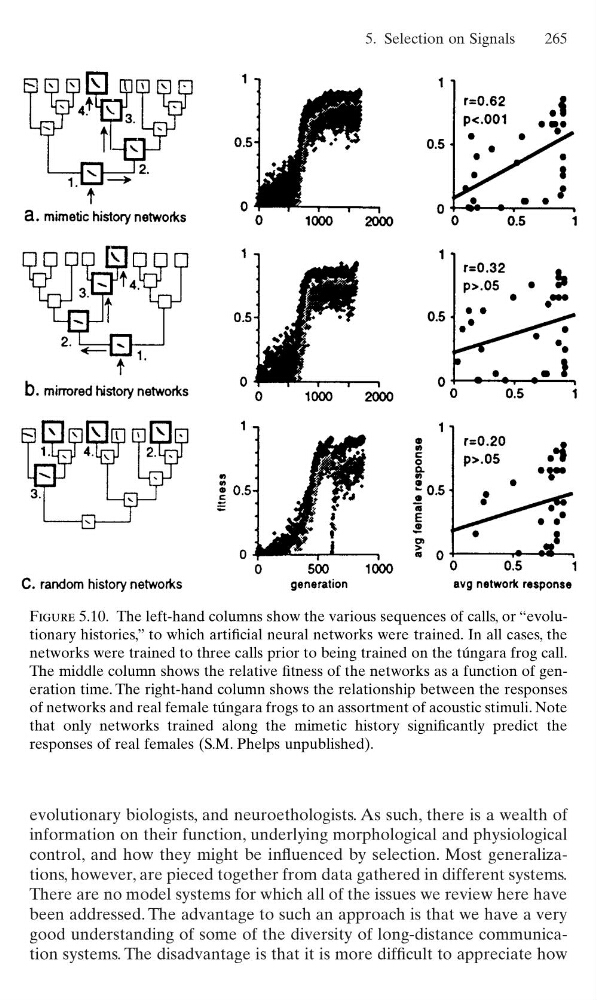
Figure 5.10. The left-hand columns show the various sequences of calls, or “evolutionary histories,” to which artificial neural networks were trained. In all cases, the
networks were trained to three calls prior to being trained on the túngara frog call.
The middle column shows the relative fitness of the networks as a function of generation time. The right-hand column shows the relationship between the responses
of networks and real female túngara frogs to an assortment of acoustic stimuli. Note
that only networks trained along the mimetic history significantly predict the
responses of real females (S.M. Phelps unpublished).
information on their function, underlying morphological and physiological
control, and how they might be influenced by selection. Most generalizations, however, are pieced together from data gathered in different systems.
There are no model systems for which all of the issues we review here have
been addressed. The advantage to such an approach is that we have a very
good understanding of some of the diversity of long-distance communication systems. The disadvantage is that it is more difficult to appreciate how
5. Selection on Signals
265
Figure 5.10. The left-hand columns show the various sequences of calls, or “evolutionary histories,” to which artificial neural networks were trained. In all cases, the
networks were trained to three calls prior to being trained on the túngara frog call.
The middle column shows the relative fitness of the networks as a function of generation time. The right-hand column shows the relationship between the responses
of networks and real female túngara frogs to an assortment of acoustic stimuli. Note
that only networks trained along the mimetic history significantly predict the
responses of real females (S.M. Phelps unpublished).