

by male túngara frogs. This hypothesis would be favored over the less
parsimonious one that the chuck was lost in the western group or that the
preference for chucks evolved twice independently. When a chuck from a
túngara frog call was digitally added to the whine call of P. coloradorum, a
species in the western clade of the Physalaemus pustulosus group, females
preferred calls with chucks to the normal species call, which lacks chucks
(Ryan and Rand 1993). The fact that P. pustulosus and P. coloradorum both
prefer calls with chucks suggests that this preference is shared through a
common ancestor as opposed to the hypothesis that P. coloradorum females
happened to evolve the same preference for traits not existing in their own
males. Because the common ancestor of P. coloradorum and P. pustulosus
existed before the Middle American–Amazonian and western–Andes
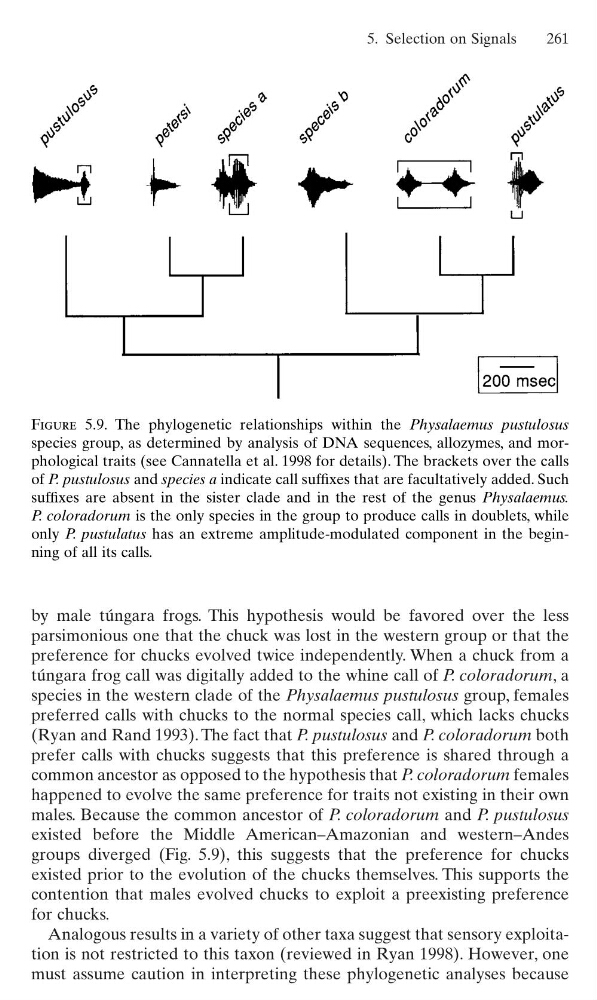
groups diverged (Fig. 5.9), this suggests that the preference for chucks
existed prior to the evolution of the chucks themselves. This supports the
contention that males evolved chucks to exploit a preexisting preference
for chucks.
Analogous results in a variety of other taxa suggest that sensory exploitation is not restricted to this taxon (reviewed in Ryan 1998). However, one
must assume caution in interpreting these phylogenetic analyses because
5. Selection on Signals
261
Figure 5.9. The phylogenetic relationships within the Physalaemus pustulosus
species group, as determined by analysis of DNA sequences, allozymes, and morphological traits (see Cannatella et al. 1998 for details). The brackets over the calls
of P. pustulosus and species a indicate call suffixes that are facultatively added. Such
suffixes are absent in the sister clade and in the rest of the genus Physalaemus.
P. coloradorum is the only species in the group to produce calls in doublets, while
only P. pustulatus has an extreme amplitude-modulated component in the beginning of all its calls.
parsimonious one that the chuck was lost in the western group or that the
preference for chucks evolved twice independently. When a chuck from a
túngara frog call was digitally added to the whine call of P. coloradorum, a
species in the western clade of the Physalaemus pustulosus group, females
preferred calls with chucks to the normal species call, which lacks chucks
(Ryan and Rand 1993). The fact that P. pustulosus and P. coloradorum both
prefer calls with chucks suggests that this preference is shared through a
common ancestor as opposed to the hypothesis that P. coloradorum females
happened to evolve the same preference for traits not existing in their own
males. Because the common ancestor of P. coloradorum and P. pustulosus
existed before the Middle American–Amazonian and western–Andes
groups diverged (Fig. 5.9), this suggests that the preference for chucks
existed prior to the evolution of the chucks themselves. This supports the
contention that males evolved chucks to exploit a preexisting preference
for chucks.
Analogous results in a variety of other taxa suggest that sensory exploitation is not restricted to this taxon (reviewed in Ryan 1998). However, one
must assume caution in interpreting these phylogenetic analyses because
5. Selection on Signals
261
Figure 5.9. The phylogenetic relationships within the Physalaemus pustulosus
species group, as determined by analysis of DNA sequences, allozymes, and morphological traits (see Cannatella et al. 1998 for details). The brackets over the calls
of P. pustulosus and species a indicate call suffixes that are facultatively added. Such
suffixes are absent in the sister clade and in the rest of the genus Physalaemus.
P. coloradorum is the only species in the group to produce calls in doublets, while
only P. pustulatus has an extreme amplitude-modulated component in the beginning of all its calls.