

another and decrease bat predation risk relative to nonoverlapping calls
(Tuttle and Ryan 1982). These frogs also modulate the number of syllables
in the call in response to predation risk; they produce calls with more syllables under conditions of higher ambient light in which they can see an
approaching bat (Tuttle and Ryan 1982). As do crickets and S. sila frogs,
female túngara frogs assess risk when responding to male calls; they are
more likely to approach attractive calls perceived as being farther away
over less attractive calls perceived as being produced closer when ambient
light levels are lower (Rand et al. 1997).
There was a surprising aspect of the finding that bats eavesdrop on frog
calls. Bats are well-known for their reliance on the returning echo of ultrasonic (50–100 kHz in Trachops) signals for target localization (Barclay et al.
1981). Frog calls, on the other hand, are relatively low-frequency signals,
with most of the spectral energy usually below 5 kHz (Ryan et al. 1983).
Trachops, however, shows enhanced behavioral sensitivity (movement of
the pinnae toward a sound source) to pure tones as they decrease from
15 kHz to 5 kHz; thus, they have heightened behavioral sensitivity to the frequencies that characterize frog calls relative to higher sonic (<15 kHz) frequencies (Ryan et al. 1983). Furthermore, these bats show what appears to
5. Selection on Signals
241
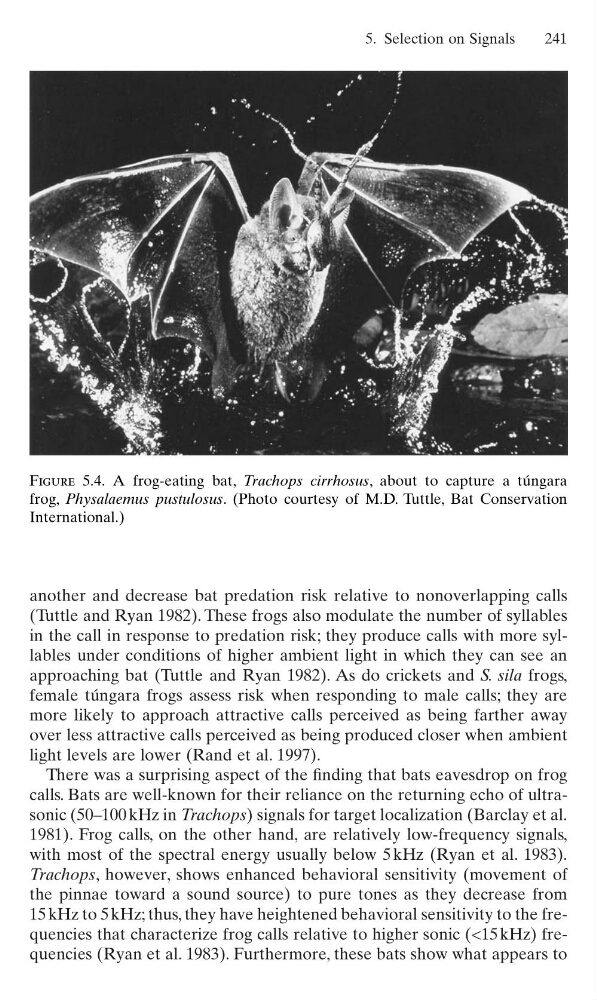
Figure 5.4. A frog-eating bat, Trachops cirrhosus, about to capture a túngara
frog, Physalaemus pustulosus. (Photo courtesy of M.D. Tuttle, Bat Conservation
International.)
(Tuttle and Ryan 1982). These frogs also modulate the number of syllables
in the call in response to predation risk; they produce calls with more syllables under conditions of higher ambient light in which they can see an
approaching bat (Tuttle and Ryan 1982). As do crickets and S. sila frogs,
female túngara frogs assess risk when responding to male calls; they are
more likely to approach attractive calls perceived as being farther away
over less attractive calls perceived as being produced closer when ambient
light levels are lower (Rand et al. 1997).
There was a surprising aspect of the finding that bats eavesdrop on frog
calls. Bats are well-known for their reliance on the returning echo of ultrasonic (50–100 kHz in Trachops) signals for target localization (Barclay et al.
1981). Frog calls, on the other hand, are relatively low-frequency signals,
with most of the spectral energy usually below 5 kHz (Ryan et al. 1983).
Trachops, however, shows enhanced behavioral sensitivity (movement of
the pinnae toward a sound source) to pure tones as they decrease from
15 kHz to 5 kHz; thus, they have heightened behavioral sensitivity to the frequencies that characterize frog calls relative to higher sonic (<15 kHz) frequencies (Ryan et al. 1983). Furthermore, these bats show what appears to
5. Selection on Signals
241
Figure 5.4. A frog-eating bat, Trachops cirrhosus, about to capture a túngara
frog, Physalaemus pustulosus. (Photo courtesy of M.D. Tuttle, Bat Conservation
International.)