

phylogenetic constraints. Confounding variables are thus less problematic
for studies of closely related species than for the community-level analyses
described above.
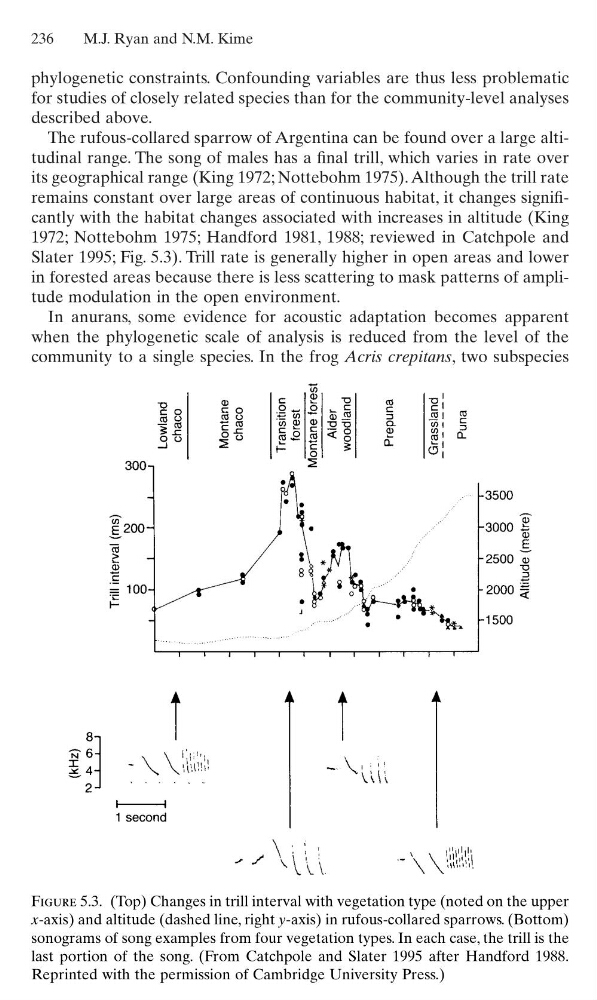
The rufous-collared sparrow of Argentina can be found over a large altitudinal range. The song of males has a final trill, which varies in rate over
its geographical range (King 1972; Nottebohm 1975). Although the trill rate
remains constant over large areas of continuous habitat, it changes significantly with the habitat changes associated with increases in altitude (King
1972; Nottebohm 1975; Handford 1981, 1988; reviewed in Catchpole and
Slater 1995; Fig. 5.3). Trill rate is generally higher in open areas and lower
in forested areas because there is less scattering to mask patterns of amplitude modulation in the open environment.
In anurans, some evidence for acoustic adaptation becomes apparent
when the phylogenetic scale of analysis is reduced from the level of the
community to a single species. In the frog Acris crepitans, two subspecies
236
M.J. Ryan and N.M. Kime
Figure 5.3. (Top) Changes in trill interval with vegetation type (noted on the upper
x-axis) and altitude (dashed line, right y-axis) in rufous-collared sparrows. (Bottom)
sonograms of song examples from four vegetation types. In each case, the trill is the
last portion of the song. (From Catchpole and Slater 1995 after Handford 1988.
Reprinted with the permission of Cambridge University Press.)
for studies of closely related species than for the community-level analyses
described above.
The rufous-collared sparrow of Argentina can be found over a large altitudinal range. The song of males has a final trill, which varies in rate over
its geographical range (King 1972; Nottebohm 1975). Although the trill rate
remains constant over large areas of continuous habitat, it changes significantly with the habitat changes associated with increases in altitude (King
1972; Nottebohm 1975; Handford 1981, 1988; reviewed in Catchpole and
Slater 1995; Fig. 5.3). Trill rate is generally higher in open areas and lower
in forested areas because there is less scattering to mask patterns of amplitude modulation in the open environment.
In anurans, some evidence for acoustic adaptation becomes apparent
when the phylogenetic scale of analysis is reduced from the level of the
community to a single species. In the frog Acris crepitans, two subspecies
236
M.J. Ryan and N.M. Kime
Figure 5.3. (Top) Changes in trill interval with vegetation type (noted on the upper
x-axis) and altitude (dashed line, right y-axis) in rufous-collared sparrows. (Bottom)
sonograms of song examples from four vegetation types. In each case, the trill is the
last portion of the song. (From Catchpole and Slater 1995 after Handford 1988.
Reprinted with the permission of Cambridge University Press.)