

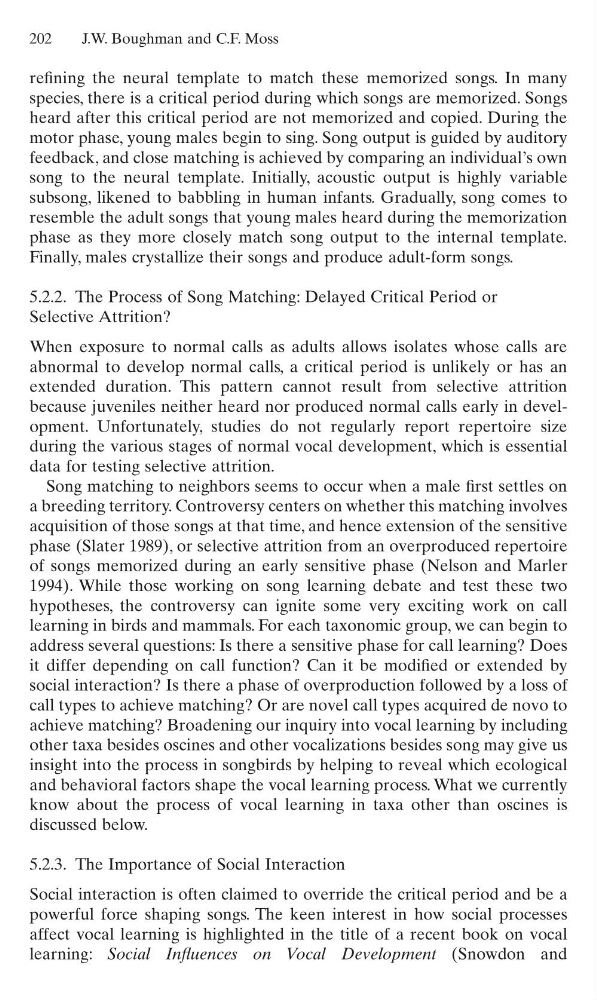
refining the neural template to match these memorized songs. In many
species, there is a critical period during which songs are memorized. Songs
heard after this critical period are not memorized and copied. During the
motor phase, young males begin to sing. Song output is guided by auditory
feedback, and close matching is achieved by comparing an individual’s own
song to the neural template. Initially, acoustic output is highly variable
subsong, likened to babbling in human infants. Gradually, song comes to
resemble the adult songs that young males heard during the memorization
phase as they more closely match song output to the internal template.
Finally, males crystallize their songs and produce adult-form songs.
5.2.2. The Process of Song Matching: Delayed Critical Period or
Selective Attrition?
When exposure to normal calls as adults allows isolates whose calls are
abnormal to develop normal calls, a critical period is unlikely or has an
extended duration. This pattern cannot result from selective attrition
because juveniles neither heard nor produced normal calls early in development. Unfortunately, studies do not regularly report repertoire size
during the various stages of normal vocal development, which is essential
data for testing selective attrition.
Song matching to neighbors seems to occur when a male first settles on
a breeding territory. Controversy centers on whether this matching involves
acquisition of those songs at that time, and hence extension of the sensitive
phase (Slater 1989), or selective attrition from an overproduced repertoire
of songs memorized during an early sensitive phase (Nelson and Marler
1994). While those working on song learning debate and test these two
hypotheses, the controversy can ignite some very exciting work on call
learning in birds and mammals. For each taxonomic group, we can begin to
address several questions: Is there a sensitive phase for call learning? Does
it differ depending on call function? Can it be modified or extended by
social interaction? Is there a phase of overproduction followed by a loss of
call types to achieve matching? Or are novel call types acquired de novo to
achieve matching? Broadening our inquiry into vocal learning by including
other taxa besides oscines and other vocalizations besides song may give us
insight into the process in songbirds by helping to reveal which ecological
and behavioral factors shape the vocal learning process. What we currently
know about the process of vocal learning in taxa other than oscines is
discussed below.
5.2.3. The Importance of Social Interaction
Social interaction is often claimed to override the critical period and be a
powerful force shaping songs. The keen interest in how social processes
affect vocal learning is highlighted in the title of a recent book on vocal
learning: Social Influences on Vocal Development (Snowdon and
202
J.W. Boughman and C.F. Moss
species, there is a critical period during which songs are memorized. Songs
heard after this critical period are not memorized and copied. During the
motor phase, young males begin to sing. Song output is guided by auditory
feedback, and close matching is achieved by comparing an individual’s own
song to the neural template. Initially, acoustic output is highly variable
subsong, likened to babbling in human infants. Gradually, song comes to
resemble the adult songs that young males heard during the memorization
phase as they more closely match song output to the internal template.
Finally, males crystallize their songs and produce adult-form songs.
5.2.2. The Process of Song Matching: Delayed Critical Period or
Selective Attrition?
When exposure to normal calls as adults allows isolates whose calls are
abnormal to develop normal calls, a critical period is unlikely or has an
extended duration. This pattern cannot result from selective attrition
because juveniles neither heard nor produced normal calls early in development. Unfortunately, studies do not regularly report repertoire size
during the various stages of normal vocal development, which is essential
data for testing selective attrition.
Song matching to neighbors seems to occur when a male first settles on
a breeding territory. Controversy centers on whether this matching involves
acquisition of those songs at that time, and hence extension of the sensitive
phase (Slater 1989), or selective attrition from an overproduced repertoire
of songs memorized during an early sensitive phase (Nelson and Marler
1994). While those working on song learning debate and test these two
hypotheses, the controversy can ignite some very exciting work on call
learning in birds and mammals. For each taxonomic group, we can begin to
address several questions: Is there a sensitive phase for call learning? Does
it differ depending on call function? Can it be modified or extended by
social interaction? Is there a phase of overproduction followed by a loss of
call types to achieve matching? Or are novel call types acquired de novo to
achieve matching? Broadening our inquiry into vocal learning by including
other taxa besides oscines and other vocalizations besides song may give us
insight into the process in songbirds by helping to reveal which ecological
and behavioral factors shape the vocal learning process. What we currently
know about the process of vocal learning in taxa other than oscines is
discussed below.
5.2.3. The Importance of Social Interaction
Social interaction is often claimed to override the critical period and be a
powerful force shaping songs. The keen interest in how social processes
affect vocal learning is highlighted in the title of a recent book on vocal
learning: Social Influences on Vocal Development (Snowdon and
202
J.W. Boughman and C.F. Moss