

192
J.W. Boughman and C.F. Moss
A)
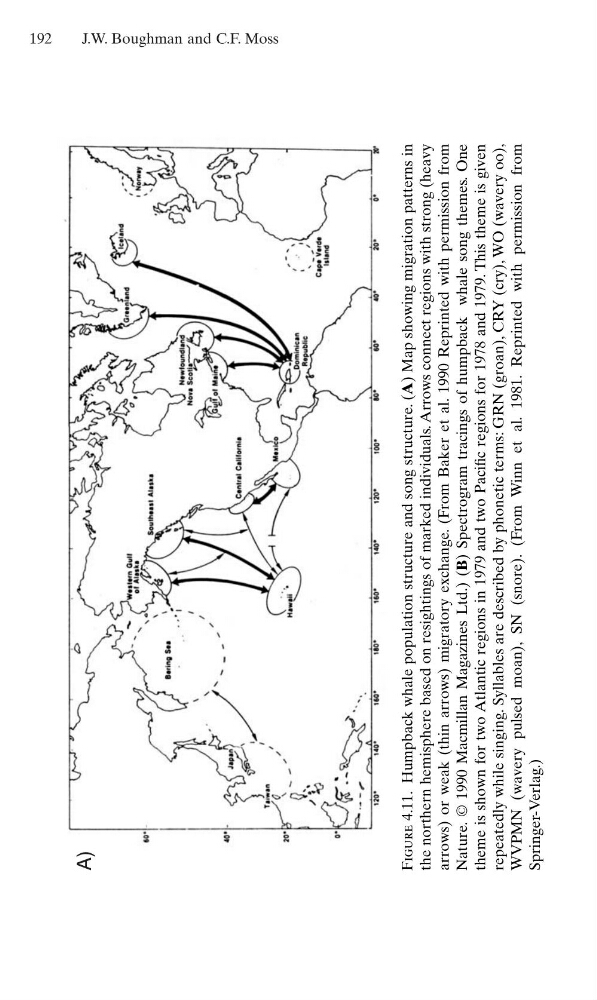
Figure 4.11. Humpback whale population structure and song structure. (A) Map showing migration patterns in
the northern hemisphere based on resightings of marked individuals. Arrows connect regions with strong (heavy
arrows) or weak (thin arrows) migratory exchange. (From Baker et al. 1990 Reprinted with permission from
Nature. © 1990 Macmillan Magazines Ltd.) (B) Spectrogram tracings of humpback whale song themes. One
theme is shown for two Atlantic regions in 1979 and two Pacific regions for 1978 and 1979. This theme is given
repeatedly while singing. Syllables are described by phonetic terms: GRN (groan), CRY (cry), WO (wavery oo),
WVPMN (wavery pulsed moan), SN (snore). (From Winn et al. 1981. Reprinted with permission from
Springer-Verlag.)
J.W. Boughman and C.F. Moss
A)
Figure 4.11. Humpback whale population structure and song structure. (A) Map showing migration patterns in
the northern hemisphere based on resightings of marked individuals. Arrows connect regions with strong (heavy
arrows) or weak (thin arrows) migratory exchange. (From Baker et al. 1990 Reprinted with permission from
Nature. © 1990 Macmillan Magazines Ltd.) (B) Spectrogram tracings of humpback whale song themes. One
theme is shown for two Atlantic regions in 1979 and two Pacific regions for 1978 and 1979. This theme is given
repeatedly while singing. Syllables are described by phonetic terms: GRN (groan), CRY (cry), WO (wavery oo),
WVPMN (wavery pulsed moan), SN (snore). (From Winn et al. 1981. Reprinted with permission from
Springer-Verlag.)