

data (Clemmons and Howitz 1990) and one experiment (Hughes et al. 1998)
support the hypothesis that vocal learning is involved in the acquisition
of normal chick-a-dee calls. Clemmons and Howitz (1990) described the
normal process of call development and found that approximate renditions
of adult-like chick-a-dee calls are first given by fledglings at 28 days. These
calls were highly variable, especially in the introductory A, B, and C notes,
and did not acquire fully adult-like characteristics for another week. Acquisition of normal chick-a-dee calls required auditory and social experience
(Hughes et al. 1998). The A note developed normally in isolated individuals, but birds who did not hear normal adult vocalizations produced abnormal B and C notes. Hughes et al. (1998) did not study development of the
170
J.W. Boughman and C.F. Moss
A)
B)
10
6
2
500
450
400
350
300
250
0
1
2
3
Week
6
6
10
8
8 10
10 9
8 10
10
10
10
10
10
10
0.2
0.4
0.6
0.8
Time (s)
A
A
B
C
D
D
Frequency (kHz)
Frequency difference (Hz)
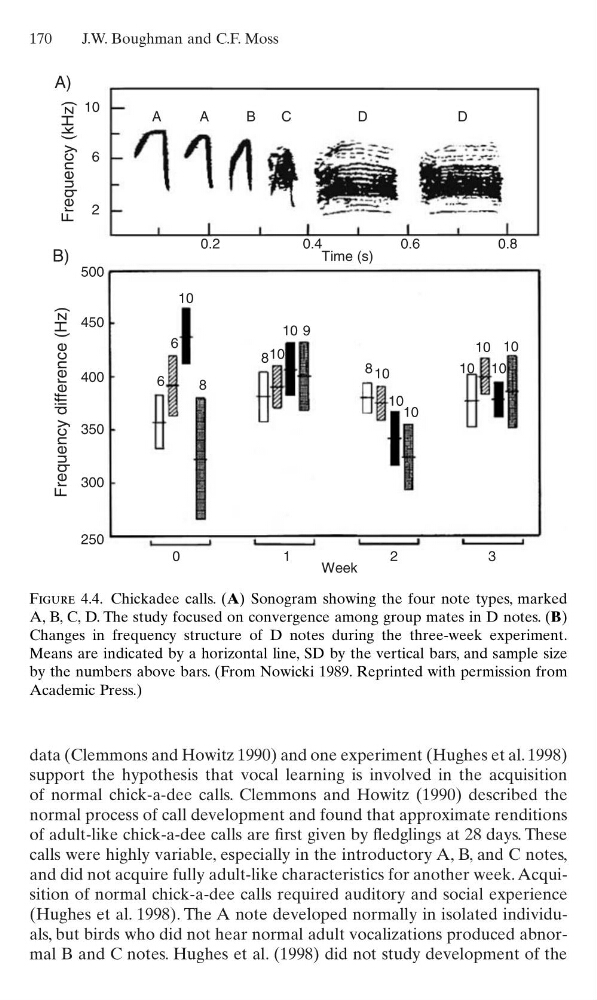
Figure 4.4. Chickadee calls. (A) Sonogram showing the four note types, marked
A, B, C, D. The study focused on convergence among group mates in D notes. (B)
Changes in frequency structure of D notes during the three-week experiment.
Means are indicated by a horizontal line, SD by the vertical bars, and sample size
by the numbers above bars. (From Nowicki 1989. Reprinted with permission from
Academic Press.)
support the hypothesis that vocal learning is involved in the acquisition
of normal chick-a-dee calls. Clemmons and Howitz (1990) described the
normal process of call development and found that approximate renditions
of adult-like chick-a-dee calls are first given by fledglings at 28 days. These
calls were highly variable, especially in the introductory A, B, and C notes,
and did not acquire fully adult-like characteristics for another week. Acquisition of normal chick-a-dee calls required auditory and social experience
(Hughes et al. 1998). The A note developed normally in isolated individuals, but birds who did not hear normal adult vocalizations produced abnormal B and C notes. Hughes et al. (1998) did not study development of the
170
J.W. Boughman and C.F. Moss
A)
B)
10
6
2
500
450
400
350
300
250
0
1
2
3
Week
6
6
10
8
8 10
10 9
8 10
10
10
10
10
10
10
0.2
0.4
0.6
0.8
Time (s)
A
A
B
C
D
D
Frequency (kHz)
Frequency difference (Hz)
Figure 4.4. Chickadee calls. (A) Sonogram showing the four note types, marked
A, B, C, D. The study focused on convergence among group mates in D notes. (B)
Changes in frequency structure of D notes during the three-week experiment.
Means are indicated by a horizontal line, SD by the vertical bars, and sample size
by the numbers above bars. (From Nowicki 1989. Reprinted with permission from
Academic Press.)