

differences in the histological fine structure of the vocal folds of different
mammalian species, differences that will have significance for the f 0 range
and possibly other aspects of vocal fold dynamics (Hirano 1991).
2.2.4. Modifications of the Vocal Tract
Moving now from the voice source to the vocal tract, there are numerous
morphological adaptations of the vocal tract in tetrapods. Many (or most)
of these can be interpreted as vocal tract elongation. These include
proboscises and descended larynges in mammals (deer and humans),
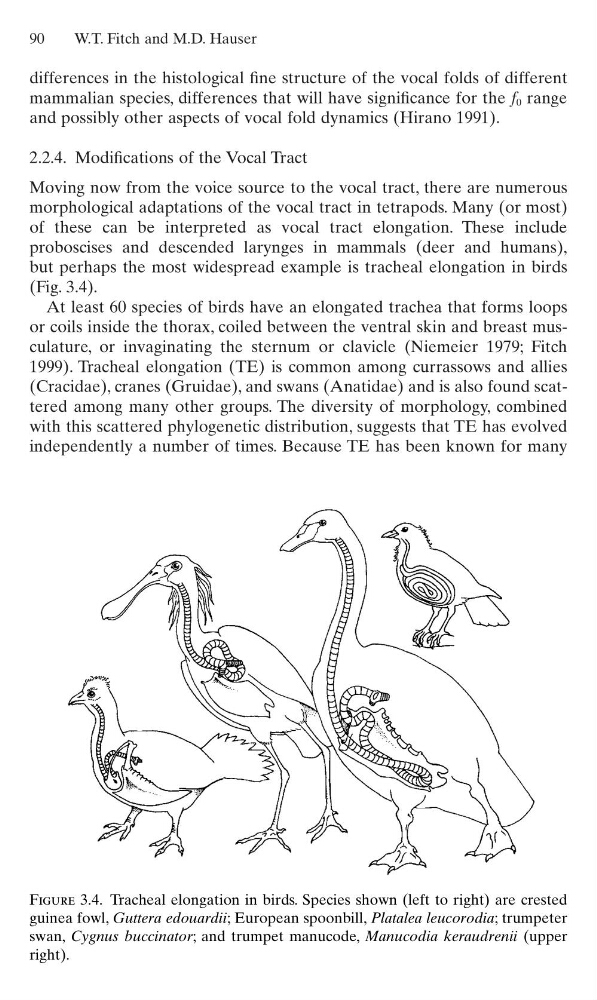
but perhaps the most widespread example is tracheal elongation in birds
(Fig. 3.4).
At least 60 species of birds have an elongated trachea that forms loops
or coils inside the thorax, coiled between the ventral skin and breast musculature, or invaginating the sternum or clavicle (Niemeier 1979; Fitch
1999). Tracheal elongation (TE) is common among currassows and allies
(Cracidae), cranes (Gruidae), and swans (Anatidae) and is also found scattered among many other groups. The diversity of morphology, combined
with this scattered phylogenetic distribution, suggests that TE has evolved
independently a number of times. Because TE has been known for many
90
W.T. Fitch and M.D. Hauser
Figure 3.4. Tracheal elongation in birds. Species shown (left to right) are crested
guinea fowl, Guttera edouardii; European spoonbill, Platalea leucorodia; trumpeter
swan, Cygnus buccinator; and trumpet manucode, Manucodia keraudrenii (upper
right).
mammalian species, differences that will have significance for the f 0 range
and possibly other aspects of vocal fold dynamics (Hirano 1991).
2.2.4. Modifications of the Vocal Tract
Moving now from the voice source to the vocal tract, there are numerous
morphological adaptations of the vocal tract in tetrapods. Many (or most)
of these can be interpreted as vocal tract elongation. These include
proboscises and descended larynges in mammals (deer and humans),
but perhaps the most widespread example is tracheal elongation in birds
(Fig. 3.4).
At least 60 species of birds have an elongated trachea that forms loops
or coils inside the thorax, coiled between the ventral skin and breast musculature, or invaginating the sternum or clavicle (Niemeier 1979; Fitch
1999). Tracheal elongation (TE) is common among currassows and allies
(Cracidae), cranes (Gruidae), and swans (Anatidae) and is also found scattered among many other groups. The diversity of morphology, combined
with this scattered phylogenetic distribution, suggests that TE has evolved
independently a number of times. Because TE has been known for many
90
W.T. Fitch and M.D. Hauser
Figure 3.4. Tracheal elongation in birds. Species shown (left to right) are crested
guinea fowl, Guttera edouardii; European spoonbill, Platalea leucorodia; trumpeter
swan, Cygnus buccinator; and trumpet manucode, Manucodia keraudrenii (upper
right).