

56
D.R. Ketten
o
-(J- Animal Weight (kg) (cetaceen)
- . - Animal Weight (kg)(lend)
-S- Minimum Audible Frequency (kHz)
.......- Maximum Audible Frequency (kHz)
1 O'
1000
N
:z:
~
. .
. . ....
" , -
u'"
R=-0.12419
c'"
.. ..
. ..flO
"- 1 0
C
fr.t::.
. . ",
0
. .
a&:'ii
. .~
:a
:;;
"
'" 0.1
•
Basilar Membrane Length (mm)
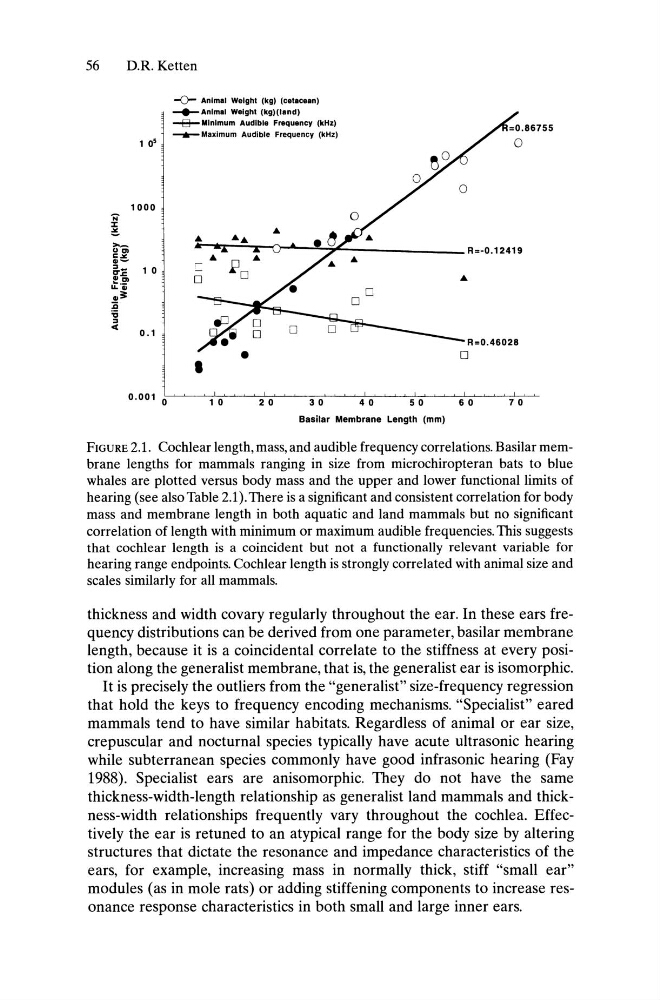
FIGURE 2.1. Cochlear length, mass, and audible frequency correlations. Basilar membrane lengths for mammals ranging in size from microchiropteran bats to blue
whales are plotted versus body mass and the upper and lower functional limits of
hearing (see also Table 2.1). There is a significant and consistent correlation for body
mass and membrane length in both aquatic and land mammals but no significant
correlation of length with minimum or maximum audible frequencies. This suggests
that cochlear length is a coincident but not a functionally relevant variable for
hearing range endpoints. Cochlear length is strongly correlated with animal size and
scales similarly for all mammals.
thickness and width covary regularly throughout the ear. In these ears frequency distributions can be derived from one parameter, basilar membrane
length, because it is a coincidental correlate to the stiffness at every position along the generalist membrane, that is, the generalist ear is isomorphic.
It is precisely the outliers from the "generalist" size-frequency regression
that hold the keys to frequency encoding mechanisms. "Specialist" eared
mammals tend to have similar habitats. Regardless of animal or ear size,
crepuscular and nocturnal species typically have acute ultrasonic hearing
while subterranean species commonly have good infrasonic hearing (Fay
1988). Specialist ears are anisomorphic. They do not have the same
thickness-width-Iength relationship as generalist land mammals and thickness-width relationships frequently vary throughout the cochlea. Effectively the ear is retuned to an atypical range for the body size by altering
structures that dictate the resonance and impedance characteristics of the
ears, for example, increasing mass in normally thick, stiff "small ear"
modules (as in mole rats) or adding stiffening components to increase resonance response characteristics in both small and large inner ears.
D.R. Ketten
o
-(J- Animal Weight (kg) (cetaceen)
- . - Animal Weight (kg)(lend)
-S- Minimum Audible Frequency (kHz)
.......- Maximum Audible Frequency (kHz)
1 O'
1000
N
:z:
~
. .
. . ....
" , -
u'"
R=-0.12419
c'"
.. ..
. ..flO
"- 1 0
C
fr.t::.
. . ",
0
. .
a&:'ii
. .~
:a
:;;
"
'" 0.1
•
Basilar Membrane Length (mm)
FIGURE 2.1. Cochlear length, mass, and audible frequency correlations. Basilar membrane lengths for mammals ranging in size from microchiropteran bats to blue
whales are plotted versus body mass and the upper and lower functional limits of
hearing (see also Table 2.1). There is a significant and consistent correlation for body
mass and membrane length in both aquatic and land mammals but no significant
correlation of length with minimum or maximum audible frequencies. This suggests
that cochlear length is a coincident but not a functionally relevant variable for
hearing range endpoints. Cochlear length is strongly correlated with animal size and
scales similarly for all mammals.
thickness and width covary regularly throughout the ear. In these ears frequency distributions can be derived from one parameter, basilar membrane
length, because it is a coincidental correlate to the stiffness at every position along the generalist membrane, that is, the generalist ear is isomorphic.
It is precisely the outliers from the "generalist" size-frequency regression
that hold the keys to frequency encoding mechanisms. "Specialist" eared
mammals tend to have similar habitats. Regardless of animal or ear size,
crepuscular and nocturnal species typically have acute ultrasonic hearing
while subterranean species commonly have good infrasonic hearing (Fay
1988). Specialist ears are anisomorphic. They do not have the same
thickness-width-Iength relationship as generalist land mammals and thickness-width relationships frequently vary throughout the cochlea. Effectively the ear is retuned to an atypical range for the body size by altering
structures that dictate the resonance and impedance characteristics of the
ears, for example, increasing mass in normally thick, stiff "small ear"
modules (as in mole rats) or adding stiffening components to increase resonance response characteristics in both small and large inner ears.