

10. Acoustic Models of Sound Production
453
tongue
softpalate
epiglottis
arytenoid and comlculate
thyroid
.
. ..~-cricoid
~
~-':-_-------"-="-=-~---=-------I..
1.35 m
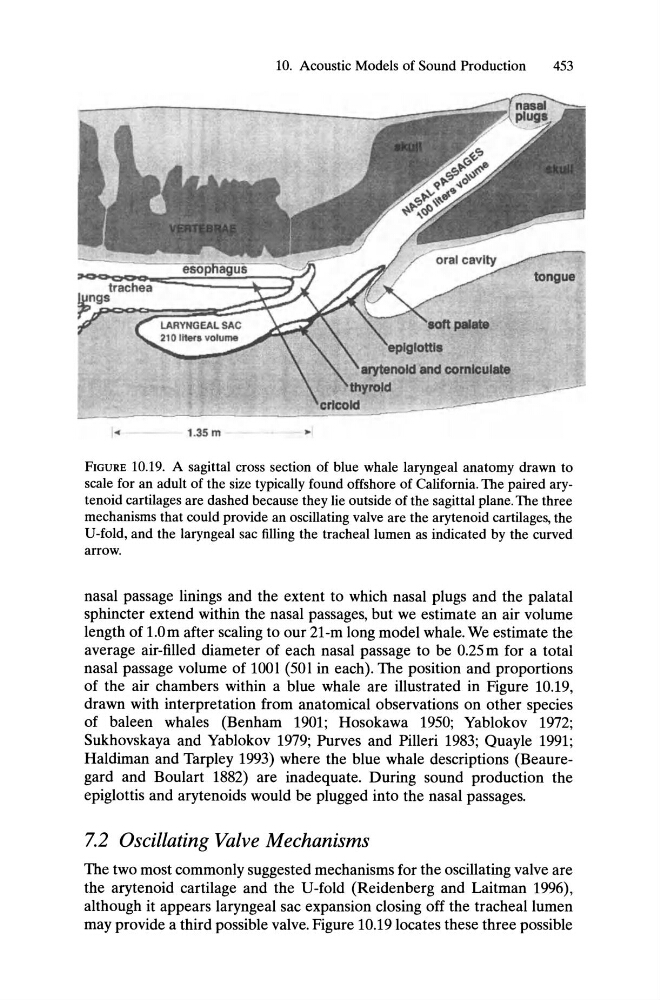
FIGURE 10.19. A sagittal cross section of blue whale laryngeal anatomy drawn to
scale for an adult of the size typically found offshore of California. The paired arytenoid cartilages are dashed because they lie outside of the sagittal plane. The three
mechanisms that could provide an oscillating valve are the arytenoid cartilages, the
V-fold, and the laryngeal sac filling the tracheal lumen as indicated by the curved
arrow.
nasal passage linings and the extent to which nasal plugs and the palatal
sphincter extend within the nasal passages, but we estimate an air volume
length of l.Om after scaling to our 21-m long model whale. We estimate the
average air-filled diameter of each nasal passage to be 0.25 m for a total
nasal passage volume of 1001 (501 in each). The position and proportions
of the air chambers within a blue whale are illustrated in Figure 10.19,
drawn with interpretation from anatomical observations on other species
of baleen whales (Benham 1901; Hosokawa 1950; Yablokov 1972;
Sukhovskaya and Yablokov 1979; Purves and Pilleri 1983; Quayle 1991;
Haldiman and Tarpley 1993) where the blue whale descriptions (Beauregard and Boulart 1882) are inadequate. During sound production the
epiglottis and arytenoids would be plugged into the nasal passages.
7.2 Oscillating Valve Mechanisms
The two most commonly suggested mechanisms for the oscillating valve are
the arytenoid cartilage and the V-fold (Reidenberg and Laitman 1996),
although it appears laryngeal sac expansion closing off the tracheal lumen
may provide a third possible valve. Figure 10.19 locates these three possible
453
tongue
softpalate
epiglottis
arytenoid and comlculate
thyroid
.
. ..~-cricoid
~
~-':-_-------"-="-=-~---=-------I..
1.35 m
FIGURE 10.19. A sagittal cross section of blue whale laryngeal anatomy drawn to
scale for an adult of the size typically found offshore of California. The paired arytenoid cartilages are dashed because they lie outside of the sagittal plane. The three
mechanisms that could provide an oscillating valve are the arytenoid cartilages, the
V-fold, and the laryngeal sac filling the tracheal lumen as indicated by the curved
arrow.
nasal passage linings and the extent to which nasal plugs and the palatal
sphincter extend within the nasal passages, but we estimate an air volume
length of l.Om after scaling to our 21-m long model whale. We estimate the
average air-filled diameter of each nasal passage to be 0.25 m for a total
nasal passage volume of 1001 (501 in each). The position and proportions
of the air chambers within a blue whale are illustrated in Figure 10.19,
drawn with interpretation from anatomical observations on other species
of baleen whales (Benham 1901; Hosokawa 1950; Yablokov 1972;
Sukhovskaya and Yablokov 1979; Purves and Pilleri 1983; Quayle 1991;
Haldiman and Tarpley 1993) where the blue whale descriptions (Beauregard and Boulart 1882) are inadequate. During sound production the
epiglottis and arytenoids would be plugged into the nasal passages.
7.2 Oscillating Valve Mechanisms
The two most commonly suggested mechanisms for the oscillating valve are
the arytenoid cartilage and the V-fold (Reidenberg and Laitman 1996),
although it appears laryngeal sac expansion closing off the tracheal lumen
may provide a third possible valve. Figure 10.19 locates these three possible