

350
P.E. Nachtigall et al.
u
ro
16 ..,...------:.=---""""=T::"'ime-d""::j:'::n:"'"e-re-n-ce-----,
9
' ' ' §'
14
-G-Predlcted MAA
8
-
- .. - Renaud & Popper
~
12 J ...- - - - - - - - - - - - - -....J'r
7
Q_
6
~ I 10
5
i= ~ 8
4
'!
6
i
3
i 4
2
-
2
1
0+-------.......-------+0
1
10
100
Frquency (kHZ)
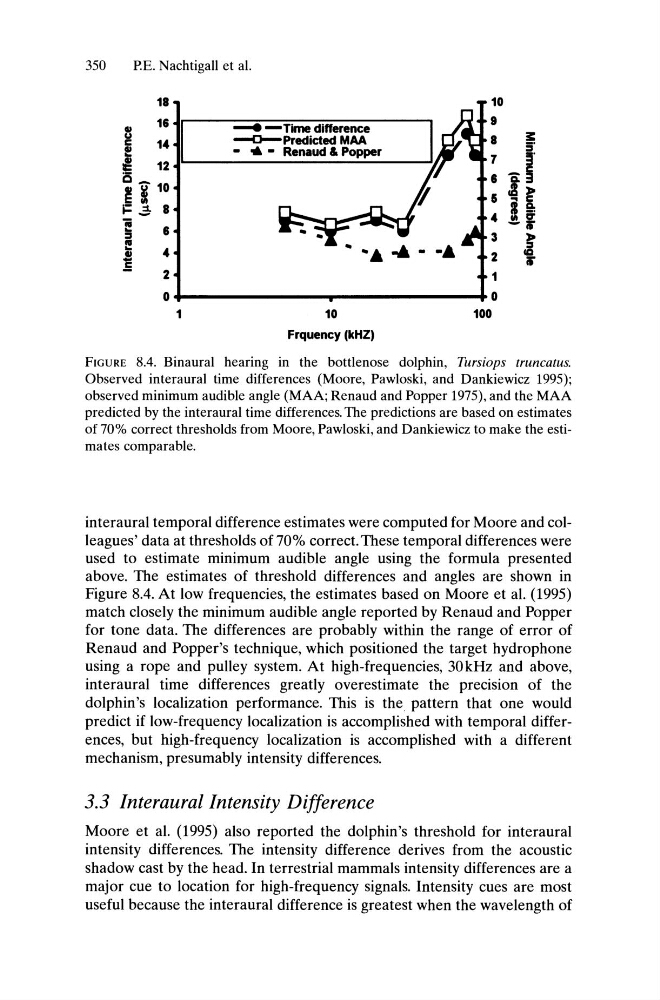
FIGURE 8.4. Binaural hearing in the bottlenose dolphin, Tursiops truncatus.
Observed interaural time differences (Moore, Pawloski, and Dankiewicz 1995);
observed minimum audible angle (MAA; Renaud and Popper 1975), and the MAA
predicted by the interaural time differences. The predictions are based on estimates
of 70% correct thresholds from Moore, Pawloski, and Dankiewicz to make the estimates comparable.
interaural temporal difference estimates were computed for Moore and colleagues' data at thresholds of 70% correct. These temporal differences were
used to estimate minimum audible angle using the formula presented
above. The estimates of threshold differences and angles are shown in
Figure 8.4. At low frequencies, the estimates based on Moore et al. (1995)
match closely the minimum audible angle reported by Renaud and Popper
for tone data. The differences are probably within the range of error of
Renaud and Popper's technique, which positioned the target hydrophone
using a rope and pulley system. At high-frequencies, 30 kHz and above,
interaural time differences greatly overestimate the precision of the
dolphin's localization performance. This is the pattern that one would
predict if low-frequency localization is accomplished with temporal differences, but high-frequency localization is accomplished with a different
mechanism, presumably intensity differences.
3.3 Interaural Intensity Difference
Moore et al. (1995) also reported the dolphin's threshold for interaural
intensity differences. The intensity difference derives from the acoustic
shadow cast by the head. In terrestrial mammals intensity differences are a
major cue to location for high-frequency signals. Intensity cues are most
useful because the interaural difference is greatest when the wavelength of
P.E. Nachtigall et al.
u
ro
16 ..,...------:.=---""""=T::"'ime-d""::j:'::n:"'"e-re-n-ce-----,
9
' ' ' §'
14
-G-Predlcted MAA
8
-
- .. - Renaud & Popper
~
12 J ...- - - - - - - - - - - - - -....J'r
7
Q_
6
~ I 10
5
i= ~ 8
4
'!
6
i
3
i 4
2
-
2
1
0+-------.......-------+0
1
10
100
Frquency (kHZ)
FIGURE 8.4. Binaural hearing in the bottlenose dolphin, Tursiops truncatus.
Observed interaural time differences (Moore, Pawloski, and Dankiewicz 1995);
observed minimum audible angle (MAA; Renaud and Popper 1975), and the MAA
predicted by the interaural time differences. The predictions are based on estimates
of 70% correct thresholds from Moore, Pawloski, and Dankiewicz to make the estimates comparable.
interaural temporal difference estimates were computed for Moore and colleagues' data at thresholds of 70% correct. These temporal differences were
used to estimate minimum audible angle using the formula presented
above. The estimates of threshold differences and angles are shown in
Figure 8.4. At low frequencies, the estimates based on Moore et al. (1995)
match closely the minimum audible angle reported by Renaud and Popper
for tone data. The differences are probably within the range of error of
Renaud and Popper's technique, which positioned the target hydrophone
using a rope and pulley system. At high-frequencies, 30 kHz and above,
interaural time differences greatly overestimate the precision of the
dolphin's localization performance. This is the pattern that one would
predict if low-frequency localization is accomplished with temporal differences, but high-frequency localization is accomplished with a different
mechanism, presumably intensity differences.
3.3 Interaural Intensity Difference
Moore et al. (1995) also reported the dolphin's threshold for interaural
intensity differences. The intensity difference derives from the acoustic
shadow cast by the head. In terrestrial mammals intensity differences are a
major cue to location for high-frequency signals. Intensity cues are most
useful because the interaural difference is greatest when the wavelength of