

8. Psychoacoustic Studies of Dolphins and Whales
343
summation process that integrates the energy in a narrow frequency band
over some time window. Energy is summed until the duration of the signal
exceeds the integration time window. As the signal is made longer, more
energy is contained within this window and it is easier to detect. A 3-dB
increase corresponds to a doubling of energy. The relationship between
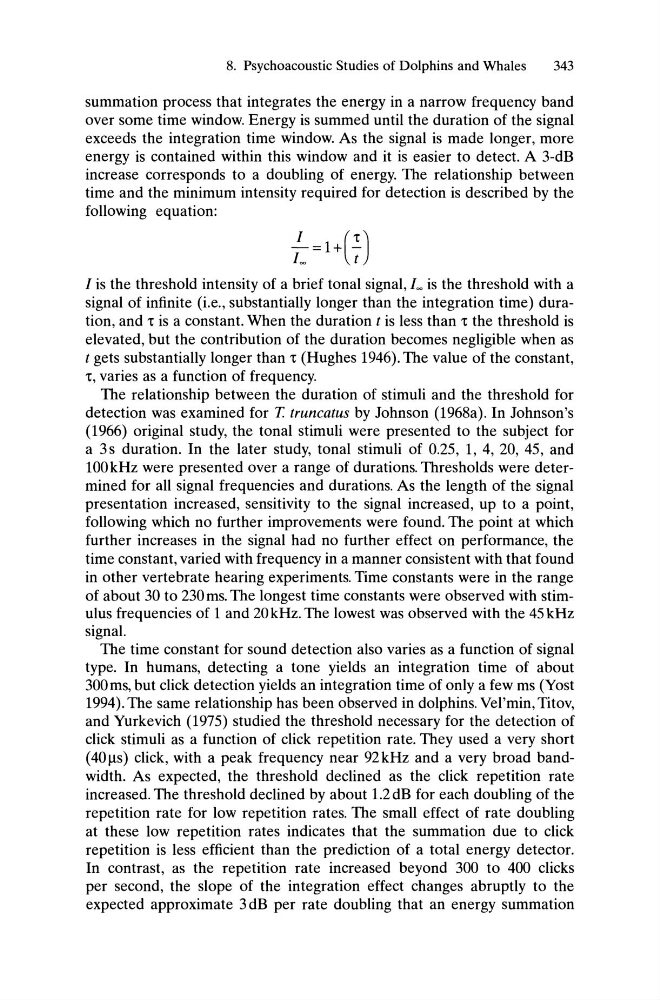
time and the minimum intensity required for detection is described by the
following equation:
i.- = 1+(~)
L
t
I is the threshold intensity of a brief tonal signal, L is the threshold with a
signal of infinite (Le., substantially longer than the integration time) duration, and or is a constant. When the duration t is less than or the threshold is
elevated, but the contribution of the duration becomes negligible when as
t gets substantially longer than or (Hughes 1946). The value of the constant,
or, varies as a function of frequency.
The relationship between the duration of stimuli and the threshold for
detection was examined for T. truncatus by Johnson (1968a). In Johnson's
(1966) original study, the tonal stimuli were presented to the subject for
a 3s duration. In the later study, tonal stimuli of 0.25, 1, 4, 20, 45, and
100kHz were presented over a range of durations. Thresholds were determined for all signal frequencies and durations. As the length of the signal
presentation increased, sensitivity to the signal increased, up to a point,
following which no further improvements were found. The point at which
further increases in the signal had no further effect on performance, the
time constant, varied with frequency in a manner consistent with that found
in other vertebrate hearing experiments. Time constants were in the range
of about 30 to 230ms. The longest time constants were observed with stimulus frequencies of 1 and 20 kHz. The lowest was observed with the 45 kHz
signal.
The time constant for sound detection also varies as a function of signal
type. In humans, detecting a tone yields an integration time of about
300ms, but click detection yields an integration time of only a few ms (Yost
1994). The same relationship has been observed in dolphins. Vel'min, Titov,
and Yurkevich (1975) studied the threshold necessary for the detection of
click stimuli as a function of click repetition rate. They used a very short
(40lls) click, with a peak frequency near 92kHz and a very broad bandwidth. As expected, the threshold declined as the click repetition rate
increased. The threshold declined by about 1.2 dB for each doubling of the
repetition rate for low repetition rates. The small effect of rate doubling
at these low repetition rates indicates that the summation due to click
repetition is less efficient than the prediction of a total energy detector.
In contrast, as the repetition rate increased beyond 300 to 400 clicks
per second, the slope of the integration effect changes abruptly to the
expected approximate 3 dB per rate doubling that an energy summation
343
summation process that integrates the energy in a narrow frequency band
over some time window. Energy is summed until the duration of the signal
exceeds the integration time window. As the signal is made longer, more
energy is contained within this window and it is easier to detect. A 3-dB
increase corresponds to a doubling of energy. The relationship between
time and the minimum intensity required for detection is described by the
following equation:
i.- = 1+(~)
L
t
I is the threshold intensity of a brief tonal signal, L is the threshold with a
signal of infinite (Le., substantially longer than the integration time) duration, and or is a constant. When the duration t is less than or the threshold is
elevated, but the contribution of the duration becomes negligible when as
t gets substantially longer than or (Hughes 1946). The value of the constant,
or, varies as a function of frequency.
The relationship between the duration of stimuli and the threshold for
detection was examined for T. truncatus by Johnson (1968a). In Johnson's
(1966) original study, the tonal stimuli were presented to the subject for
a 3s duration. In the later study, tonal stimuli of 0.25, 1, 4, 20, 45, and
100kHz were presented over a range of durations. Thresholds were determined for all signal frequencies and durations. As the length of the signal
presentation increased, sensitivity to the signal increased, up to a point,
following which no further improvements were found. The point at which
further increases in the signal had no further effect on performance, the
time constant, varied with frequency in a manner consistent with that found
in other vertebrate hearing experiments. Time constants were in the range
of about 30 to 230ms. The longest time constants were observed with stimulus frequencies of 1 and 20 kHz. The lowest was observed with the 45 kHz
signal.
The time constant for sound detection also varies as a function of signal
type. In humans, detecting a tone yields an integration time of about
300ms, but click detection yields an integration time of only a few ms (Yost
1994). The same relationship has been observed in dolphins. Vel'min, Titov,
and Yurkevich (1975) studied the threshold necessary for the detection of
click stimuli as a function of click repetition rate. They used a very short
(40lls) click, with a peak frequency near 92kHz and a very broad bandwidth. As expected, the threshold declined as the click repetition rate
increased. The threshold declined by about 1.2 dB for each doubling of the
repetition rate for low repetition rates. The small effect of rate doubling
at these low repetition rates indicates that the summation due to click
repetition is less efficient than the prediction of a total energy detector.
In contrast, as the repetition rate increased beyond 300 to 400 clicks
per second, the slope of the integration effect changes abruptly to the
expected approximate 3 dB per rate doubling that an energy summation