

8. Psychoacoustic Studies of Dolphins and Whales
331
ical function,f, typically entails some transformation of the physical dimension. Some version of the log function is observed with many dimensions,
such that equal differences in the perceived magnitude of a stimulus correspond to equal-log differences, that is, equal ratios, in the underlying physical magnitude. This function was first suggested by Fechner (1860) and is
a reasonable first approximation to the actual relationship. More recent
research, since the 1950s, has found that a power function gives a better fit
to the data. Stevens (1957) found that both loudness and brightness, for
example, were proportional to the cube root of the energy in the stimulus.
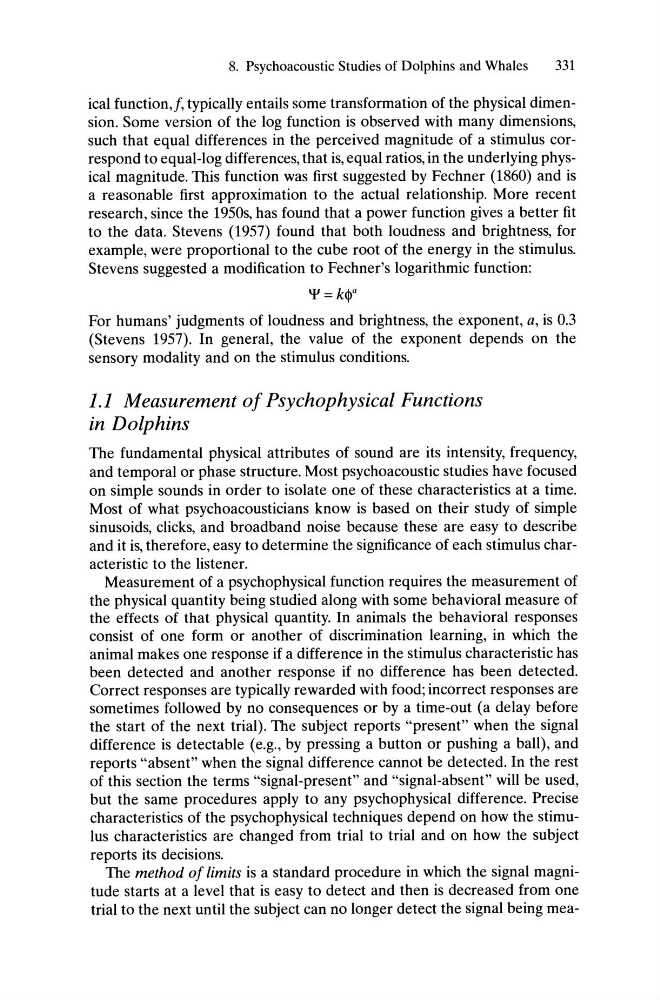
Stevens suggested a modification to Fechner's logarithmic function:
'II = ka
For humans' judgments of loudness and brightness, the exponent, a, is 0.3
(Stevens 1957). In general, the value of the exponent depends on the
sensory modality and on the stimulus conditions.
1.1 Measurement of Psychophysical Functions
in Dolphins
The fundamental physical attributes of sound are its intensity, frequency,
and temporal or phase structure. Most psychoacoustic studies have focused
on simple sounds in order to isolate one of these characteristics at a time.
Most of what psychoacousticians know is based on their study of simple
sinusoids, clicks, and broadband noise because these are easy to describe
and it is, therefore, easy to determine the significance of each stimulus characteristic to the listener.
Measurement of a psychophysical function requires the measurement of
the physical quantity being studied along with some behavioral measure of
the effects of that physical quantity. In animals the behavioral responses
consist of one form or another of discrimination learning, in which the
animal makes one response if a difference in the stimulus characteristic has
been detected and another response if no difference has been detected.
Correct responses are typically rewarded with food; incorrect responses are
sometimes followed by no consequences or by a time-out (a delay before
the start of the next trial). The subject reports "present" when the signal
difference is detectable (e.g., by pressing a button or pushing a ball), and
reports "absent" when the signal difference cannot be detected. In the rest
of this section the terms "signal-present" and "signal-absent" will be used,
but the same procedures apply to any psychophysical difference. Precise
characteristics of the psychophysical techniques depend on how the stimulus characteristics are changed from trial to trial and on how the subject
reports its decisions.
The method of limits is a standard procedure in which the signal magnitude starts at a level that is easy to detect and then is decreased from one
trial to the next until the subject can no longer detect the signal being mea-
331
ical function,f, typically entails some transformation of the physical dimension. Some version of the log function is observed with many dimensions,
such that equal differences in the perceived magnitude of a stimulus correspond to equal-log differences, that is, equal ratios, in the underlying physical magnitude. This function was first suggested by Fechner (1860) and is
a reasonable first approximation to the actual relationship. More recent
research, since the 1950s, has found that a power function gives a better fit
to the data. Stevens (1957) found that both loudness and brightness, for
example, were proportional to the cube root of the energy in the stimulus.
Stevens suggested a modification to Fechner's logarithmic function:
'II = k
For humans' judgments of loudness and brightness, the exponent, a, is 0.3
(Stevens 1957). In general, the value of the exponent depends on the
sensory modality and on the stimulus conditions.
1.1 Measurement of Psychophysical Functions
in Dolphins
The fundamental physical attributes of sound are its intensity, frequency,
and temporal or phase structure. Most psychoacoustic studies have focused
on simple sounds in order to isolate one of these characteristics at a time.
Most of what psychoacousticians know is based on their study of simple
sinusoids, clicks, and broadband noise because these are easy to describe
and it is, therefore, easy to determine the significance of each stimulus characteristic to the listener.
Measurement of a psychophysical function requires the measurement of
the physical quantity being studied along with some behavioral measure of
the effects of that physical quantity. In animals the behavioral responses
consist of one form or another of discrimination learning, in which the
animal makes one response if a difference in the stimulus characteristic has
been detected and another response if no difference has been detected.
Correct responses are typically rewarded with food; incorrect responses are
sometimes followed by no consequences or by a time-out (a delay before
the start of the next trial). The subject reports "present" when the signal
difference is detectable (e.g., by pressing a button or pushing a ball), and
reports "absent" when the signal difference cannot be detected. In the rest
of this section the terms "signal-present" and "signal-absent" will be used,
but the same procedures apply to any psychophysical difference. Precise
characteristics of the psychophysical techniques depend on how the stimulus characteristics are changed from trial to trial and on how the subject
reports its decisions.
The method of limits is a standard procedure in which the signal magnitude starts at a level that is easy to detect and then is decreased from one
trial to the next until the subject can no longer detect the signal being mea-