

308
W.E Dolphin
1.0
80 dB
- '0 ...
- c: 0 0.8
0
~
- CD 0.6
"
::::J
~
Q. 0.4
E
«
~
(IS
0.2
CD
Q.
I
~
(IS
CD 0.0
a..
2
3 4 5
10°
2
3 4 5
10 1
lSI (msec)
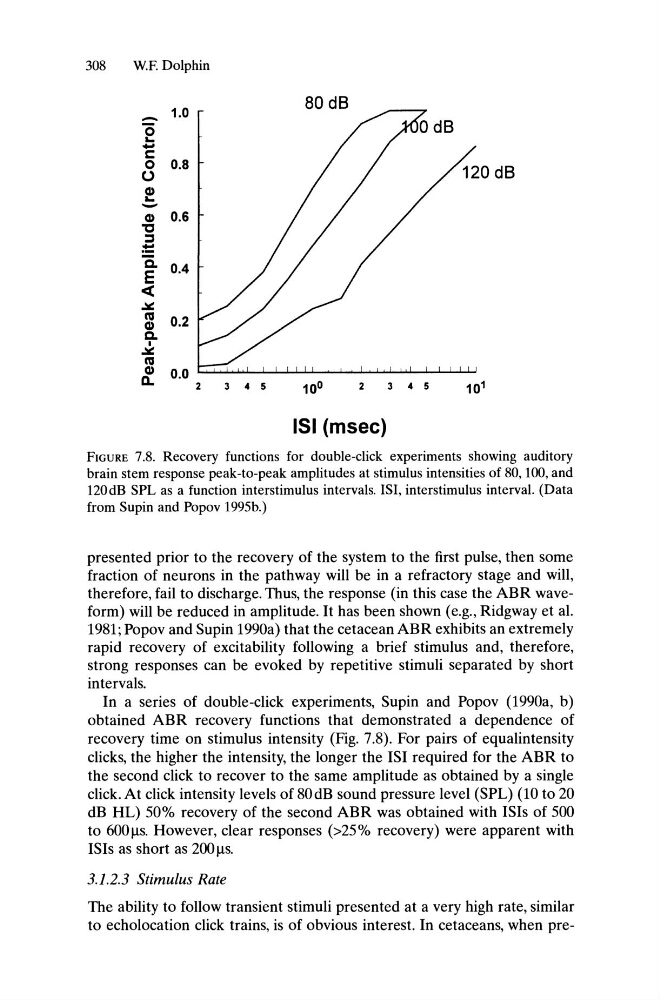
FIGURE 7.8. Recovery functions for double-click experiments showing auditory
brain stem response peak-to-peak amplitudes at stimulus intensities of 80, 100, and
120dB SPL as a function interstimulus intervals. lSI, interstimulus interval. (Data
from Supin and Popov 1995b.)
presented prior to the recovery of the system to the first pulse, then some
fraction of neurons in the pathway will be in a refractory stage and will,
therefore, fail to discharge. Thus, the response (in this case the ABR waveform) will be reduced in amplitude. It has been shown (e.g., Ridgway et al.
1981; Popov and Supin 1990a) that the cetacean ABR exhibits an extremely
rapid recovery of excitability following a brief stimulus and, therefore,
strong responses can be evoked by repetitive stimuli separated by short
intervals.
In a series of double-click experiments, Supin and Popov (1990a, b)
obtained ABR recovery functions that demonstrated a dependence of
recovery time on stimulus intensity (Fig. 7.8). For pairs of equalintensity
clicks, the higher the intensity, the longer the lSI required for the ABR to
the second click to recover to the same amplitude as obtained by a single
click. At click intensity levels of 80dB sound pressure level (SPL) (10 to 20
dB HL) 50% recovery of the second ABR was obtained with ISIs of 500
to 600~s. However, clear responses (>25% recovery) were apparent with
ISIs as short as 200~s.
3.1.2.3 Stimulus Rate
The ability to follow transient stimuli presented at a very high rate, similar
to echolocation click trains, is of obvious interest. In cetaceans, when pre-
W.E Dolphin
1.0
80 dB
- '0 ...
- c: 0 0.8
0
~
- CD 0.6
"
::::J
~
Q. 0.4
E
«
~
(IS
0.2
CD
Q.
I
~
(IS
CD 0.0
a..
2
3 4 5
10°
2
3 4 5
10 1
lSI (msec)
FIGURE 7.8. Recovery functions for double-click experiments showing auditory
brain stem response peak-to-peak amplitudes at stimulus intensities of 80, 100, and
120dB SPL as a function interstimulus intervals. lSI, interstimulus interval. (Data
from Supin and Popov 1995b.)
presented prior to the recovery of the system to the first pulse, then some
fraction of neurons in the pathway will be in a refractory stage and will,
therefore, fail to discharge. Thus, the response (in this case the ABR waveform) will be reduced in amplitude. It has been shown (e.g., Ridgway et al.
1981; Popov and Supin 1990a) that the cetacean ABR exhibits an extremely
rapid recovery of excitability following a brief stimulus and, therefore,
strong responses can be evoked by repetitive stimuli separated by short
intervals.
In a series of double-click experiments, Supin and Popov (1990a, b)
obtained ABR recovery functions that demonstrated a dependence of
recovery time on stimulus intensity (Fig. 7.8). For pairs of equalintensity
clicks, the higher the intensity, the longer the lSI required for the ABR to
the second click to recover to the same amplitude as obtained by a single
click. At click intensity levels of 80dB sound pressure level (SPL) (10 to 20
dB HL) 50% recovery of the second ABR was obtained with ISIs of 500
to 600~s. However, clear responses (>25% recovery) were apparent with
ISIs as short as 200~s.
3.1.2.3 Stimulus Rate
The ability to follow transient stimuli presented at a very high rate, similar
to echolocation click trains, is of obvious interest. In cetaceans, when pre-