

7. Electrophysiological Techniques
301
2.3 Auditory Brain Stem Response Morphology,
Amplitudes, Wave Latencies, and Comparison to Humans
and Other Animals
The ABRs obtained from cetaceans are qualitatively similar to those
obtained from other mammalian species, including humans. However, the
absolute amplitudes of the component waveforms, measured in microvolts,
are much larger than those measured in other orders. For instance, using
surface electrodes, peak-to-peak amplitudes of 3 to 61lV are regularly
recorded in T. truncatus and P crassidens (e.g., Dolphin 1995b), and may be
as large as 20llV using subdermal needle electrodes (e.g., Popov and Supin
1990). In contrast, ABRs recorded from humans using similar scalp electrodes yield amplitudes on the order of 0.1 to 0.511V (e.g., Ferraro and
Durant 1994; Ferraro and Ruther 1994).
The increased amplitudes of the ABR waves in cetaceans may be related
to the larger fiber diameters (discussed below) as well as volume and
number of neurons involved in the response generation. The ABR represents a massed response of large neuronal assemblies; the more neurons
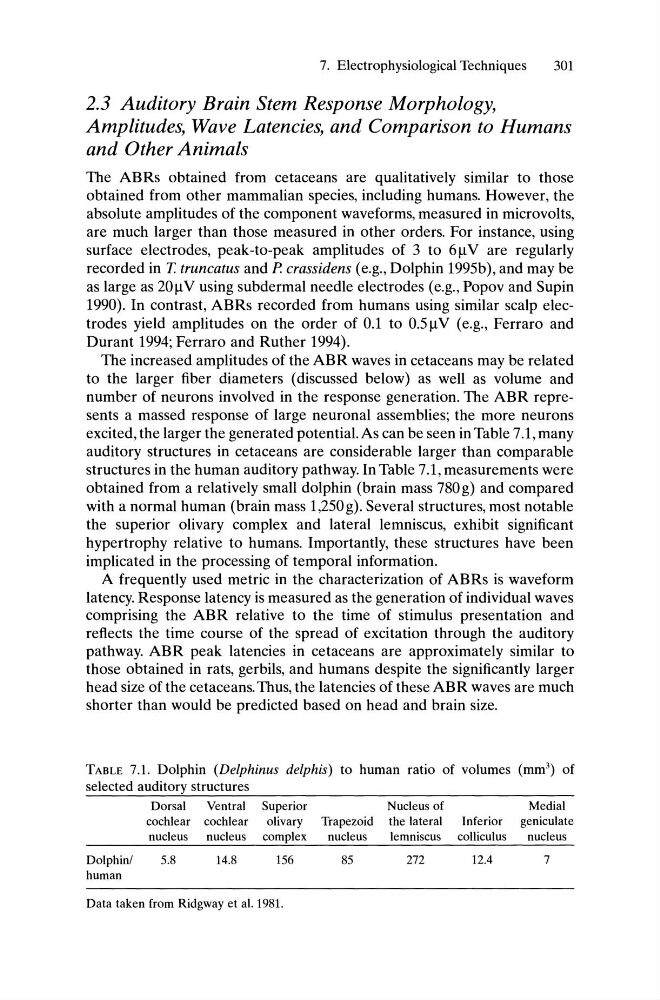
excited, the larger the generated potential. As can be seen in Table 7.1, many
auditory structures in cetaceans are considerable larger than comparable
structures in the human auditory pathway. In Table 7.1, measurements were
obtained from a relatively small dolphin (brain mass 780 g) and compared
with a normal human (brain mass 1,250g). Several structures, most notable
the superior olivary complex and lateral lemniscus, exhibit significant
hypertrophy relative to humans. Importantly, these structures have been
implicated in the processing of temporal information.
A frequently used metric in the characterization of ABRs is waveform
latency. Response latency is measured as the generation of individual waves
comprising the ABR relative to the time of stimulus presentation and
reflects the time course of the spread of excitation through the auditory
pathway. ABR peak latencies in cetaceans are approximately similar to
those obtained in rats, gerbils, and humans despite the significantly larger
head size of the cetaceans. Thus, the latencies of these ABR waves are much
shorter than would be predicted based on head and brain size.
TABLE 7.1. Dolphin (Delphinus de/phis) to human ratio of volumes (mm
3 ) of
selected auditory structures
Dorsal
Ventral
cochlear cochlear
nucleus
nucleus
Superior
olivary
complex
Trapezoid
nucleus
Nucleus of
the lateral
lemniscus
Inferior
colliculus
Medial
geniculate
nucleus
Dolphin/
human
5.8
14.8
156
85
272
12.4
7
Data taken from Ridgway et al. 1981.
301
2.3 Auditory Brain Stem Response Morphology,
Amplitudes, Wave Latencies, and Comparison to Humans
and Other Animals
The ABRs obtained from cetaceans are qualitatively similar to those
obtained from other mammalian species, including humans. However, the
absolute amplitudes of the component waveforms, measured in microvolts,
are much larger than those measured in other orders. For instance, using
surface electrodes, peak-to-peak amplitudes of 3 to 61lV are regularly
recorded in T. truncatus and P crassidens (e.g., Dolphin 1995b), and may be
as large as 20llV using subdermal needle electrodes (e.g., Popov and Supin
1990). In contrast, ABRs recorded from humans using similar scalp electrodes yield amplitudes on the order of 0.1 to 0.511V (e.g., Ferraro and
Durant 1994; Ferraro and Ruther 1994).
The increased amplitudes of the ABR waves in cetaceans may be related
to the larger fiber diameters (discussed below) as well as volume and
number of neurons involved in the response generation. The ABR represents a massed response of large neuronal assemblies; the more neurons
excited, the larger the generated potential. As can be seen in Table 7.1, many
auditory structures in cetaceans are considerable larger than comparable
structures in the human auditory pathway. In Table 7.1, measurements were
obtained from a relatively small dolphin (brain mass 780 g) and compared
with a normal human (brain mass 1,250g). Several structures, most notable
the superior olivary complex and lateral lemniscus, exhibit significant
hypertrophy relative to humans. Importantly, these structures have been
implicated in the processing of temporal information.
A frequently used metric in the characterization of ABRs is waveform
latency. Response latency is measured as the generation of individual waves
comprising the ABR relative to the time of stimulus presentation and
reflects the time course of the spread of excitation through the auditory
pathway. ABR peak latencies in cetaceans are approximately similar to
those obtained in rats, gerbils, and humans despite the significantly larger
head size of the cetaceans. Thus, the latencies of these ABR waves are much
shorter than would be predicted based on head and brain size.
TABLE 7.1. Dolphin (Delphinus de/phis) to human ratio of volumes (mm
3 ) of
selected auditory structures
Dorsal
Ventral
cochlear cochlear
nucleus
nucleus
Superior
olivary
complex
Trapezoid
nucleus
Nucleus of
the lateral
lemniscus
Inferior
colliculus
Medial
geniculate
nucleus
Dolphin/
human
5.8
14.8
156
85
272
12.4
7
Data taken from Ridgway et al. 1981.