

I
IOmsec
286
S.H. Ridgway
II
rv
DOLPHIN I b
I
IOmsec
CAT
I
IOmsec
KILLER WHALE
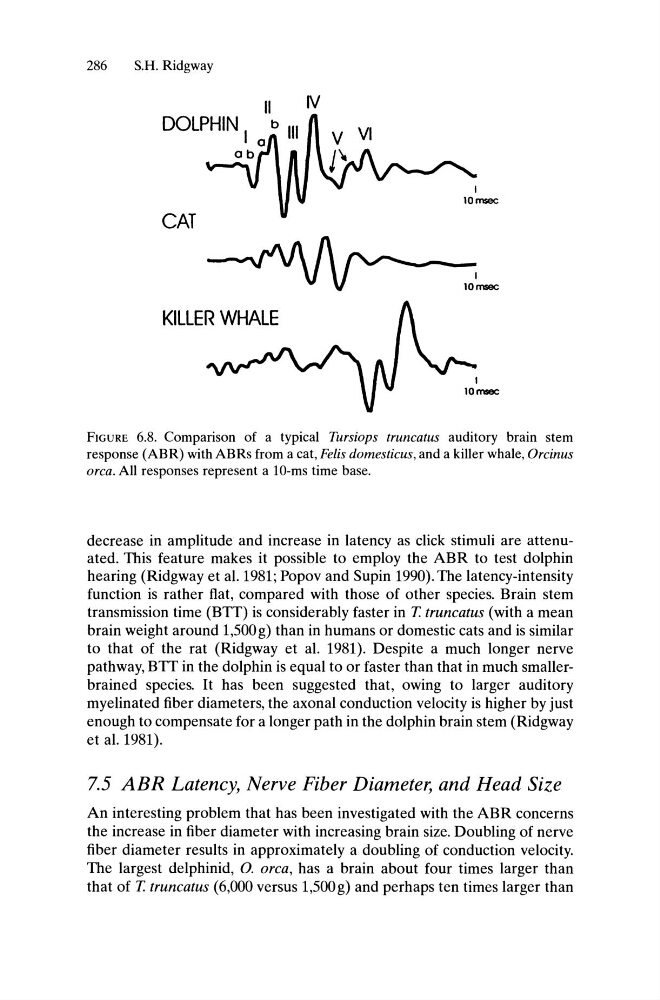
FIGURE 6.8. Comparison of a typical Tursiops truncatus auditory brain stem
response (ABR) with ABRs from a cat, Felis domesticus, and a killer whale, Orcinus
orca. All responses represent a lO-ms time base.
decrease in amplitude and increase in latency as click stimuli are attenuated. This feature makes it possible to employ the ABR to test dolphin
hearing (Ridgway et al. 1981; Popov and Supin 1990). The latency-intensity
function is rather flat, compared with those of other species. Brain stem
transmission time (BIT) is considerably faster in T truncatus (with a mean
brain weight around 1,500g) than in humans or domestic cats and is similar
to that of the rat (Ridgway et al. 1981). Despite a much longer nerve
pathway, BIT in the dolphin is equal to or faster than that in much smallerbrained species. It has been suggested that, owing to larger auditory
myelinated fiber diameters, the axonal conduction velocity is higher by just
enough to compensate for a longer path in the dolphin brain stem (Ridgway
et al. 1981).
7.5 ABR Latency, Nerve Fiber Diameter, and Head Size
An interesting problem that has been investigated with the ABR concerns
the increase in fiber diameter with increasing brain size. Doubling of nerve
fiber diameter results in approximately a doubling of conduction velocity.
The largest delphinid, 0. orca, has a brain about four times larger than
that of T truncatus (6,000 versus 1,500g) and perhaps ten times larger than
IOmsec
286
S.H. Ridgway
II
rv
DOLPHIN I b
I
IOmsec
CAT
I
IOmsec
KILLER WHALE
FIGURE 6.8. Comparison of a typical Tursiops truncatus auditory brain stem
response (ABR) with ABRs from a cat, Felis domesticus, and a killer whale, Orcinus
orca. All responses represent a lO-ms time base.
decrease in amplitude and increase in latency as click stimuli are attenuated. This feature makes it possible to employ the ABR to test dolphin
hearing (Ridgway et al. 1981; Popov and Supin 1990). The latency-intensity
function is rather flat, compared with those of other species. Brain stem
transmission time (BIT) is considerably faster in T truncatus (with a mean
brain weight around 1,500g) than in humans or domestic cats and is similar
to that of the rat (Ridgway et al. 1981). Despite a much longer nerve
pathway, BIT in the dolphin is equal to or faster than that in much smallerbrained species. It has been suggested that, owing to larger auditory
myelinated fiber diameters, the axonal conduction velocity is higher by just
enough to compensate for a longer path in the dolphin brain stem (Ridgway
et al. 1981).
7.5 ABR Latency, Nerve Fiber Diameter, and Head Size
An interesting problem that has been investigated with the ABR concerns
the increase in fiber diameter with increasing brain size. Doubling of nerve
fiber diameter results in approximately a doubling of conduction velocity.
The largest delphinid, 0. orca, has a brain about four times larger than
that of T truncatus (6,000 versus 1,500g) and perhaps ten times larger than