

284
S.H. Ridgway
(Au 1993) and the other for lower-frequency sounds, such as the whistles
and squeals produced by many of the smaller delphinoids (see Caldwell and
Caldwell 1968, 1971; Steiner 1981; Moore and Ridgway 1995).
7.2 Event-Related Potentials: A Possible Window into
Cetacean Cognition
Short-latency, event-related potentials (ERPs) have revealed specialized
processing in the cochlea, auditory nerve, brain stem, colliculus, and cortex
(Bullock et al. 1968; Bullock and Ridgway 1972; Bullock and Gurevich
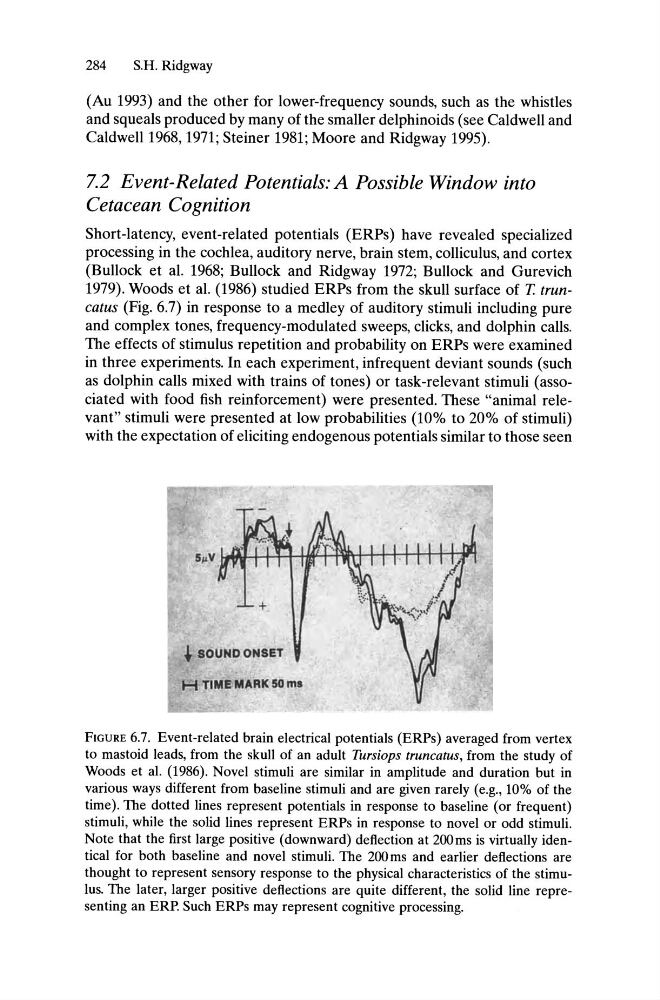
1979). Woods et al. (1986) studied ERPs from the skull surface of T. truncatus (Fig. 6.7) in response to a medley of auditory stimuli including pure
and complex tones, frequency-modulated sweeps, clicks, and dolphin calls.
The effects of stimulus repetition and probability on ERPs were examined
in three experiments. In each experiment, infrequent deviant sounds (such
as dolphin calls mixed with trains of tones) or task-relevant stimuli (associated with food fish reinforcement) were presented. These "animal relevant" stimuli were presented at low probabilities (10% to 20% of stimuli)
with the expectation of eliciting endogenous potentials similar to those seen
+
+SOUND ONSET
H TIME MARK 50 ms
FIGURE 6.7. Event-related brain electrical potentials (ERPs) averaged from vertex
to mastoid leads, from the skull of an adult Tursiops truncatus, from the study of
Woods et al. (1986). Novel stimuli are similar in amplitude and duration but in
various ways different from baseline stimuli and are given rarely (e.g., 10% of the
time). The dotted lines represent potentials in response to baseline (or frequent)
stimuli, while the solid lines represent ERPs in response to novel or odd stimuli.
Note that the first large positive (downward) deflection at 200ms is virtually identical for both baseline and novel stimuli. The 200ms and earlier deflections are
thought to represent sensory response to the physical characteristics of the stimulus. The later, larger positive deflections are quite different, the solid line representing an ERP. Such ERPs may represent cognitive processing.
S.H. Ridgway
(Au 1993) and the other for lower-frequency sounds, such as the whistles
and squeals produced by many of the smaller delphinoids (see Caldwell and
Caldwell 1968, 1971; Steiner 1981; Moore and Ridgway 1995).
7.2 Event-Related Potentials: A Possible Window into
Cetacean Cognition
Short-latency, event-related potentials (ERPs) have revealed specialized
processing in the cochlea, auditory nerve, brain stem, colliculus, and cortex
(Bullock et al. 1968; Bullock and Ridgway 1972; Bullock and Gurevich
1979). Woods et al. (1986) studied ERPs from the skull surface of T. truncatus (Fig. 6.7) in response to a medley of auditory stimuli including pure
and complex tones, frequency-modulated sweeps, clicks, and dolphin calls.
The effects of stimulus repetition and probability on ERPs were examined
in three experiments. In each experiment, infrequent deviant sounds (such
as dolphin calls mixed with trains of tones) or task-relevant stimuli (associated with food fish reinforcement) were presented. These "animal relevant" stimuli were presented at low probabilities (10% to 20% of stimuli)
with the expectation of eliciting endogenous potentials similar to those seen
+
+SOUND ONSET
H TIME MARK 50 ms
FIGURE 6.7. Event-related brain electrical potentials (ERPs) averaged from vertex
to mastoid leads, from the skull of an adult Tursiops truncatus, from the study of
Woods et al. (1986). Novel stimuli are similar in amplitude and duration but in
various ways different from baseline stimuli and are given rarely (e.g., 10% of the
time). The dotted lines represent potentials in response to baseline (or frequent)
stimuli, while the solid lines represent ERPs in response to novel or odd stimuli.
Note that the first large positive (downward) deflection at 200ms is virtually identical for both baseline and novel stimuli. The 200ms and earlier deflections are
thought to represent sensory response to the physical characteristics of the stimulus. The later, larger positive deflections are quite different, the solid line representing an ERP. Such ERPs may represent cognitive processing.