

280
S.H. Ridgway
o
' I ' 1"11111111 "' 1" 1""111111"1"1111111"' 11""111"111111""1""1' "11"1111 1 ' !'
2
3
4
5
6
7
8
9
10 1
2
3
4
'111'1
1
5
6
7
8
9
10
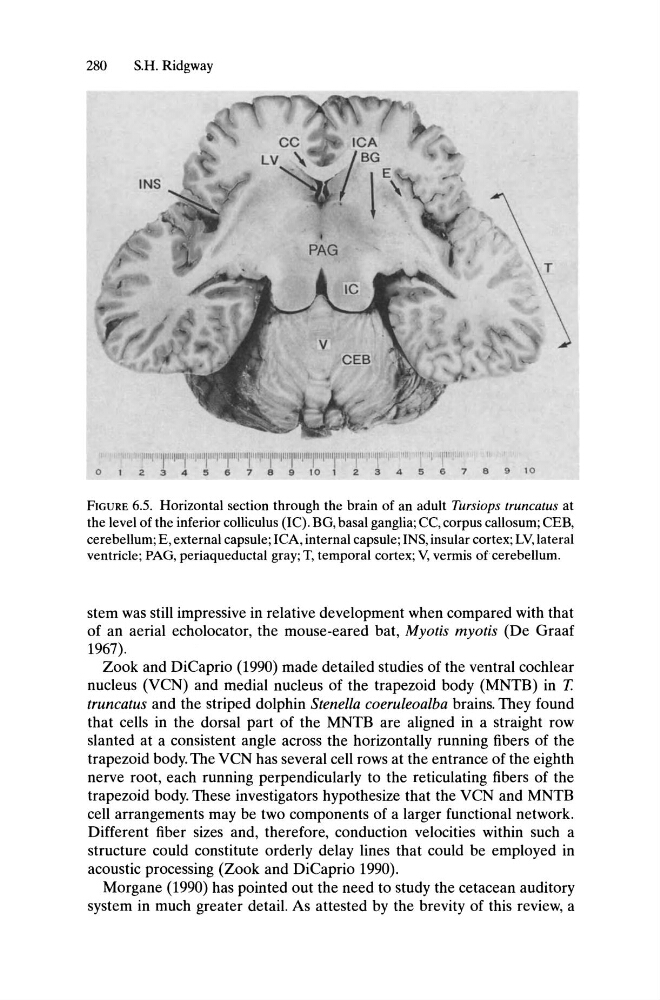
FIGURE 6.5. Horizontal section through the brain of an adult Tursiops truncatus at
the level of the inferior colliculus (Ie). BG, basal ganglia; CC, corpus callosum; CEB,
cerebellum; E, external capsule; ICA, internal capsule; INS, insular cortex; LV, lateral
ventricle; PAG, periaqueductal gray; T, temporal cortex; V, vermis of cerebellum.
stem was still impressive in relative development when compared with that
of an aerial echolocator, the mouse-eared bat, Myotis myotis (De Graaf
1967).
Zook and DiCaprio (1990) made detailed studies of the ventral cochlear
nucleus (YCN) and medial nucleus of the trapezoid body (MNTB) in T.
truncatus and the striped dolphin Stenella coeruleoalba brains. They found
that cells in the dorsal part of the MNTB are aligned in a straight row
slanted at a consistent angle across the horizontally running fibers of the
trapezoid body. The YCN has several cell rows at the entrance of the eighth
nerve root, each running perpendicularly to the reticulating fibers of the
trapezoid body. These investigators hypothesize that the YCN and MNTB
cell arrangements may be two components of a larger functional network.
Different fiber sizes and, therefore, conduction velocities within such a
structure could constitute orderly delay lines that could be employed in
acoustic processing (Zook and DiCaprio 1990).
Morgane (1990) has pointed out the need to study the cetacean auditory
system in much greater detail. As attested by the brevity of this review, a
S.H. Ridgway
o
' I ' 1"11111111 "' 1" 1""111111"1"1111111"' 11""111"111111""1""1' "11"1111 1 ' !'
2
3
4
5
6
7
8
9
10 1
2
3
4
'111'1
1
5
6
7
8
9
10
FIGURE 6.5. Horizontal section through the brain of an adult Tursiops truncatus at
the level of the inferior colliculus (Ie). BG, basal ganglia; CC, corpus callosum; CEB,
cerebellum; E, external capsule; ICA, internal capsule; INS, insular cortex; LV, lateral
ventricle; PAG, periaqueductal gray; T, temporal cortex; V, vermis of cerebellum.
stem was still impressive in relative development when compared with that
of an aerial echolocator, the mouse-eared bat, Myotis myotis (De Graaf
1967).
Zook and DiCaprio (1990) made detailed studies of the ventral cochlear
nucleus (YCN) and medial nucleus of the trapezoid body (MNTB) in T.
truncatus and the striped dolphin Stenella coeruleoalba brains. They found
that cells in the dorsal part of the MNTB are aligned in a straight row
slanted at a consistent angle across the horizontally running fibers of the
trapezoid body. The YCN has several cell rows at the entrance of the eighth
nerve root, each running perpendicularly to the reticulating fibers of the
trapezoid body. These investigators hypothesize that the YCN and MNTB
cell arrangements may be two components of a larger functional network.
Different fiber sizes and, therefore, conduction velocities within such a
structure could constitute orderly delay lines that could be employed in
acoustic processing (Zook and DiCaprio 1990).
Morgane (1990) has pointed out the need to study the cetacean auditory
system in much greater detail. As attested by the brevity of this review, a