

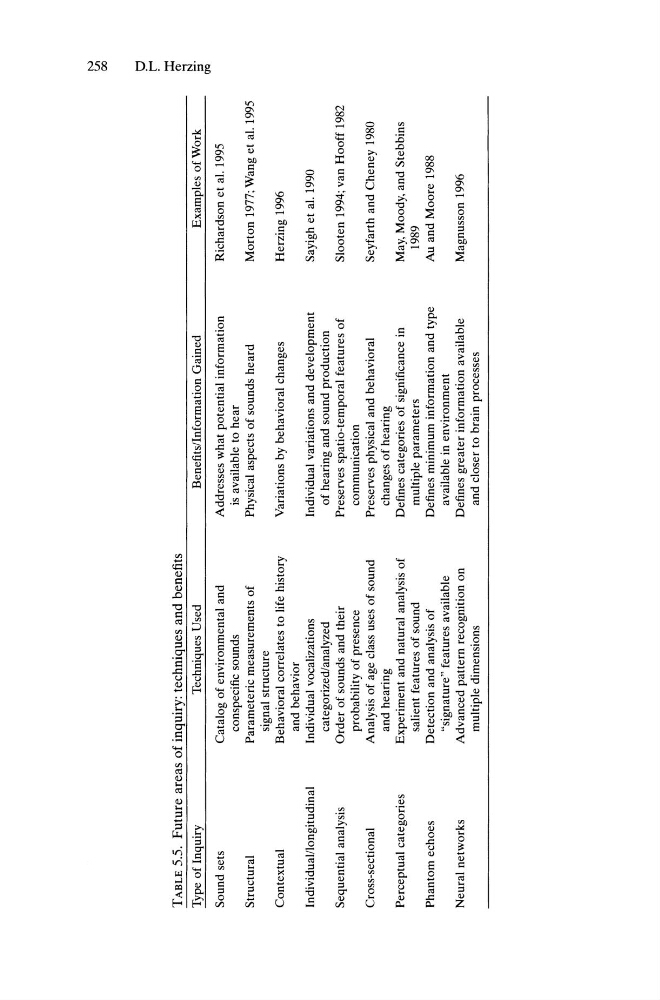
TABLE
5.5. Future areas of inquiry: techniques and benefits
Type of Inquiry
Techniques Used
Benefits/Information Gained
Examples of Work
N
VI
00
p
r
::t
('1)
N
S'
(JQ
Sound sets
Structural
Contextual
Individual/longitudinal
Sequential analysis
Cross-sectional
Perceptual categories
Phantom echoes
Neural networks
Catalog of environmental and
conspecific sounds
Parameteric measurements of
signal structure
Behavioral correlates to life history
and behavior
Individual vocalizations
categorized/analyzed
Order of sounds and their
probability of presence
Analysis of age class uses of sound
and hearing
Experiment and natural analysis
of
salient features of sound
Detection and analysis of
"signature" features available
Advanced pattern recognition on
multiple dimensions
Addresses what potential information
is available to hear
Physical aspects of sounds heard
Variations by behavioral changes
Individual variations and development
of hearing and sound production
Preserves spatio-temporal features
of
communication
Preserves physical and behavioral
changes of hearing
Defines categories of significance
in
multiple parameters
Defines minimum information and type
available
in environment
Defines greater information available
and closer to brain processes
Richardson et
al. 1995
Morton 1977; Wang et al. 1995
Herzing 1996
Sayigh et al. 1990
Slooten 1994; van Hooff 1982
Seyfarth and Cheney 1980
May, Moody, and Stebbins
1989
Au and Moore 1988
Magnusson 1996
5.5. Future areas of inquiry: techniques and benefits
Type of Inquiry
Techniques Used
Benefits/Information Gained
Examples of Work
N
VI
00
p
r
::t
('1)
N
S'
(JQ
Sound sets
Structural
Contextual
Individual/longitudinal
Sequential analysis
Cross-sectional
Perceptual categories
Phantom echoes
Neural networks
Catalog of environmental and
conspecific sounds
Parameteric measurements of
signal structure
Behavioral correlates to life history
and behavior
Individual vocalizations
categorized/analyzed
Order of sounds and their
probability of presence
Analysis of age class uses of sound
and hearing
Experiment and natural analysis
of
salient features of sound
Detection and analysis of
"signature" features available
Advanced pattern recognition on
multiple dimensions
Addresses what potential information
is available to hear
Physical aspects of sounds heard
Variations by behavioral changes
Individual variations and development
of hearing and sound production
Preserves spatio-temporal features
of
communication
Preserves physical and behavioral
changes of hearing
Defines categories of significance
in
multiple parameters
Defines minimum information and type
available
in environment
Defines greater information available
and closer to brain processes
Richardson et
al. 1995
Morton 1977; Wang et al. 1995
Herzing 1996
Sayigh et al. 1990
Slooten 1994; van Hooff 1982
Seyfarth and Cheney 1980
May, Moody, and Stebbins
1989
Au and Moore 1988
Magnusson 1996