

5. Acoustics and Social Behavior
253
including group foraging, courtship, fighting, playing, and interspecific interactions. This social, sensory, and cross-generational exposure is similar to
the developmental systems of primates and hominids where comprehension of the function of a communication system precedes production of the
signals themselves; exposure to, and comprehension about, social interaction and language necessarily take place before production and active
teaching.
What are the transmission mechanisms involved in such a learning
process? Mechanisms of exposure and transfer of information include the
use of observational and social learning, teaching, mimicry, synchronization
of behavior, and exposure to multimodal, behavioral, and generational
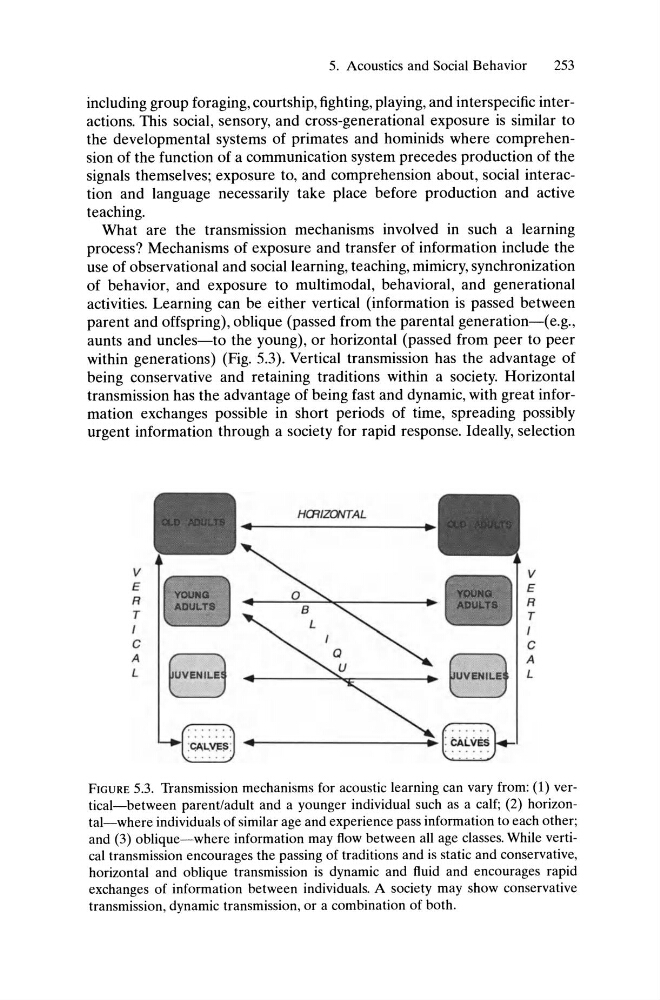
activities. Learning can be either vertical (information is passed between
parent and offspring), oblique (passed from the parental generation-(e.g.,
aunts and uncles-to the young), or horizontal (passed from peer to peer
within generations) (Fig. 5.3). Vertical transmission has the advantage of
being conservative and retaining traditions within a society. Horizontal
transmission has the advantage of being fast and dynamic, with great information exchanges possible in short periods of time, spreading possibly
urgent information through a society for rapid response. Ideally, selection
HCRIZONTAL
v
V
E
E
R
YOUNG
ADULT'
R
T
T
I
I
C
C
A
tUVENILE}
~UVENIL,
A
L
L
FIGURE 5.3. Transmission mechanisms for acoustic learning can vary from: (1) vertical-between parent/adult and a younger individual such as a calf; (2) horizontal-where individuals of similar age and experience pass information to each other;
and (3) oblique-where information may flow between all age classes. While vertical transmission encourages the passing of traditions and is static and conservative,
horizontal and oblique transmission is dynamic and fluid and encourages rapid
exchanges of information between individuals. A society may show conservative
transmission, dynamic transmission, or a combination of both.
253
including group foraging, courtship, fighting, playing, and interspecific interactions. This social, sensory, and cross-generational exposure is similar to
the developmental systems of primates and hominids where comprehension of the function of a communication system precedes production of the
signals themselves; exposure to, and comprehension about, social interaction and language necessarily take place before production and active
teaching.
What are the transmission mechanisms involved in such a learning
process? Mechanisms of exposure and transfer of information include the
use of observational and social learning, teaching, mimicry, synchronization
of behavior, and exposure to multimodal, behavioral, and generational
activities. Learning can be either vertical (information is passed between
parent and offspring), oblique (passed from the parental generation-(e.g.,
aunts and uncles-to the young), or horizontal (passed from peer to peer
within generations) (Fig. 5.3). Vertical transmission has the advantage of
being conservative and retaining traditions within a society. Horizontal
transmission has the advantage of being fast and dynamic, with great information exchanges possible in short periods of time, spreading possibly
urgent information through a society for rapid response. Ideally, selection
HCRIZONTAL
v
V
E
E
R
YOUNG
ADULT'
R
T
T
I
I
C
C
A
tUVENILE}
~UVENIL,
A
L
L
FIGURE 5.3. Transmission mechanisms for acoustic learning can vary from: (1) vertical-between parent/adult and a younger individual such as a calf; (2) horizontal-where individuals of similar age and experience pass information to each other;
and (3) oblique-where information may flow between all age classes. While vertical transmission encourages the passing of traditions and is static and conservative,
horizontal and oblique transmission is dynamic and fluid and encourages rapid
exchanges of information between individuals. A society may show conservative
transmission, dynamic transmission, or a combination of both.