

1. Overview
11
imental evidence with live dolphins to support the notion that the larynx is
the source of sound production.
Wood (1968) speculated that the site of sound production in Kogia sp is
the museau de singe, also referred to as the "monkey lips" because of their
resemblance to the lips of monkeys. The museau de singe are two pairs of
small bulbous fatty dorsal projections at the posterior boundary of the
melon's shell in dolphins (Cranford, Chapter 3). Cranford et al. (1997) used
an endoscope coupled to a high-speed video recorder to observe synchronous movements of the monkey lips and the production of pulses in T truncatus. Their results provide the strongest evidence that the museau de singe
are directly involved in the production of pulse signals by dolphins. When
the endoscope was inserted though the monkey lips, preventing them from
closing properly against each other, the dolphin was unable to produce
sounds.
4.2 Role of the Head and Melon
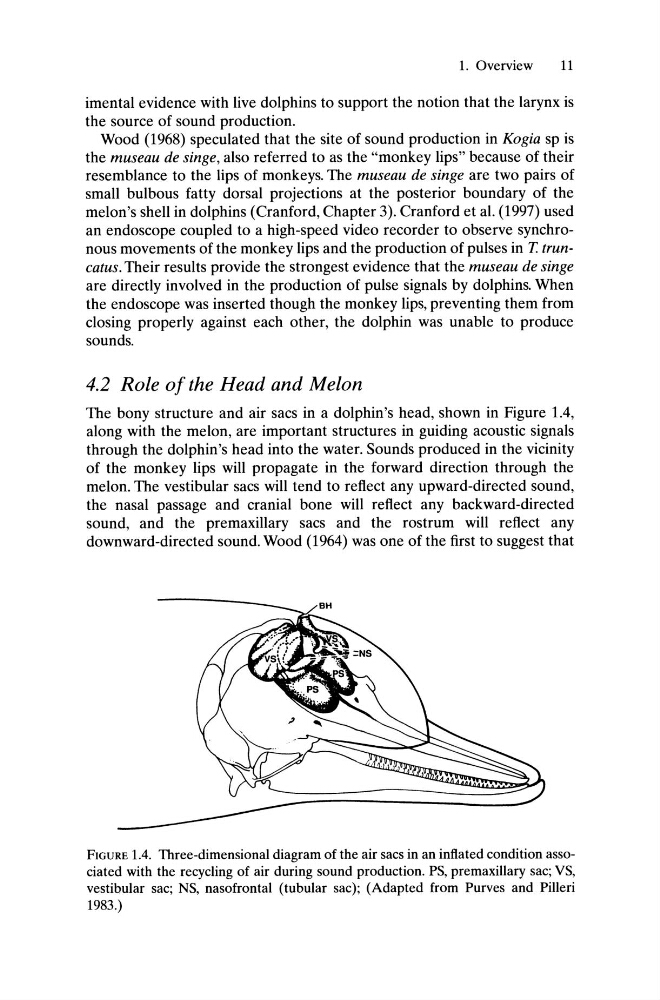
The bony structure and air sacs in a dolphin's head, shown in Figure 1.4,
along with the melon, are important structures in guiding acoustic signals
through the dolphin's head into the water. Sounds produced in the vicinity
of the monkey lips will propagate in the forward direction through the
melon. The vestibular sacs will tend to reflect any upward-directed sound,
the nasal passage and cranial bone will reflect any backward-directed
sound, and the premaxillary sacs and the rostrum will reflect any
downward-directed sound. Wood (1964) was one of the first to suggest that
FIGURE 1.4. Three-dimensional diagram of the air sacs in an inflated condition associated with the recycling of air during sound production. PS, premaxillary sac; VS,
vestibular sac; NS, nasofrontal (tubular sac); (Adapted from Purves and Pilleri
1983.)
11
imental evidence with live dolphins to support the notion that the larynx is
the source of sound production.
Wood (1968) speculated that the site of sound production in Kogia sp is
the museau de singe, also referred to as the "monkey lips" because of their
resemblance to the lips of monkeys. The museau de singe are two pairs of
small bulbous fatty dorsal projections at the posterior boundary of the
melon's shell in dolphins (Cranford, Chapter 3). Cranford et al. (1997) used
an endoscope coupled to a high-speed video recorder to observe synchronous movements of the monkey lips and the production of pulses in T truncatus. Their results provide the strongest evidence that the museau de singe
are directly involved in the production of pulse signals by dolphins. When
the endoscope was inserted though the monkey lips, preventing them from
closing properly against each other, the dolphin was unable to produce
sounds.
4.2 Role of the Head and Melon
The bony structure and air sacs in a dolphin's head, shown in Figure 1.4,
along with the melon, are important structures in guiding acoustic signals
through the dolphin's head into the water. Sounds produced in the vicinity
of the monkey lips will propagate in the forward direction through the
melon. The vestibular sacs will tend to reflect any upward-directed sound,
the nasal passage and cranial bone will reflect any backward-directed
sound, and the premaxillary sacs and the rostrum will reflect any
downward-directed sound. Wood (1964) was one of the first to suggest that
FIGURE 1.4. Three-dimensional diagram of the air sacs in an inflated condition associated with the recycling of air during sound production. PS, premaxillary sac; VS,
vestibular sac; NS, nasofrontal (tubular sac); (Adapted from Purves and Pilleri
1983.)