

206
P.L. Tyack and c.w. Clark
290'
300'
40'
300'
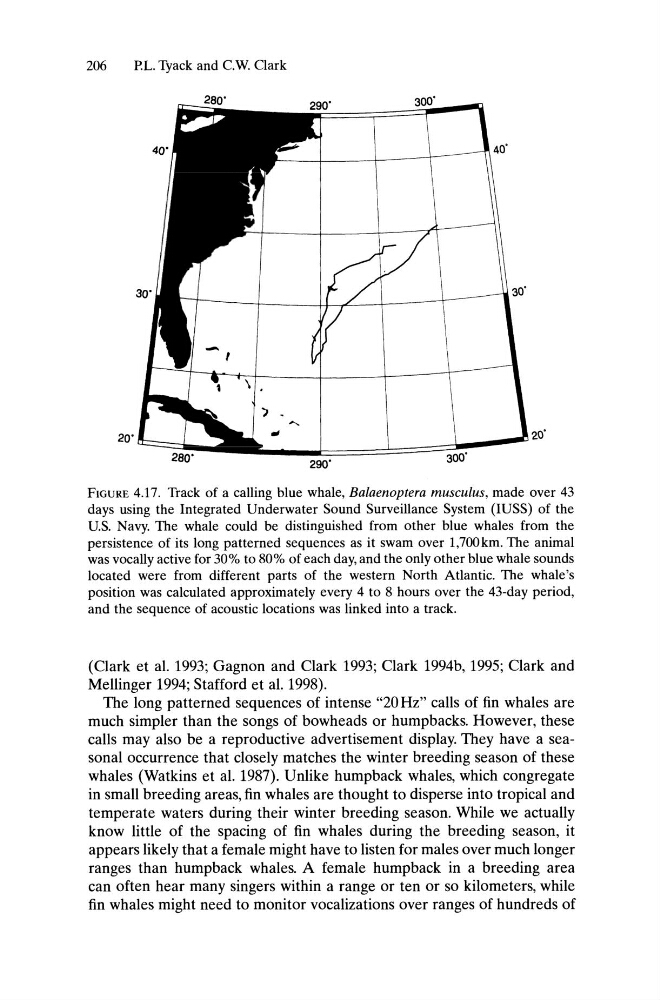
FiGURE 4.17. Track of a calling blue whale, Balaenoptera musculus, made over 43
days using the Integrated Underwater Sound Surveillance System (IUSS) of the
U.S. Navy. The whale could be distinguished from other blue whales from the
persistence of its long patterned sequences as it swam over 1,700km. The animal
was vocally active for 30% to 80% of each day, and the only other blue whale sounds
located were from different parts of the western North Atlantic. The whale's
position was calculated approximately every 4 to 8 hours over the 43-day period,
and the sequence of acoustic locations was linked into a track.
(Clark et al. 1993; Gagnon and Clark 1993; Clark 1994b, 1995; Clark and
Mellinger 1994; Stafford et al. 1998).
The long patterned sequences of intense "20Hz" calls of fin whales are
much simpler than the songs of bowheads or humpbacks. However, these
calls may also be a reproductive advertisement display. They have a seasonal occurrence that closely matches the winter breeding season of these
whales (Watkins et al. 1987). Unlike humpback whales, which congregate
in small breeding areas, fin whales are thought to disperse into tropical and
temperate waters during their winter breeding season. While we actually
know little of the spacing of fin whales during the breeding season, it
appears likely that a female might have to listen for males over much longer
ranges than humpback whales. A female humpback in a breeding area
can often hear many singers within a range or ten or so kilometers, while
fin whales might need to monitor vocalizations over ranges of hundreds of
P.L. Tyack and c.w. Clark
290'
300'
40'
300'
FiGURE 4.17. Track of a calling blue whale, Balaenoptera musculus, made over 43
days using the Integrated Underwater Sound Surveillance System (IUSS) of the
U.S. Navy. The whale could be distinguished from other blue whales from the
persistence of its long patterned sequences as it swam over 1,700km. The animal
was vocally active for 30% to 80% of each day, and the only other blue whale sounds
located were from different parts of the western North Atlantic. The whale's
position was calculated approximately every 4 to 8 hours over the 43-day period,
and the sequence of acoustic locations was linked into a track.
(Clark et al. 1993; Gagnon and Clark 1993; Clark 1994b, 1995; Clark and
Mellinger 1994; Stafford et al. 1998).
The long patterned sequences of intense "20Hz" calls of fin whales are
much simpler than the songs of bowheads or humpbacks. However, these
calls may also be a reproductive advertisement display. They have a seasonal occurrence that closely matches the winter breeding season of these
whales (Watkins et al. 1987). Unlike humpback whales, which congregate
in small breeding areas, fin whales are thought to disperse into tropical and
temperate waters during their winter breeding season. While we actually
know little of the spacing of fin whales during the breeding season, it
appears likely that a female might have to listen for males over much longer
ranges than humpback whales. A female humpback in a breeding area
can often hear many singers within a range or ten or so kilometers, while
fin whales might need to monitor vocalizations over ranges of hundreds of